

Choosing the right educational support for a child is one of the most important decisions parents make. In Singapore’s competitive academic environment, families often seek additional guidance to help their children build strong foundations, improve confidence, and achieve their academic goals. While there are many options available, some educational institutions have earned the trust of families over decades through consistent results, quality teaching, and a genuine commitment to student development.
As a well-established tuition centre in Singapore, Mavis Tutorial Centre has become a familiar name among parents across the island. Over the years, countless students have benefited from its structured learning programmes, with many families continuing to enrol younger siblings after positive experiences with older children. This long-standing trust did not develop overnight. It is the result of a philosophy that prioritises educational excellence, student growth, and continuous adaptation to Singapore’s evolving education system.
This article explores the key reasons why generations of Singapore families continue to place their trust in Mavis Tutorial Centre and what parents can learn when evaluating academic support for their children.
A Long History of Supporting Students in Singapore
One reason Mavis Tutorial Centre remains a trusted tuition centre in Singapore is its long-standing presence within the local education landscape. Educational trends, examination formats, and curriculum requirements have changed significantly over the years. Yet successful learning institutions continue to adapt while maintaining their commitment to student achievement.
A long history often demonstrates:
| Benefit | Why It Matters |
| Experience | Understanding of student learning needs |
| Stability | Consistent educational support |
| Adaptability | Ability to respond to curriculum changes |
| Reputation | Positive experiences shared by families |
Parents often value institutions that have demonstrated reliability over many years.
Understanding Singapore’s Education System
Singapore’s education system is recognised globally for its strong academic standards. However, these standards can also create challenges for students.
Students must navigate:
- Increasingly complex syllabuses
- Competitive examinations
- Higher-order thinking questions
- Project-based learning
- Time management pressures
Educational support is most effective when it complements school learning rather than simply providing additional worksheets.
A key factor behind long-term trust is the ability to align teaching strategies with evolving educational requirements.
Supporting Students Across Every Academic Stage
One reason many families continue choosing Mavis Tutorial Centre is its ability to support students throughout different stages of their educational journey. Rather than focusing on a single academic level, the centre provides structured programmes designed to meet students’ evolving learning needs from primary school through junior college.
This continuity allows students to build strong foundations early and strengthen their skills progressively as academic demands increase.
Primary School Programmes
The primary years form the foundation of a child’s academic development. During this stage, students learn essential literacy, numeracy, and problem-solving skills that support future learning.
Primary-level programmes focus on:
- English
- Mathematics
- Science
- Chinese
Students are guided to develop:
- Strong conceptual understanding
- Effective study habits
- Critical thinking skills
- Examination techniques
As students prepare for the PSLE, greater emphasis is placed on application-based questions, higher-order thinking skills, and confidence-building strategies.
Secondary School Programmes
Secondary school introduces more specialised subjects and increasingly complex concepts. Students must learn to manage a heavier workload while adapting to more challenging examination requirements.
Secondary-level support includes:
| Subject Areas | Key Focus |
| English | Comprehension, composition writing, oral communication |
| Mathematics | Algebra, geometry, statistics, problem-solving |
| Additional Mathematics | Advanced mathematical concepts and applications |
| Physics | Concept mastery, calculations, practical skills |
| Chemistry | Scientific reasoning and application |
| Biology | Analytical and conceptual understanding |
| Chinese | Language proficiency and examination preparation |
Students are encouraged to strengthen both content knowledge and examination techniques to prepare effectively for national examinations.
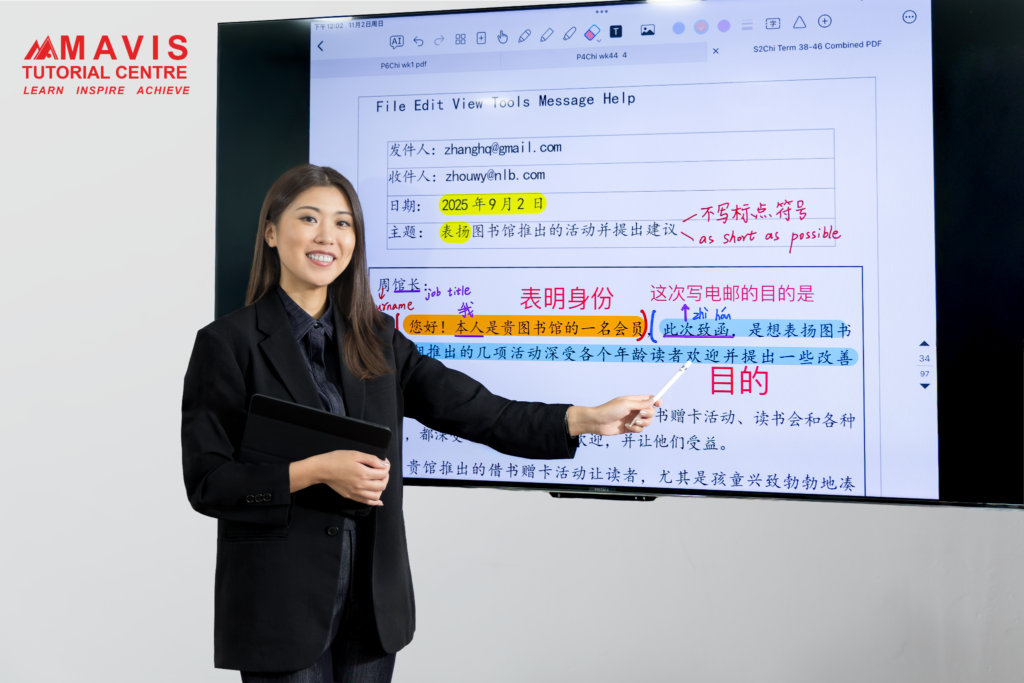
Chinese Language Programmes
Chinese remains an important subject within Singapore’s bilingual education system. Many students face challenges in areas such as vocabulary acquisition, comprehension, composition writing, and oral communication.
Chinese programmes aim to help students:
- Expand vocabulary
- Improve reading comprehension
- Strengthen composition-writing skills
- Develop oral communication confidence
- Prepare for school and national examinations
Regular exposure to the language and structured practice can help students become more comfortable using Chinese in both academic and real-life situations.
Supporting Integrated Programme (IP) Students
Integrated Programme (IP) students often face unique academic challenges due to the accelerated and enrichment-focused nature of their curriculum.
Unlike traditional examination pathways, IP students are frequently expected to:
- Analyse complex texts
- Apply concepts across disciplines
- Engage in independent research
- Demonstrate critical thinking
- Solve higher-order problems
Support for IP students focuses on:
- Deep conceptual understanding
- Advanced problem-solving
- Analytical writing
- Independent learning skills
This helps students manage the rigorous demands of the Integrated Programme while preparing for future academic success.
Junior College (JC) Preparation and Support
The transition from secondary school to Junior College represents one of the most significant academic shifts in Singapore’s education system.
JC students face:
- Faster-paced learning
- More advanced content
- Greater independent study expectations
- Increased examination pressure
Subjects such as:
- H1 Mathematics
- H2 Mathematics
- H2 Physics
- H2 Chemistry
require strong analytical abilities and consistent practice.
JC-level programmes focus on helping students:
- Master complex concepts
- Improve problem-solving skills
- Develop effective revision strategies
- Prepare for A-Level examinations
Students are encouraged to move beyond memorisation and develop a deeper understanding of subject content.
A Learning Journey That Grows with Students
One factor that contributes to the long-standing trust families place in Mavis Tutorial Centre is the ability to support students through multiple stages of their educational journey.
A student may begin with Primary Mathematics support, continue through Secondary Science and English programmes, and later receive guidance for IP or JC-level subjects. This continuity allows students to benefit from a consistent learning philosophy while adapting to new academic challenges as they progress.
By supporting learners across:
- Primary School
- Secondary School
- Chinese Language Programmes
- Integrated Programme (IP)
- Junior College (JC)
Mavis Tutorial Centre continues to provide educational support that evolves alongside the needs of Singapore students.
Consistency in Teaching and Learning
Consistency is one of the most overlooked factors in education. Academic improvement typically occurs through:
- Regular practice
- Reinforcement of concepts
- Continuous feedback
- Gradual skill development
Students rarely improve through occasional bursts of effort alone.
Families often trust educational programmes that provide structured and consistent learning experiences over time.
Adapting to Different Learning Needs
Every child learns differently. Some students learn quickly through observation.
Others require:
- Additional explanations
- More practice opportunities
- Visual learning methods
- Step-by-step guidance
A flexible educational approach helps students learn according to their individual strengths and challenges.
Common Student Profiles
| Student Type | Support Often Needed |
| High Achiever | Enrichment and advanced problem-solving |
| Average Learner | Reinforcement and confidence building |
| Struggling Student | Stronger foundational support |
| Exam-Anxious Student | Structured practice and reassurance |
Recognising these differences allows educators to provide more meaningful support.
The Role of Parent-Educator Partnerships
Strong educational outcomes often result from collaboration between parents and educators.
Parents play an important role by:
- Encouraging consistent study habits
- Monitoring progress
- Providing emotional support
- Reinforcing positive attitudes towards learning
When educational institutions communicate effectively with families, students often benefit from a more supportive learning environment.
Why Reputation Matters
In education, reputation is often built through personal experiences and recommendations.
Parents frequently rely on:
- Word-of-mouth referrals
- Experiences from friends and relatives
- Feedback from former students
- Long-term track records
When multiple generations of families return to the same institution, it often indicates sustained satisfaction and trust.
This type of trust develops through years of delivering meaningful educational support rather than short-term results alone.
Final Thoughts
The trust that generations of Singapore families place in Mavis Tutorial Centre reflects more than academic results alone. It represents confidence in a long-standing educational approach that values strong foundations, consistent learning, student confidence, and continuous improvement.
Ultimately, the reason families return across generations is simple: effective education is built on trust, and trust is earned through years of helping students learn, grow, and succeed.
For more information about programmes and learning support, visit: mavistutorial.com
Stay connected with our educational page for more such tech education information