

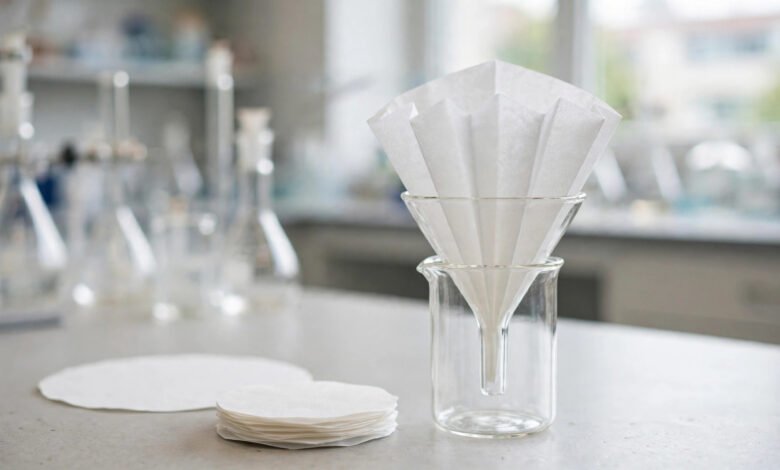
Filter paper is a thin, round, white sheet of porous paper made from cellulose fibres. Dry, it looks plain and matte, a little like stiff tissue paper, but it is full of tiny holes you cannot see. Those holes let liquid pass through while trapping solid particles on the surface, which is why it is used in school and laboratory filtration.
What Does Filter Paper Look Like?
A standard laboratory filter paper is a flat, circular sheet, usually bright white. The circles most often seen in school labs are 90 mm, 110 mm or 125 mm across, though papers are sold in many sizes, from small 42.5 mm discs up to 320 mm sheets.
Dry, it feels soft and slightly fibrous, with a matte surface, and one side is usually a little smoother than the other. It is thin, roughly 0.18 mm for a common grade, and it bends and folds easily. Grade 3 is about double the thickness of Grade 1.
Wet filter paper looks different. It turns a duller greyish white, becomes partly see-through, and goes limp. It also tears very easily when wet, because water weakens the bonds between the cellulose fibres. That is why lab instructions always warn students to handle a wet filter paper gently and never to pull at it.
What Is Filter Paper Made Of?
Filter paper is made from cellulose, the natural fibre found in plant cell walls. Laboratory papers are usually made from cotton linters or refined wood pulp, processed so that the finished sheet is more than 95 percent alpha cellulose. That high purity matters, because ordinary paper contains fillers and sizing chemicals that would contaminate a chemical test.
The fibres are pressed into a loose, open network. The gaps between them form tiny channels, and their size decides what the paper holds back: wide channels filter fast but only catch large particles, while narrow channels catch fine particles but filter slowly.
Nothing is added to make laboratory filter paper water resistant. That is the whole point. Ordinary paper is treated with sizing so that ink sits on the surface instead of soaking in. Filter paper is deliberately left absorbent, so liquid can flow through it freely.
Types of Filter Paper
There are two main families, qualitative and quantitative, and the difference comes down to how pure the paper is and what you plan to do with what it catches.
Qualitative filter paper is the everyday kind used in school labs and for routine separations. It removes solid particles from a liquid, clarifies a cloudy solution, or collects a precipitate so you can see it. Its ash content is around 0.06 percent, which is low, but not low enough for work where the paper itself will be burned and weighed.
Quantitative filter paper, also called ashless paper, is made for gravimetric analysis. In that kind of work, the collected solid and the paper are heated in a furnace until only ash is left, and the ash is weighed. If the paper itself left much ash behind, the result would be wrong. Ashless grades are acid washed so that they leave at most 0.007 percent ash, which is practically nothing.
Hardened papers are tougher ashless grades with much higher wet strength, made for vacuum work in Buchner funnels. Glass microfibre paper is made from fine glass fibres instead of cellulose, so it survives high temperatures and strong chemicals and is used for air sampling and water testing. Prepleated papers come already folded into a fan shape, which gives the liquid more surface and speeds up filtration.
Filter Paper Grades Explained
The best known grading system comes from Whatman, now part of Cytiva, and its numbers are used in labs all over the world. Each grade has a stated particle retention size, measured in micrometres, which tells you the smallest particle it will reliably hold back.
Grade 1 is the most widely used paper of all. It retains particles down to about 11 micrometres, with a medium flow rate, and it is the standard choice for clarifying liquids and routine qualitative work, including collecting precipitates such as lead sulfate, calcium oxalate and calcium carbonate.
Grade 2 retains particles down to about 8 micrometres. It is slightly more retentive than Grade 1 and a little slower, but it is also more absorbent, which is useful in plant growth trials where the paper holds soil nutrients.
Grade 4 is the fast one. It retains particles of about 20 to 25 micrometres and filters extremely quickly, which makes it ideal for coarse particles and jelly-like precipitates such as ferric hydroxide and aluminium hydroxide.
Grades 3 and 5 fill the gaps. Grade 3 retains about 6 micrometres and is double the thickness of Grade 1, so it holds more precipitate and suits Buchner funnels. Grade 5 retains about 2.5 micrometres and is the finest qualitative paper, a slow but excellent clarifying filter.
The ashless grades follow the same idea. Grade 40 (8 micrometres) is the general purpose gravimetric paper. Grade 41 (20 to 25 micrometres) is the fastest ashless paper, used for coarse precipitates and air pollution analysis. Grade 42 (2.5 micrometres) is the finest of all Whatman cellulose papers, the world standard for critical gravimetric analysis. Grade 44 is a thinner version of Grade 42, retaining about 3 micrometres.
A practical rule follows from all of this. If you only need to see or remove a solid, a qualitative grade such as Grade 1 or Grade 4 is enough. If you need to burn the paper and weigh what is left, you need an ashless grade such as 40, 41 or 42. Picking a grade finer than you need only slows the filtration down for no benefit.
How to Use Filter Paper in a Funnel
In a school lab, filter paper is almost always used in a conical glass funnel for gravity filtration. The paper starts as a flat circle and has to be folded into a cone that fits the funnel.
First, fold the circle in half, then fold it in half again to make quarters. Then tear off a small piece from the corner of the outer fold. This small step matters, because it lets the cone sit snugly against the glass instead of leaving a gap. Open the folded paper out into a cone. You will notice that three layers of paper line one half of the cone and one layer lines the other half.
Place the cone in the funnel so that the top of the paper sits a few millimetres below the rim, about half a centimetre at least. Wet the paper with a little of the solvent you are filtering, usually distilled water, and press it gently against the glass. The water holds the paper in place and seals it to the funnel wall so that no solid can slip past the edge.
Support the funnel in a ring stand or in the neck of a flask, with a clean beaker underneath and the funnel stem touching the inside wall of the beaker so the liquid runs down smoothly. Pour the mixture slowly down a glass rod, and never fill the funnel more than two thirds full. If the paper was weighed first, keep the torn-off corner piece, because its mass counts in the final weighing.
For a faster flow, fold the paper into a fluted shape instead: crease it into eighths and then sixteenths and open it out like a fan. The folds give the liquid more surface and let air escape. Fluted paper is always used for hot solutions, in a stemless funnel, because a hot liquid would cool and crystallise in a long stem.
What Does Filter Paper Look Like After Filtration?
After filtration, the trapped solid, called the residue, sits on the paper as a damp layer or crust, coloured by the solid itself: a white precipitate leaves a white layer, a rusty brown one leaves a brown layer, and sand leaves a gritty, pale layer. The liquid that passed through, called the filtrate, collects below and should look clearer than the mixture you started with.
If the solid is the product, lift the paper out with a spatula, place it on a watch glass, and let it dry before scraping the solid off. If the liquid is the product, throw the paper away. A stained paper is normal: it absorbs colour from the solution and stays tinted after drying.
One thing to watch for is a tear. Wet filter paper is weak, and if the paper splits, solid will pass straight into the filtrate and the separation will fail, so a torn paper means starting again with a fresh sheet.
Filter Paper vs Ordinary Paper
It is easy to confuse filter paper with ordinary paper, but they are built for opposite jobs. Ordinary writing or printing paper is made to resist liquid. It contains fillers such as clay or calcium carbonate, and it is treated with sizing chemicals so that ink sits on the surface and the sheet stays strong when handled. If you tried to filter through it, the liquid would pass very slowly or not at all, and the sheet would go soft and fall apart.
Filter paper is made to let liquid through. It has no fillers and no sizing, only a loose network of cellulose fibres with open channels between them. That is why it feels rougher and more absorbent than printer paper, and why it tears so easily when wet. The two papers look similar at a glance, both are thin white sheets, but a drop of water tells them apart at once. On ordinary paper the drop sits on the surface. On filter paper it soaks straight through.
Why Do Exams Ask About the Appearance of Filter Paper?
The phrase appearance of filter paper reads like a question from a school science textbook or a lab practical, and that is exactly where it comes from. Separation of mixtures is a standard topic in school science, and textbooks ask students to describe the paper used in filtration, its properties and how it is used. For an exam answer, the key points are short. Filter paper is a thin, white, circular sheet made of cellulose fibres. It is porous, so liquid passes through while solids are trapped. It is folded into a cone, placed in a funnel, wetted so it sticks to the glass, and the solid stays on the paper while the clear filtrate collects below. Qualitative paper is for everyday separations, and ashless quantitative paper is for work where the paper is burned and weighed.
Frequently Asked Questions
What does filter paper look like?
It is a thin, round, white sheet of porous paper made from cellulose fibres, usually 90 mm, 110 mm or 125 mm across. Dry, it is opaque and matte with a slightly rough, fibrous feel. Wet, it turns dull greyish white, partly see-through, and tears easily.
What is filter paper made of?
It is made from cellulose fibres, usually cotton linters or refined wood pulp, with more than 95 percent alpha cellulose. It contains no fillers or sizing chemicals, which is why liquid can flow through it freely.
What is the difference between qualitative and quantitative filter paper?
Qualitative paper is for everyday separations and clarifying liquids. Quantitative paper is ashless, leaving at most 0.007 percent ash, so it can be burned with the collected solid and weighed in gravimetric analysis without spoiling the result.
Which Whatman grade should I use?
Grade 1 is the standard all-rounder. Grade 4 is the fast choice for coarse precipitates. Grade 42 is the finest ashless grade for critical gravimetric analysis. Use the coarsest grade that still catches your solid, because a finer grade only slows the filtration down.
How do you fold filter paper for a funnel?
Fold the circle in half, then into quarters, tear off a small corner, and open it into a cone with three layers on one side and one layer on the other. Seat it in the funnel just below the rim, wet it so it sticks to the glass, and never fill the funnel more than two thirds full.
Can you use ordinary paper instead of filter paper?
No. Ordinary paper is sized and filled so that it resists liquid, so it would block the flow and fall apart when wet. Only filter paper has the open, porous structure that lets liquid pass while trapping solids.
Conclusion
Filter paper looks unremarkable, a thin white circle that could pass for a piece of tissue paper, but its appearance is the result of careful design. It is porous, absorbent and free of fillers, which is exactly what lets it separate a solid from a liquid. Once you know what to look for, you can read a filter paper at a glance: its whiteness, its thinness, its fibrous surface and the way it goes limp and see-through when wet. Pick the right grade, fold it into a proper cone, and it will do in a few minutes what no ordinary paper can do at all.