
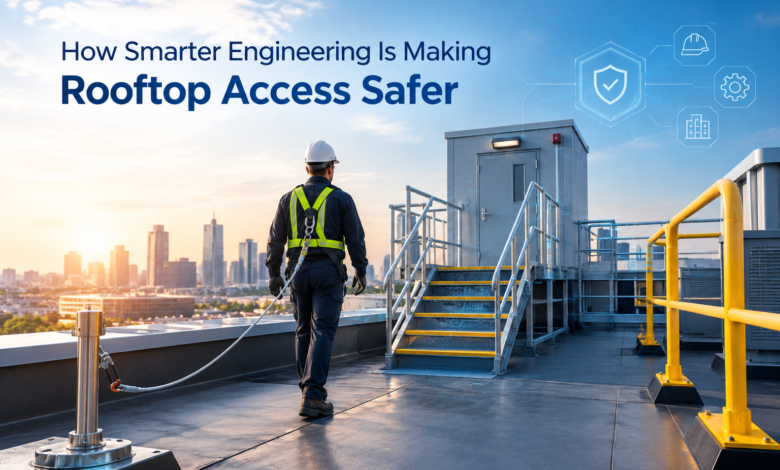
Commercial rooftops are busy working environments. HVAC equipment, solar panels, ventilation systems, and other essential infrastructure often require regular inspection and maintenance, meaning employees and contractors need reliable ways to reach different areas of a roof.
This access can become challenging when obstacles, changes in level, and exposed edges are involved. Smarter engineering is helping businesses address these hazards by creating safer, more practical routes that allow people to move around rooftops with greater confidence.
Designing Safety Into Rooftop Access
Effective rooftop safety begins with good design. Rather than relying entirely on workers to identify and avoid hazards every time they access a roof, businesses can create designated routes that reduce unnecessary exposure to risk.
Engineered access systems can guide people around fragile surfaces, equipment and other hazardous areas. They can also make it easier to cross changes in height without climbing directly over pipes, ducting or structural features.
By considering how workers will actually use the roof, designers can create access arrangements that are both practical and safer.
Making Rooftop Obstacles Easier to Navigate
Pipes, cables and ductwork are common features on commercial and industrial roofs. Although they may only be relatively small obstacles, repeatedly stepping or climbing over them can increase the risk of trips and falls. Workers may also damage equipment if they use pipes or other installations for support.
Purpose-built solutions such as Kee Safety step over platforms can provide a defined way to cross rooftop obstacles without requiring workers to improvise their route.
Engineering these crossings into the rooftop layout can be particularly useful in areas that maintenance teams need to access frequently.
Reducing Reliance on Individual Judgement
Training and safe working procedures remain important, but engineering controls can help create a more consistent approach to rooftop safety.
A worker faced with an awkward obstacle might otherwise have to decide whether to climb over it, walk around it, or find another route. A clearly designed access system removes much of this uncertainty by providing an obvious path.
This can also help businesses manage contractors and occasional roof users who may be less familiar with the building and its hazards.
Considering the Entire Rooftop Journey
Safer rooftop access is not only about the point where someone enters or leaves the roof. The entire journey should be considered, from the access point to the equipment or work area and back again.
This means looking at potential fall edges, slippery surfaces, changes in level, fragile areas, and obstacles. Frequently used routes may benefit from walkways, guardrails, crossings or other engineered systems that separate workers from hazards wherever practical.
Layouts should also account for how maintenance requirements could change as new equipment is installed.
Supporting Long-Term Safety
Rooftop safety systems need to remain suitable throughout the life of a building. Regular inspections can identify damage, deterioration or changes to the roof that affect existing access arrangements.
Businesses should also review rooftop routes whenever equipment is replaced, solar panels are installed, or building services are modified. A route that was suitable several years ago may no longer reflect how the roof is actually used.
Smarter engineering makes rooftop safety less dependent on improvised decisions. By designing clear routes, providing appropriate ways to cross obstacles and reviewing access as buildings evolve, organisations can create rooftops that are easier and safer for employees and contractors to navigate.