
Warehouse automation is no longer optional. Rising labor costs, faster delivery expectations, and growing order volumes are pushing businesses to rethink how goods move inside their facilities.
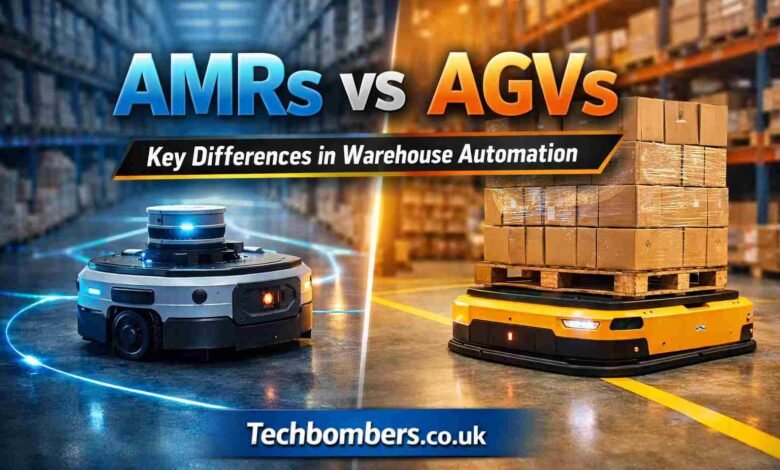
Two technologies dominate this shift: Autonomous Mobile Robots (AMRs) and Automated Guided Vehicles (AGVs).
At first glance, they seem similar. Both move materials from one point to another. But the way they operate is completely different. That difference impacts efficiency, cost, and long-term scalability.
This guide breaks everything down in simple terms so you can understand which solution fits your warehouse.
What Are Automated Guided Vehicles (AGVs)?
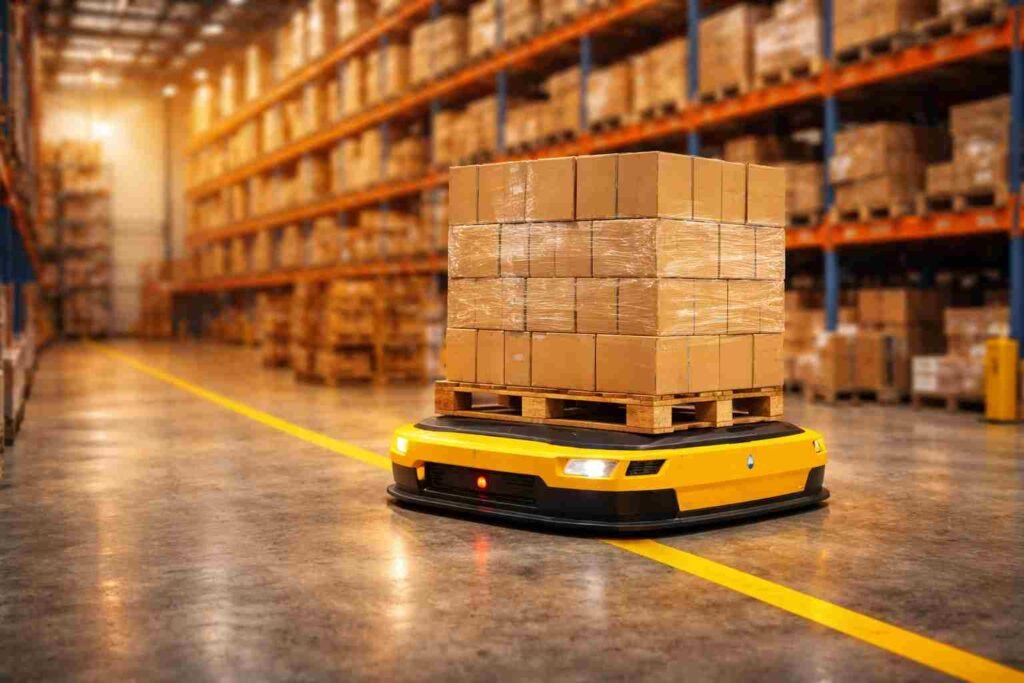
AGVs are one of the earliest forms of warehouse automation. They have been used for decades, especially in manufacturing environments.
These vehicles follow predefined paths inside a facility. The path is created using physical guides such as:
- Magnetic tape
- Embedded wires
- Laser markers or reflectors
AGVs do not “think” or adapt. They simply follow instructions along fixed routes.
If something blocks their path, they usually stop and wait. In some cases, they require manual intervention to resume operation.
Because of this, AGVs work best in stable environments where layouts rarely change.
What Are Autonomous Mobile Robots (AMRs)?

AMRs represent the next step in warehouse automation.
Instead of following fixed paths, AMRs use sensors, cameras, and mapping software to navigate independently. They scan their surroundings and build a digital map of the warehouse.
This allows them to:
- Choose the best route in real time
- Avoid obstacles without stopping
- Adapt to layout changes
AMRs rely on technologies like LiDAR and SLAM (Simultaneous Localization and Mapping). These systems help the robot understand where it is and where it needs to go.
Unlike AGVs, AMRs operate more like a self-driving system inside a warehouse.
Core Difference: Fixed vs Dynamic Movement
The biggest difference between AMRs and AGVs is how they move.
AGVs follow a fixed path. AMRs create their own path.
This single difference affects everything else, from flexibility to cost to efficiency.
In a static environment, fixed paths can work well. But in a dynamic warehouse where people, pallets, and equipment are constantly moving, flexibility becomes critical.
You Might Also Check: What Is a Forklift In Warehouse?
AMRs vs AGVs: Detailed Comparison
Below is a high-quality comparison table that highlights the most important differences:
| Feature | Autonomous Mobile Robots (AMRs) | Automated Guided Vehicles (AGVs) |
| Navigation | Dynamic navigation using sensors and maps | Fixed routes using wires, tape, or markers |
| Flexibility | High – adapts to layout changes easily | Low – requires physical changes to routes |
| Obstacle Handling | Avoids obstacles and reroutes automatically | Stops when path is blocked |
| Deployment Time | Fast – minimal infrastructure required | Slow – needs installation of guiding systems |
| Scalability | Easy to scale by adding more robots | Difficult to scale due to fixed paths |
| Initial Cost | Higher upfront investment | Lower upfront cost |
| Long-Term Cost | Lower due to efficiency and flexibility | Higher due to maintenance and upgrades |
| Maintenance | Software updates and sensor calibration | Physical infrastructure maintenance required |
| Safety | Advanced sensors improve safety around humans | Basic safety, often stops when blocked |
| Best Use Case | Dynamic warehouses, e-commerce, 3PL | Stable environments, manufacturing lines |
Advantages of AMRs
AMRs are gaining popularity for a reason. They solve many of the limitations that older systems struggle with.
Flexibility in Changing Environments
Warehouses are rarely static. Layouts change, inventory shifts, and workflows evolve.
AMRs can adapt without requiring physical changes to the facility.
Real-Time Decision Making
AMRs do not rely on a fixed route. They calculate the best path based on current conditions.
This reduces congestion and improves efficiency.
Faster Deployment
There is no need to install wires or magnetic tracks. AMRs can be deployed by simply mapping the space.
This saves time during implementation.
Better Use of Space
Since AMRs are not tied to fixed paths, they can use available space more efficiently.
Easier Scaling
Adding more AMRs is straightforward. You do not need to redesign the entire system.
Limitations of AMRs
Despite their advantages, AMRs are not perfect.
Higher Initial Cost
The technology involved is more advanced. This increases upfront investment.
Complexity
AMRs rely on software, sensors, and integration with warehouse systems. This requires proper setup and expertise.
Advantages of AGVs
AGVs still have a place in modern warehouses, especially in specific use cases.
Simplicity
AGVs follow fixed routes. This makes them easy to understand and operate.
Lower Upfront Cost
The initial investment is usually lower compared to AMRs.
Reliable for Repetitive Tasks
If your workflow does not change, AGVs can perform consistently without surprises.
Limitations of AGVs
The limitations of AGVs become clear in more complex environments.
Lack of Flexibility
Any change in layout requires physical updates to the guiding system.
Downtime Due to Obstacles
AGVs stop when something blocks their path. This can slow down operations.
Scaling Challenges
Expanding an AGV system often means redesigning routes and infrastructure.
Use Cases: Where Each Works Best
Choosing between AMRs and AGVs depends heavily on your environment.
Best Use Cases for AGVs
- Manufacturing plants with fixed layouts
- Repetitive transport tasks
- Low-variation workflows
Best Use Cases for AMRs
- E-commerce fulfillment centers
- Third-party logistics (3PL) warehouses
- Facilities with frequent layout changes
- High-mix, high-volume operations
Cost Consideration: Short-Term vs Long-Term
Cost is often the deciding factor, but it needs to be viewed correctly.
AGVs may seem cheaper at the beginning. However, they require:
- Infrastructure setup
- Ongoing maintenance
- Costly modifications when layouts change
AMRs have a higher upfront cost, but they reduce:
- Labor dependency
- Downtime
- Reconfiguration costs
Over time, many businesses find that AMRs deliver better return on investment.
Integration with Warehouse Systems
Modern warehouses rely heavily on software systems like WMS (Warehouse Management Systems).
AMRs are typically designed to integrate easily with these systems. They can:
- Receive tasks automatically
- Optimize routes based on real-time data
- Provide performance insights
AGVs can also integrate, but their functionality is often more limited due to their fixed nature.
Safety Considerations
Safety is critical in any warehouse environment.
AMRs are equipped with advanced sensors that allow them to:
- Detect humans and obstacles
- Adjust speed dynamically
- Navigate safely in shared spaces
AGVs rely more on basic safety measures. They often stop when something is detected in their path.
This difference makes AMRs better suited for environments where humans and robots work together.
Future of Warehouse Automation
The trend is clearly moving toward more intelligent systems.
AMRs are becoming more common because they align with the needs of modern logistics:
- Faster order fulfillment
- Flexible operations
- Data-driven decision making
AGVs are still relevant, but their use is mostly limited to predictable environments.
As technology continues to evolve, the gap between the two will likely grow wider.
You Might Also Check: How to Improve Warehouse Picking Speed and Accuracy in 2026
How to Choose the Right Solution
There is no one-size-fits-all answer. The right choice depends on your specific needs.
Ask yourself:
- Does your warehouse layout change often?
- Do you need to scale operations quickly?
- Is your workflow predictable or dynamic?
- What is your long-term growth plan?
If your operations are stable and repetitive, AGVs may be enough.
If your environment is dynamic and growing, AMRs are the better investment.
Final Thoughts
AMRs and AGVs both play an important role in warehouse automation. But they are built for different types of operations.
AGVs are reliable and simple, but limited.
AMRs are flexible and intelligent, but require higher investment.
The key is not choosing the “better” technology. The key is choosing the one that fits your warehouse.
As logistics continues to evolve, businesses that invest in adaptable systems will have a clear advantage.
For more insights, read our article on: Warehouse Robotics Trends & Innovations in 2026