
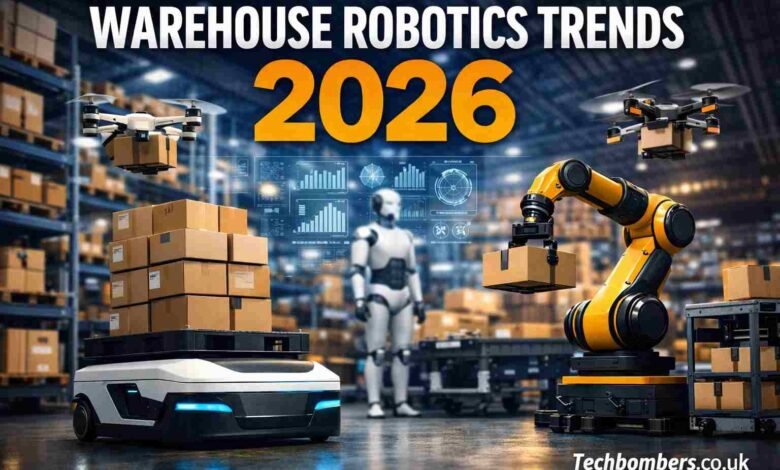
The warehouse and logistics industry has been undergoing a monumental transformation over the past decade, and 2026 is no exception. With the rapid advancements in technology, warehouse robotics are now at the forefront of innovation in supply chain management. From autonomous mobile robots (AMRs) to artificial intelligence (AI)-driven decision systems, automation is reshaping how businesses approach warehousing, inventory management, and order fulfillment.
In this post, we’ll explore the top trends in warehouse robotics for 2026, the key technological innovations driving these changes, and what the future holds for the industry.
The Evolution of Warehouse Robotics
Robots have come a long way since their early applications in warehouses. What started with simple automated guided vehicles (AGVs) to move goods has now evolved into sophisticated machines capable of performing complex tasks such as picking, sorting, and palletizing.
In the past, robotics technology was seen as a luxury reserved for large corporations like Amazon and Walmart. However, the story has changed. As the cost of automation continues to decrease and technology improves, even smaller businesses can now implement robotics in their warehouses.
Key Milestones in Warehouse Robotics:
- Early 2000s: AGVs were introduced for basic transportation tasks.
- 2010s: The introduction of autonomous mobile robots (AMRs) and the integration of AI for more flexible, intelligent operations.
- Mid-2020s: Robotics-as-a-Service (RaaS) models allowed smaller businesses to access automation at scale.
Key Trends in Warehouse Robotics for 2026
Warehouse robotics are set to continue their expansion in 2026, bringing innovative solutions to the market. Below are the key trends expected to dominate the warehouse automation landscape this year.
Autonomous Mobile Robots (AMRs) Are Leading the Charge
In 2026, Autonomous Mobile Robots (AMRs) are set to dominate warehouse operations. These robots can navigate independently and perform tasks such as goods transport, inventory management, and even basic customer fulfillment functions.
AMRs differ from traditional AGVs in their flexibility. While AGVs require fixed paths, AMRs use AI to navigate warehouses, allowing them to adapt to changes in the environment. This flexibility makes AMRs ideal for modern, dynamic warehouse environments where demand and inventory change frequently.
Benefits of AMRs:
- Scalability: Easily expanded to meet increasing demand.
- Flexibility: Ability to navigate complex, dynamic environments.
- Efficiency: Faster order fulfillment and reduced human labor costs.
Several large players, including Amazon, have already deployed AMRs across their facilities. These robots not only improve operational efficiency but also contribute to higher safety standards by reducing the need for humans to perform dangerous tasks like heavy lifting.
AI and Machine Learning Are Powering Smarter Operations
As the warehouse robotics industry evolves, artificial intelligence (AI) is playing an increasingly central role in optimizing operations. From inventory management to predictive analytics, AI allows robots to make decisions on the fly and optimize workflows in real time.
In 2026, AI will enable robots to:
- Predict inventory needs by analyzing real-time data and historical trends.
- Optimize pick paths to reduce travel time and speed up order fulfillment.
- Predict maintenance needs to avoid costly downtime by identifying when machines are likely to fail.
You Might Also Check: How Can Modern Technology Enhance Inventory Accuracy?
Robotics-as-a-Service (RaaS) Models Gain Popularity
One of the most exciting trends in 2026 is the rise of Robotics-as-a-Service (RaaS). Traditionally, adopting warehouse robotics required significant upfront investment in hardware and software. However, RaaS allows companies to lease robots on a subscription basis, dramatically lowering the barriers to entry for smaller businesses.
RaaS provides businesses with flexibility, allowing them to scale their robotic fleet up or down based on demand. It also includes regular updates, maintenance, and technical support, making it a more accessible option for businesses of all sizes.
Collaborative Robots (Cobots) Are Enhancing Human-Robot Interaction
The future of warehouse robotics isn’t about replacing humans; it’s about working alongside them. Collaborative robots, or cobots, are designed to assist human workers, rather than replace them entirely.
These robots are capable of performing repetitive and physically demanding tasks, such as lifting heavy boxes or sorting items. By automating these processes, cobots free up human workers to focus on higher-value tasks, like decision-making or quality control.
The integration of cobots improves safety and efficiency, as they can handle hazardous tasks, reducing the risk of injury. As the technology improves, cobots will become more adept at working alongside humans in environments where precision and flexibility are key.
Emerging Technologies in Warehouse Robotics
Warehouse robotics is not just about moving goods; it’s about using advanced technologies to enhance the functionality of robots. In 2026, several emerging technologies are expected to transform the warehouse automation landscape.
AI and Vision-Based Systems
Computer vision combined with AI is revolutionizing how robots interact with their environment. Robots can now use vision systems to recognize objects, sort inventory, and even inspect items for quality control. AI-powered vision systems help robots handle a wide variety of goods with different shapes, sizes, and packaging.
These systems can:
- Identify products on shelves without needing human intervention.
- Track inventory in real-time, ensuring warehouses stay stocked and organized.
- Ensure quality control by detecting damaged or defective products.
AI and computer vision are also playing a pivotal role in reducing human error in warehouse operations, leading to fewer mistakes in order fulfillment.
Robotic Picking and Sorting Systems
Robots that can pick and sort products are no longer just a concept; they are becoming a reality. Today’s robotic systems are designed to handle complex picking tasks by using a combination of AI, machine learning, and vision systems.
One of the key innovations is the “goods-to-person” system, where robots bring products to human workers for packaging, rather than the other way around. This significantly reduces the time spent walking around the warehouse, leading to faster order fulfillment.
You Might Also Check: How to Prevent Picking Errors in Your Warehouse
Robot-Powered Palletizing and De-Palletizing
One of the most labor-intensive tasks in a warehouse is palletizing—placing products onto pallets for storage or shipment. However, robots are increasingly taking over this role. Robot-powered palletizing systems can handle heavy loads and work more quickly and efficiently than human workers.
This technology is also being extended to de-palletizing, where robots are used to break down pallets and distribute items throughout the warehouse for further processing.
Market Trends and Forecasts for 2026
Warehouse robotics is an industry on the rise. According to recent reports, the global warehouse robotics market is expected to exceed $36 billion by 2035, driven by the need for faster, more efficient supply chains and the increasing reliance on e-commerce.
Market Drivers:
- E-commerce growth: As online shopping continues to rise, there’s a growing demand for faster order fulfillment, which robotics can provide.
- Labor shortages: Warehouse operators are struggling to find enough workers to meet increasing demand. Robotics helps fill this gap by automating tasks that were once performed manually.
- Cost efficiency: Robotics can help warehouses reduce operational costs by improving efficiency and reducing the need for human labor.
In 2026, we expect to see more widespread adoption of robotics across industries such as retail, automotive, and food processing, all of which require high levels of warehouse automation.
Regional Insights:
- North America: Home to some of the largest warehouse automation providers, North America is expected to continue leading in the adoption of robotics.
- Asia-Pacific: The Asia-Pacific region is seeing rapid growth in warehouse automation, driven by the booming e-commerce industry in countries like China and India.
- Europe: Europe is focusing on integrating automation technologies to improve the efficiency of their supply chains, particularly in industries like automotive manufacturing.
Challenges in Warehouse Robotics
While warehouse robotics offers numerous benefits, there are still challenges that businesses need to consider when implementing these systems.
High Initial Investment
Although costs are coming down, robotics systems can still require a significant upfront investment. For smaller businesses, this can be a barrier to entry. However, RaaS models are helping to alleviate this challenge, as companies can lease robots instead of buying them outright.
Integration with Legacy Systems
Integrating robotics into existing warehouse infrastructure can be tricky. Legacy systems, such as traditional software and manual processes, may need to be updated or replaced to work effectively with robotic systems. This integration process requires careful planning and investment in technology.
Workforce Displacement
One of the main concerns around warehouse automation is the potential displacement of human workers. However, many companies are focusing on retraining their workforce to take on new roles, such as managing robots or handling more complex tasks that require human intervention.
The Future of Warehouse Robotics
The future of warehouse robotics looks incredibly promising. As technology continues to evolve, robots will become more autonomous, intelligent, and capable of handling a wider range of tasks.
Some exciting developments to watch in the coming years include:
- Fully autonomous warehouses: In the future, robots may handle every aspect of warehouse operations, with minimal human intervention.
- Drones: Drones are expected to play a larger role in warehouse operations, particularly in inventory management and order fulfillment.
- Blockchain integration: As supply chains become more complex, blockchain technology may be integrated with robotics to ensure transparency and efficiency in inventory tracking.
Conclusion
Warehouse robotics is no longer just a futuristic concept; it’s a reality that’s already transforming industries worldwide. In 2026, we’re seeing incredible advancements in AI, AMRs, RaaS, and collaborative robots that are reshaping the way warehouses operate.
As businesses continue to adopt and innovate with these technologies, we can expect faster, more efficient, and safer warehouse operations. The future of warehouse robotics is bright, and companies that embrace this change will be better positioned to thrive in the increasingly competitive e-commerce landscape.
For more insights, read our article on: What is a Digital Warehouse?