
What London Architects See in Your Home That You’ve Stopped Noticing

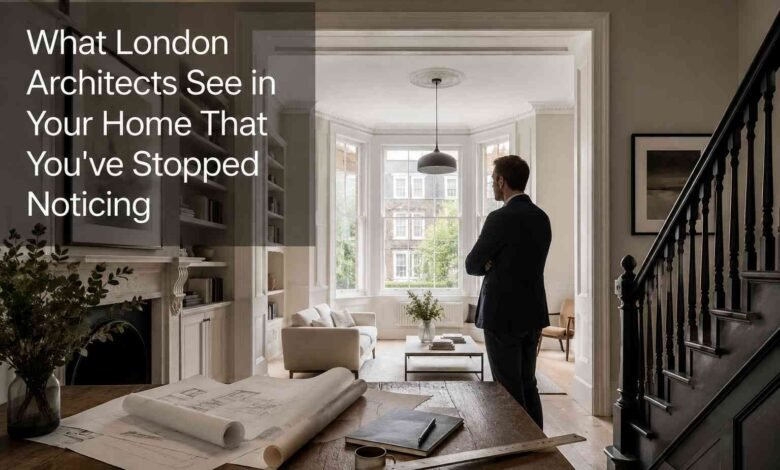
You walk past it every day. The dark corner where the hallway meets the kitchen. The door that swings the wrong way and blocks the radiator. The window that faces the neighbour’s wall instead of the garden. The cupboard under the stairs that’s too shallow to store anything useful.
You’ve lived with these things so long they’ve become invisible. They’re just how your house is. You stopped questioning them years ago.
An architect walks in and sees them immediately. Not because they’re smarter than you. Because they’re looking at your home with fresh eyes and a trained understanding of how space, light, and movement work together. That fresh perspective is worth more than most homeowners realise. At Extension Architecture, we work as architects in London who spend our days walking through homes and spotting opportunities that the people living in them have completely stopped seeing. Here’s what we typically find.
The Wall That Shouldn’t Be There
Every London home has at least one wall that’s doing nothing useful. A partition between the kitchen and dining room that blocks light and creates two cramped rooms instead of one generous one. A lobby wall that makes the hallway feel like a tunnel. A wall between the front and rear reception rooms that served a purpose in 1890 but serves none today.
Not all of these walls can come out. Some are load bearing. Some carry services that would be expensive to reroute. But a surprising number are simple stud partitions that a builder could remove in a morning.
Your architect identifies which walls are structural and which aren’t during the first visit. The ones that aren’t become immediate opportunities. Removing even one unnecessary partition can transform how your ground floor feels without spending anything on an extension.
Light You’re Not Capturing
Most London homes waste natural light. Windows face the wrong way. Internal walls block light from traveling between rooms. Ceilings are solid, where a roof light could bring daylight flooding in from above.
Your architect maps the light conditions across your home. Where does the morning sun enter? Where does afternoon warmth land? Where are the dark spots that never see direct daylight regardless of the time of year?
Then they design around those observations. A glazed internal screen replacing a solid wall lets borrowed light reach a dark hallway. A strategically placed roof light over the center of the plan illuminates the deepest part of the house. A wider window opening on the garden elevation captures low winter sun that the current narrow window misses entirely.
These changes don’t require an extension. They work within the existing footprint. And they make the house feel dramatically brighter without adding a single square metre.
Circulation That Wastes Space
London homes waste enormous amounts of space on circulation. Hallways that are wider than they need to be. Landings that serve no purpose except connecting doors. L shaped corridors that exist because someone put a wall in the wrong place fifty years ago.
Your architect looks at how you move through the house and identifies where space is being lost to unnecessary circulation. Straightening a dog leg corridor might free up enough room for a built in wardrobe. Reducing a landing by 400mm might let you widen the bathroom enough for a proper shower enclosure. Absorbing part of the hallway into the living room might give you the open plan feel you wanted without touching the rear wall.
These spatial efficiencies are invisible to homeowners because you’ve adapted your daily movements around the existing layout. You walk the L shaped corridor without thinking about it. An architect sees the wasted square metres immediately.
Storage You Haven’t Thought Of
Every London homeowner complains about storage. Not enough cupboards. Nowhere to put coats. Shoes piling up by the front door. Vacuum cleaner living in the kitchen because there’s nowhere else.
Your architect finds storage opportunities in places you’ve overlooked. The space above the door that could hold a deep shelf. The alcove beside the chimney breast that’s exactly the right depth for built in shelving. The void under the staircase that could become a pull out shoe rack instead of a dumping ground.
On projects in areas like Croydon, where 1930s semis have generous hallways and underused alcoves, we regularly find enough hidden storage to eliminate the need for freestanding furniture that clutters rooms and blocks light.
The Room You’re Using Wrong
Sometimes the biggest improvement isn’t adding space. Its rearranging what you already have.
The smallest bedroom that you’re using as a home office might work better as a walk in wardrobe for the master bedroom. The dining room you eat in twice a year might serve your family better as a playroom or study. The large bathroom with a bath nobody uses could become a compact shower room plus a separate utility cupboard.
These swaps cost very little. Sometimes nothing more than moving a door or adding a partition. But they can dramatically improve how your home functions for your specific family rather than the generic family the house was originally designed for.
What Changes After That First Visit
Most homeowners who walk an architect through their home for the first time say the same thing afterwards. “I can’t believe I didn’t see that.” The dark corner that could be bright. The wasted space that could be useful. The wall that could disappear. The room that could work harder.
That shift in perspective is what you’re paying for when you hire an architect. Not just drawings and planning applications. A completely different way of seeing the home you thought you already knew inside out.
For more insights, read our article on: Efficient Planning for Modern Home Improvement Projects