
Warehouses run on speed, accuracy, and efficiency. Moving heavy goods by hand is slow, risky, and not practical at scale. This is where forklifts come in.
A forklift is one of the most important machines in any warehouse. It helps lift, move, and stack heavy loads quickly and safely. Without forklifts, modern logistics would struggle to keep up with demand.
In this guide, you’ll learn what a forklift is, how it works, where it’s used, and why it matters in warehouse operations.
What Is a Forklift?
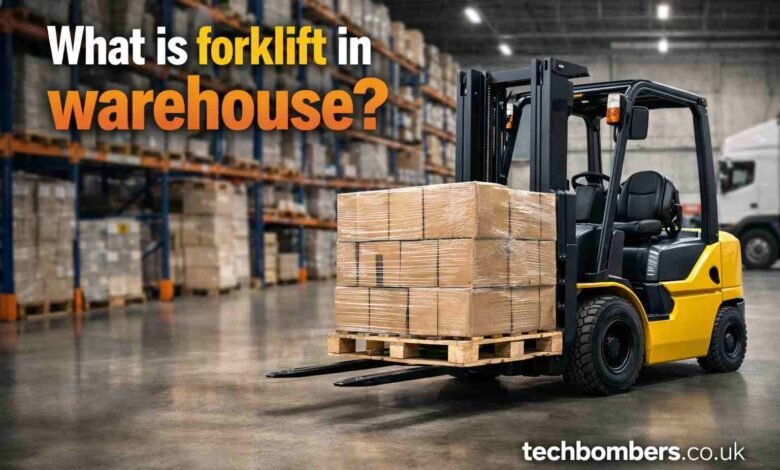
A forklift is a small industrial vehicle designed to lift and move heavy materials over short distances. It uses two metal prongs, called forks, to pick up loads—usually placed on pallets.
The operator controls the forklift from a seated or standing position, depending on the type. Using hydraulic power, the machine can raise and lower loads with precision.
In simple terms, a forklift replaces manual lifting and makes material handling faster and safer.
You Might Also Check: What are Automated Guided Vehicles (AGVs)?
Why Forklifts Are Important in Warehouses
Warehouses deal with large volumes of goods every day. These goods are often heavy and packed on pallets. Moving them manually would take too much time and effort.
Forklifts solve this problem in several ways.
First, they increase speed. A forklift can move dozens of boxes at once, reducing the time needed to load or unload shipments.
Second, they improve safety. Workers don’t need to carry heavy items, which lowers the risk of injuries.
Third, they support organization. Forklifts allow goods to be stacked vertically, making better use of warehouse space.
Without forklifts, warehouse operations would be slower, less efficient, and more dangerous.
Common Uses of Forklifts in Warehouses
Forklifts are used throughout the warehouse workflow. They are not limited to just one task.
One of their main uses is loading and unloading trucks. When goods arrive, forklifts quickly remove pallets from trucks. The same process is used when shipping products out.
They are also used to transport goods within the warehouse. Instead of carrying items by hand, forklifts move them across long distances with ease.
Another important use is stacking. Forklifts can lift pallets to high shelves, which helps maximize storage space.
They are also used for organizing inventory. Workers can rearrange goods quickly, making it easier to manage stock.
Types of Forklifts Used in Warehouses
Not all forklifts are the same. Different types are designed for different tasks.
Counterbalance Forklifts
This is the most common type. It has forks at the front and a weight at the back to balance heavy loads. It is easy to operate and widely used for general tasks.
Reach Trucks
Reach trucks are designed for narrow aisles. They can extend their forks forward to reach high shelves. These are common in large warehouses with vertical storage systems.
Pallet Jacks
Pallet jacks are used to move pallets at ground level. They come in manual and electric versions. While they do not lift loads high, they are useful for short-distance movement.
Order Pickers
Order pickers allow operators to lift themselves along with the load. This is useful when picking individual items from high shelves.
Rough Terrain Forklifts
These are used outside the warehouse on uneven surfaces. They have large tires and are built for stability in tough conditions.
Each type serves a specific purpose, and choosing the right one depends on the warehouse layout and tasks.
You Might Also Check: What is a Cobot in Warehouse? Key Advantages for 2026
Main Parts of a Forklift
Understanding the basic parts of a forklift helps in knowing how it works.
The forks are the two metal arms used to lift loads. They slide under pallets and hold the weight securely.
The mast is the vertical structure that raises and lowers the forks. It allows the forklift to lift loads to different heights.
The overhead guard protects the operator from falling objects. It is an important safety feature.
The tires support movement. Different tires are used depending on whether the forklift operates indoors or outdoors.
The controls include steering, lifting, and tilting functions. These allow the operator to move and position loads accurately.
How a Forklift Works
A forklift works using a combination of mechanical and hydraulic systems.
The operator starts the machine and uses the controls to move it into position. The forks are aligned with the pallet.
Once in place, the forks slide under the load. The operator then uses the hydraulic system to lift the load off the ground.
The forklift can then move forward, backward, or turn as needed. When the load reaches its destination, the operator lowers it carefully.
The process is simple, but it requires skill and attention to detail.
Forklift Safety Tips
Safety is a critical part of using forklifts. Improper use can lead to accidents and injuries.
Only trained operators should use forklifts. Training ensures that the operator understands how to handle the machine safely.
Always check the load before lifting. It should be stable and within the forklift’s capacity.
Keep the forks low while moving. This improves stability and reduces the risk of tipping.
Watch the surroundings at all times. Warehouses can be busy, with people and equipment moving around.
Wearing safety gear, such as helmets and safety shoes, also helps reduce risk.
Advantages of Using Forklifts
Forklifts offer several clear benefits in warehouse operations.
They save time by moving large loads quickly. This increases overall productivity.
They reduce physical strain on workers. Employees do not need to lift heavy items manually.
They improve accuracy. Goods can be placed exactly where needed.
They also allow better use of space by enabling vertical storage.
These advantages make forklifts a key part of modern warehouses.
Challenges and Limitations
Despite their benefits, forklifts also have some limitations.
They require proper training. Untrained operators can create safety risks.
Maintenance is necessary to keep them in good condition. This adds to operating costs.
They also need space to operate. In very tight areas, movement can be difficult.
Understanding these challenges helps businesses use forklifts more effectively.
The Future of Forklifts in Warehousing
Technology is changing how forklifts are used.
Electric forklifts are becoming more common. They produce less noise and no emissions, making them suitable for indoor use.
Automation is also growing. Some warehouses now use self-driving forklifts that can move goods without human operators.
Smart systems are being added to improve efficiency. These systems help track movement and optimize workflows.
As warehouses continue to evolve, forklifts will remain an essential part of the system.
Conclusion
A forklift is more than just a machine. It is a key tool that keeps warehouses running smoothly.
From lifting heavy loads to organizing inventory, forklifts make work faster, safer, and more efficient.
Understanding how forklifts work and how they are used can help businesses improve their operations and maintain a safe working environment.
If you are involved in warehouse work or planning to enter the logistics field, learning about forklifts is a smart first step.
For more insights, read our article on: Warehouse Robotics Trends & Innovations in 2026