WMS vs WES vs WCS: What’s the Difference in Modern Warehouses?

Walk into any modern fulfillment center and it becomes obvious quickly that nothing is running on guesswork. Orders move fast, robots coordinate with conveyors, and workers scan items in a rhythm that only works because software is controlling almost every step in the background. What looks like simple picking and shipping is actually a layered system of decisions happening in real time.
This is where confusion usually starts for people who study warehouse systems. WMS, WES, and WCS are often mentioned together, sometimes even used interchangeably, but they are not the same thing. Each one operates at a different level of the warehouse, and each one solves a different problem. Understanding the difference is important for anyone working in logistics, supply chain, or warehouse automation.
Why Warehouse Software Systems Exist in the First Place
Warehouses used to be heavily manual. People tracked inventory on paper, supervisors assigned tasks verbally, and errors were accepted as part of the process. That approach does not work anymore because modern supply chains are built on speed, accuracy, and visibility.
Three major changes forced warehouses to adopt software systems:
- Growth of eCommerce created constant order flow instead of batch shipping
- Customer expectations shifted toward same-day and next-day delivery
- Automation introduced machines that needed coordination with humans
When you combine these factors, manual control breaks down. Software becomes the central nervous system of the warehouse, making sure nothing slows down or conflicts with something else.
This is where WMS, WES, and WCS come in. They are not competing systems. They are different layers of control.
What is a Warehouse Management System (WMS)
A Warehouse Management System (WMS) is the foundation of warehouse operations. It is the system that keeps track of what exists in the warehouse and where it is located.
At its core, a WMS answers simple but critical questions:
- What inventory do we have?
- Where is it stored?
- What needs to be shipped?
- What needs to be received?
Without these answers, a warehouse cannot function at scale.
Core Role of WMS in Operations
A WMS focuses on inventory accuracy and order management. It handles structured workflows such as:
- Receiving goods from suppliers
- Storing inventory in defined locations
- Tracking stock movement inside the warehouse
- Creating picking and packing tasks
- Managing shipping and dispatch
The key point is that a WMS is process-driven. It follows defined rules to make sure inventory stays accurate and traceable.
Key Functions of a WMS
A modern WMS typically includes:
Inventory control
It records every item entering or leaving the warehouse. This ensures stock levels are always up to date.
Order management
It converts customer orders into warehouse tasks such as picking and packing.
Putaway optimization
It decides where incoming stock should be stored based on logic like space availability or product type.
Labor tracking
It monitors worker activity, productivity, and task completion rates.
Reporting and visibility
It provides dashboards that show stock levels, order status, and warehouse performance.
Where WMS is Used
WMS is common in:
- Retail distribution centers
- E-commerce fulfillment warehouses
- Manufacturing supply chains
- Third-party logistics (3PL) providers
Any warehouse that handles inventory at scale will need a WMS, even if it is not automated.
Simple Way to Understand WMS
Think of WMS as the memory of the warehouse. It remembers everything:
what came in, what is stored, and what needs to go out.
But memory alone does not execute actions or manage machines. That is where the next systems come in.
What is a Warehouse Execution System (WES)
A Warehouse Execution System (WES) sits between planning and physical execution. If WMS is the memory of the warehouse, WES is the decision-making layer that controls how work flows in real time.
WES exists because modern warehouses do not operate in a straight line. Workloads change every minute. Machines may slow down, labor availability shifts, and priority orders need immediate attention. A WMS alone is not designed to react dynamically to these conditions.
Core Role of WES in Warehouses
A WES focuses on orchestration. It does not just assign tasks; it decides the best way to execute them based on live conditions.
It answers questions like:
- Which orders should be processed first?
- Where is the bottleneck right now?
- Should we release more work or slow it down?
- How do we balance humans and automation?
Key Functions of WES
A WES typically performs:
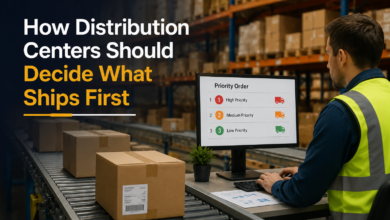
Order prioritization
It decides which orders should be released based on shipping deadlines, workload, and system capacity.
Dynamic task balancing
If one area is overloaded, it redistributes work to keep flow steady.
Wave and batch control
It manages how orders are grouped and released into the warehouse.
Real-time decision making
It adjusts workflow based on current warehouse conditions instead of static rules.
Coordination of automation and labor
It ensures humans and machines are not competing for the same bottleneck.
Why WES Became Important
WES became relevant when warehouses started using automation like:
- Autonomous mobile robots (AMRs)
- Conveyor systems
- Automated sorting systems
- Goods-to-person systems
These systems create high-speed environments where delays or imbalances can cause downtime. A static WMS cannot react fast enough. WES fills that gap by continuously adjusting operations.
Simple Way to Understand WES
If WMS is memory, WES is the traffic controller.
It does not store inventory data in detail. Instead, it manages how work moves through the system without congestion.
What is a Warehouse Control System (WCS)
A Warehouse Control System (WCS) operates at the physical level of warehouse automation. It directly controls machines, equipment, and mechanical processes.
While WMS and WES deal with decisions and workflows, WCS deals with movement.
Core Role of WCS
WCS is responsible for executing instructions on automation systems such as:
- Conveyors
- Sorters
- Robotic arms
- Automated storage and retrieval systems (AS/RS)
- Scanning and identification devices
It ensures physical items move correctly from one point to another.
Key Functions of WCS
A WCS performs tasks like:
Equipment control
It sends direct commands to machines, telling them where to move items.
Real-time routing
It determines the best physical path for products inside automated systems.
Machine coordination
It ensures multiple machines work together without collision or delay.
System monitoring
It tracks machine health and operational status.
Error handling at equipment level
It manages jams, blockages, and mechanical issues.
Where WCS is Used
WCS is found in:
- Highly automated fulfillment centers
- Parcel sorting hubs
- Large distribution warehouses
- Industrial manufacturing facilities
Without WCS, automation systems cannot operate smoothly because machines would not have coordinated instructions.
Simple Way to Understand WCS
WCS is the muscle of the warehouse.
It physically moves products based on instructions received from higher-level systems.
WMS vs WES vs WCS: Core Differences Explained
Even though these systems work together, they operate at completely different layers.
1. Level of Decision Making
- WMS decides what needs to be done
- WES decides how work should flow
- WCS decides how machines physically execute it
2. Speed of Operation
- WMS works in structured processes (minutes to hours)
- WES works in real time (seconds to minutes)
- WCS works instantly (milliseconds)
3. Focus Area
- WMS focuses on inventory and order data
- WES focuses on workflow optimization
- WCS focuses on equipment control
4. Dependency Chain
WMS → WES → WCS
Higher-level instructions flow downward, while execution feedback flows upward.
Comparison Table
| Feature | WMS | WES | WCS |
| Main purpose | Inventory & order management | Workflow orchestration | Machine control |
| Decision level | Strategic | Tactical | Operational |
| Speed | Moderate | Fast | Real-time |
| Controls | Data & tasks | Workflows | Equipment |
| Example | Create pick list | Prioritize orders | Move carton on conveyor |
How WMS, WES, and WCS Work Together
A modern automated warehouse is not built on a single system. It is built on integration between all three layers.
Here is a simple real-world flow:
Step 1: Order Entry (WMS)
A customer places an order online. The WMS receives it, checks inventory, and creates a picking task.
Step 2: Workflow Decision (WES)
The WES evaluates:
- Order priority
- Current warehouse workload
- Available labor and machines
It then decides when and how to release the order into execution.
Step 3: Physical Execution (WCS)
Once tasks are released, the WCS takes control of automation equipment:
- Conveyor routes items
- Sorters direct packages
- Robots transport goods
Step 4: Feedback Loop
Data flows back to WMS and WES so the system stays updated and adjusts future decisions.
Real Warehouse Example (Simple Scenario)
Imagine a warehouse handling 10,000 online orders per day.
- WMS logs all orders and identifies stock locations.
- WES decides to prioritize express shipping orders first.
- WCS directs conveyors and robots to move those items faster through the system.
Without WES, everything would move in a fixed sequence. Without WCS, machines would not know what to do. Without WMS, nothing would be organized at all.
Which System Does a Business Actually Need?
Not every warehouse needs all three systems from day one.
Small Warehouses
Usually only need WMS because operations are simple and mostly manual.
Growing Warehouses
WMS + partial WES features become useful when order volume increases and delays start appearing.
Large Automated Warehouses
Require all three:
- WMS for inventory accuracy
- WES for real-time coordination
- WCS for automation control
Industry Trends in Warehouse Systems
Warehouse software is changing quickly due to automation and AI.
Some clear trends include:
- WES becoming more important as automation increases
- WMS platforms adding execution features
- Cloud-based warehouse systems replacing on-premise tools
- Robotics requiring deeper integration with WCS systems
The future is not about choosing one system. It is about combining them into one connected ecosystem.
Common Mistakes Companies Make
Many warehouse projects fail not because of bad software, but because of bad system planning.
Common mistakes include:
- Using WMS alone in highly automated environments
- Adding robots without a WES layer
- Treating WMS upgrades as full execution systems
- Poor integration between systems
These mistakes create bottlenecks that slow down operations even if technology is advanced.
Final Thoughts
WMS, WES, and WCS are not competing technologies. They are layers of the same system.
- WMS manages warehouse data and inventory
- WES controls workflow and decision flow in real time
- WCS operates machines and physical movement
A modern warehouse only performs efficiently when all three layers are properly aligned. The more automation a warehouse has, the more important this structure becomes.
If you understand how these systems interact, you can clearly see how modern logistics moves from simple storage to fully coordinated, real-time execution.