
Construction projects don’t fail because of ideas. They fail when machines stop working at the wrong time.
A crane breaks down in the middle of a lift. An excavator stops during foundation work. A concrete pump fails when the slab is already scheduled. In construction, these moments don’t just cause delays—they disturb the entire project chain, from labor scheduling to material delivery.
For decades, maintenance in construction has followed a simple pattern: fix it when it breaks or service it at fixed intervals whether it needs it or not. Both approaches are inefficient in real working conditions. Machines don’t fail on schedule, and unnecessary servicing wastes both time and cost.
This is where AI predictive maintenance changes the system. Instead of reacting to breakdowns, machines are monitored continuously, and data is used to predict when something is likely to fail. Maintenance is then planned before failure happens.
It is not a futuristic concept anymore. It is already part of modern construction equipment ecosystems, especially in large-scale infrastructure and industrial projects.
What is AI Predictive Maintenance in Construction?
AI predictive maintenance is a system that uses machine data, sensors, and artificial intelligence models to estimate when a construction machine or component will require maintenance.
Instead of guessing or following fixed service intervals, the system reads real-time machine behavior and identifies patterns that usually appear before a failure.
In construction, this applies to equipment such as:
- Excavators
- Bulldozers
- Cranes
- Loaders
- Dump trucks
- Concrete mixers
- Generators and compressors
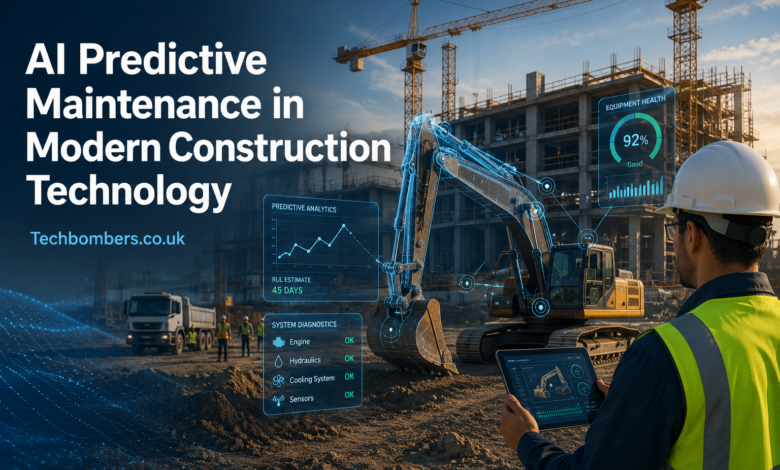
Each machine produces continuous operational data. AI systems analyze this data and detect abnormal behavior that may indicate wear, damage, or system stress.
The goal is simple: prevent downtime by acting early.
How AI Predictive Maintenance Works on Construction Sites
The system is built on three core layers: data collection, data analysis, and maintenance action.
Data Collection from Machines
Modern construction equipment is fitted with sensors and telematics systems. These devices collect operational data such as:
- Engine temperature
- Hydraulic pressure
- Vibration patterns
- Fuel consumption behavior
- Oil condition
- Operating hours
- Error or fault codes
This data is collected continuously while the machine is working on-site.
Data Transmission and Storage
The collected data is sent to a centralized system, usually cloud-based platforms or fleet management software. This allows engineers and managers to view machine health remotely.
AI-Based Analysis
This is the core of predictive maintenance.
Machine learning models analyze historical and real-time data to identify patterns that typically occur before failure. For example:
- A gradual increase in vibration may indicate bearing wear
- Rising engine temperature may signal cooling system issues
- Irregular hydraulic pressure may suggest internal leakage
The system does not rely on a single reading. It studies trends over time.
Prediction and Alert System
When the AI model detects a risk pattern, it generates alerts. These alerts usually include:
- Component likely to fail
- Estimated urgency level
- Recommended maintenance action
Maintenance Scheduling
Instead of emergency repair, maintenance is planned during safe downtime. This avoids disruption of construction activities.
Key Technologies Behind Predictive Maintenance
AI predictive maintenance in construction is not a single tool. It is a combination of multiple technologies working together.
Internet of Things (IoT)
IoT sensors are embedded in machines to collect real-time operational data. Without these sensors, predictive maintenance cannot function.
Machine Learning
Machine learning models learn from historical equipment behavior. They improve over time as more data is collected.
Cloud Computing
Construction sites generate large volumes of data. Cloud systems store and process this information so it can be accessed from anywhere.
Edge Computing
Some processing happens directly on machines or nearby devices. This allows faster response for critical issues.
Digital Twin Technology
A digital twin is a virtual model of a physical machine. It mirrors real-time conditions and helps simulate future failures or stress points.
Applications in Modern Construction
AI predictive maintenance is not limited to one type of equipment. It is used across multiple layers of construction operations.
Heavy Equipment Monitoring
The most common use is monitoring large machines such as excavators, cranes, and loaders. These machines are expensive, and any breakdown directly affects productivity.
Fleet Management
Construction companies often operate multiple machines across different sites. Predictive systems help track machine health across the entire fleet and optimize usage.
Crane and Lifting Safety
Cranes operate under high-risk conditions. Predictive maintenance helps detect structural stress, overload risks, and mechanical fatigue before failure occurs.
Infrastructure Monitoring
Beyond machines, predictive systems are also used in roads, bridges, and tunnels. Sensors detect cracks, stress, and material degradation over time.
Fuel and Efficiency Optimization
When machines operate inefficiently due to hidden faults, fuel consumption increases. Predictive systems help detect such inefficiencies early.
Benefits of AI Predictive Maintenance
The value of predictive maintenance in construction is practical, not theoretical.
Reduced Downtime
Unexpected machine failures are one of the biggest causes of project delays. Predictive maintenance reduces these interruptions by addressing problems early.
Lower Repair Costs
Fixing a small issue early is significantly cheaper than repairing a complete breakdown.
Better Equipment Lifespan
Machines last longer when they are maintained at the right time instead of being overused or repaired too late.
Improved Project Planning
When machines are predictable, project scheduling becomes more reliable.
Increased Site Safety
Equipment failure on construction sites can be dangerous. Predictive alerts help reduce safety risks.
Efficient Resource Use
Maintenance teams can plan work based on real need instead of routine checks.
Real-World Industry Adoption
Construction equipment manufacturers and infrastructure companies are already integrating predictive maintenance into their systems.
Major equipment providers have introduced connected machine platforms that allow contractors to:
- Monitor machine health remotely
- Receive real-time alerts
- Track performance trends
- Schedule maintenance digitally
This shift is part of a larger movement toward connected construction ecosystems where machines, operators, and management systems are linked through data.
Instead of isolated equipment, construction sites are becoming data-driven environments.
Challenges and Limitations
Despite its advantages, predictive maintenance is not simple to implement.
High Setup Cost
Installing sensors, software systems, and cloud infrastructure requires investment, especially for small contractors.
Data Quality Issues
If sensors are poorly calibrated or damaged, the system can produce inaccurate predictions.
Integration with Older Machines
Many construction companies still use older equipment that is not designed for digital monitoring.
Cybersecurity Risks
Connected machines introduce risks related to data security and system access.
Skill Gap
Operators and engineers need training to understand and act on AI-based insights.
Dependence on Continuous Data
If data collection is interrupted, prediction accuracy decreases.
Future of Predictive Maintenance in Construction
The future of construction is moving toward fully connected and semi-autonomous systems.
AI predictive maintenance will become part of a larger ecosystem that includes:
- Autonomous construction machinery
- Digital twin-based project management
- Real-time site simulation
- AI-driven scheduling systems
- 5G-enabled instant data transfer
Instead of isolated predictions, entire construction sites will operate as intelligent systems where machines communicate their condition continuously.
In the long term, maintenance will not be a separate activity. It will become embedded into machine operation itself.
What It Means for Construction Professionals
For engineers, contractors, and project managers, predictive maintenance changes decision-making.
- Engineers can focus on system optimization instead of emergency repairs
- Contractors can reduce financial uncertainty caused by breakdowns
- Project managers can plan timelines with higher accuracy
- Equipment managers can extend asset value through better maintenance cycles
It also changes competition in the construction industry. Companies that adopt data-driven maintenance gain a clear advantage in speed, reliability, and cost control.
Conclusion
AI predictive maintenance is reshaping how construction equipment is managed. It replaces guesswork with data and replaces emergency repairs with planned action.
The real shift is not only technical. It is operational. Construction sites are moving from reactive systems to predictive ecosystems where machines are continuously monitored, analyzed, and optimized.
Companies that adopt this system early will operate with fewer delays, safer sites, and more efficient resource use. Those who ignore it will continue facing unplanned downtime and rising operational costs.
FAQs
What is AI predictive maintenance in construction?
AI predictive maintenance is a system that uses sensors, machine data, and artificial intelligence to predict equipment failures before they happen. In construction, it helps monitor machines like excavators, cranes, and loaders by analyzing performance data and identifying early signs of wear or malfunction.
How is predictive maintenance different from traditional maintenance?
Traditional maintenance is either reactive (fixing after breakdown) or preventive (servicing at fixed intervals). Predictive maintenance is different because it uses real-time data and AI models to determine the actual condition of a machine. This allows maintenance only when it is truly needed.
What kind of data is used for predictive maintenance in construction equipment?
Construction machines generate several types of data, including engine temperature, vibration levels, hydraulic pressure, oil condition, fuel usage, operating hours, and fault codes. AI systems analyze these signals over time to detect unusual patterns that may indicate upcoming failure.
Does predictive maintenance reduce construction costs?
Yes, it helps reduce costs by preventing unexpected breakdowns, avoiding unnecessary servicing, and improving machine efficiency. It also reduces project delays caused by equipment failure, which indirectly saves labor and operational expenses.
Can small construction companies also use predictive maintenance systems?
Yes, but adoption depends on budget and equipment compatibility. Large companies usually implement full AI-based systems, while smaller contractors can start with basic telematics or sensor-based monitoring systems and gradually upgrade to advanced predictive solutions.