
The industrial landscape is moving away from the era of “Isolationist Automation.” For decades, robots were giant, dangerous machines locked behind steel cages, performing repetitive tasks at high speeds but requiring a total separation from human workers.
However, as e-commerce demands higher flexibility and faster turnaround times in 2026, the industry has turned toward a more integrated solution: Cobots. These machines are designed to share the floor, not replace the human element, creating a hybrid workforce that is far more efficient than either could be alone.
What exactly is a Cobot?
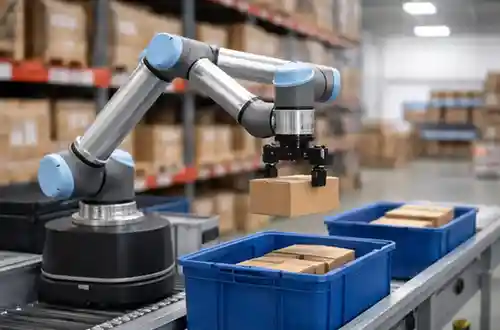
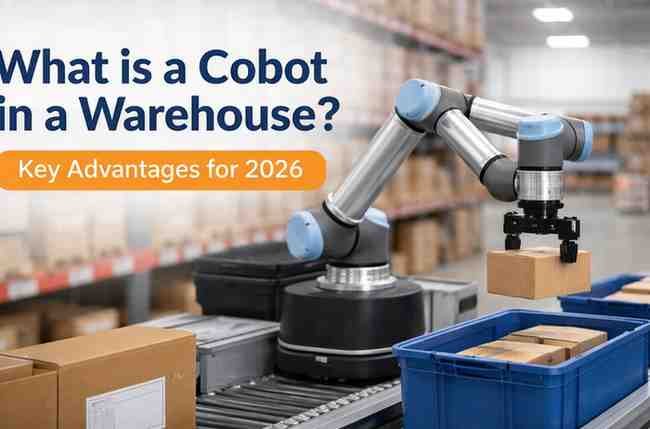
A Cobot, or Collaborative Robot, is a robotic system specifically engineered with integrated safety sensors, power-limiting technology, and rounded edges that allow it to operate in close proximity to human employees without the need for safety fencing. Unlike traditional industrial robots that are “blind” to their surroundings, a Cobot is constantly aware of its environment.
If a human worker accidentally bumps into a Cobot or enters its immediate path, the machine’s internal sensors detect the resistance and trigger an instantaneous stop. This inherent safety makes them the ideal “helping hand” for tasks that require human oversight but involve repetitive or physically taxing movements.
The Strategic Necessity of Cobots in Today’s Warehousing
Modern warehouses are no longer just storage spaces; they are high-speed fulfillment centers that must adapt to changing SKUs and seasonal spikes almost daily. Traditional automation is often too rigid for this environment. This is where Cobots provide a strategic advantage. They act as a bridge between manual labor and full-scale automation. By taking over “Dull, Dirty, and Dangerous” tasks—such as palletizing heavy boxes or sorting thousands of small parts—they prevent workplace injuries and chronic fatigue among staff.
Furthermore, Cobots address the critical labor shortages currently facing the UK logistics sector. Instead of trying to hire more people for mundane tasks, firms are deploying Cobots to handle the routine work, allowing their human employees to focus on more complex, high-value operations like quality control and inventory management. This not only increases productivity but also improves employee morale, as workers are freed from the most exhausting parts of their shift.
Leading Cobot Technologies: A 2026 Industry Overview
While the market is growing rapidly, five specific robotic systems have established themselves as the gold standard for warehouse integration.
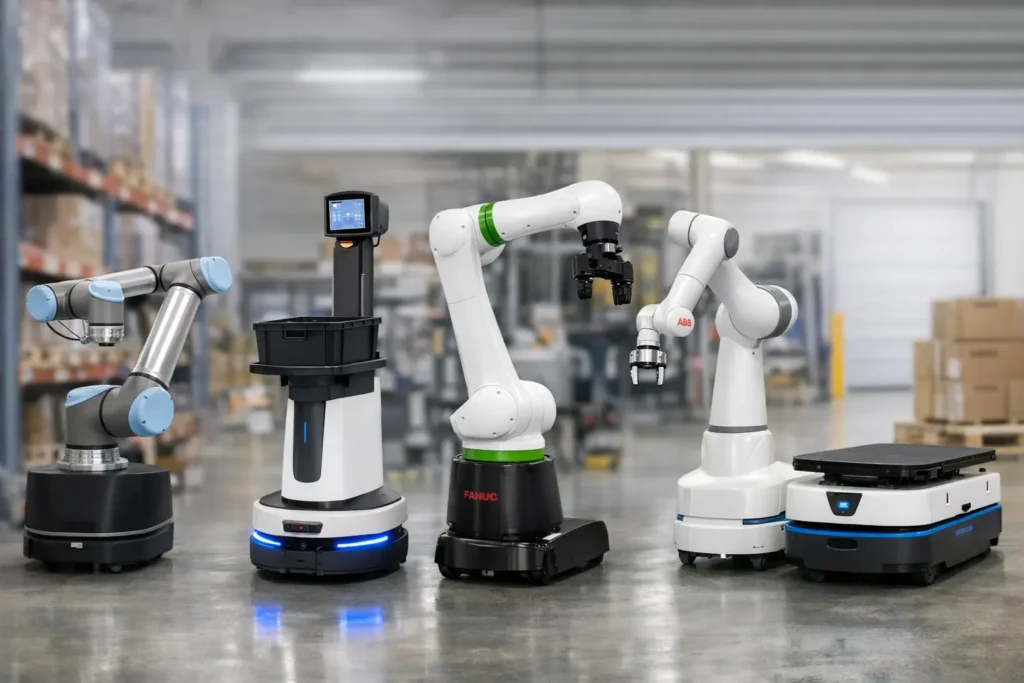
The Universal Robots UR10e remains a top choice due to its incredibly intuitive “hand-guiding” programming, which allows even non-technical staff to teach the robot a new path in minutes.
For facilities focused on high-volume e-commerce, Locus Robotics (LocusBot) has redefined the “Goods-to-Person” model. These mobile cobots navigate independently to picking locations, meeting human workers at the bin to eliminate the 60% to 70% of time usually wasted on walking through aisles.
In the heavy-duty segment, the Fanuc CRX Series offers industrial-grade reliability with a focus on “Zero Maintenance” for up to eight years, making it a favorite for long-term ROI.
For those needing higher reach and speed, the ABB GoFa provides a slim, lightweight design that can be easily repositioned across the warehouse floor as needs change.
Lastly, Fetch Robotics (Freight) excels in autonomous transport, acting as a smart cart that follows workers or moves independently to the shipping dock, ensuring that humans never have to push heavy trolleys manually.
Advantages of cobots over traditional robots
The decision to implement Cobots over traditional robots often comes down to “Agility” versus “Brute Force.”
Traditional robots are designed for high-speed, high-volume production lines where the environment never changes. They are bolted to the floor and require a massive footprint due to safety enclosures.
In contrast, Cobots offer a minimal footprint. Because they don’t need cages, they can be integrated into existing manual lines without redesigning the entire warehouse layout. This makes them significantly more cost-effective for retrofitting older facilities.
Another major advantage is Ease of Deployment. A traditional robot requires a specialized programmer and weeks of setup.
A Cobot can often be unboxed, programmed, and operational within 24 to 48 hours. This flexibility extends to daily operations; a single Cobot can be moved from a “Packaging” station in the morning to a “Sorting” station in the afternoon simply by changing its end-effector (gripper) and selecting a new program on a tablet. This versatility is something a traditional industrial robot simply cannot offer.
Critical Implementation Strategy and Risk Management
Despite their collaborative nature, successful Cobot integration requires a disciplined approach. The first step is always a thorough Industrial Risk Assessment.
While the robot itself is safe, the “end-effector” (the tool at the end of the arm) or the object being carried might not be. For example, a Cobot carrying a sharp object still requires careful path planning. Organizations must also prioritize human-robot interaction training.
Workers need to understand how to reset the robot, how to change its tasks, and most importantly, how to optimize their own workflow to work alongside the machine rather than competing with it.
It is also vital to start with “Small Wins.” Instead of attempting to automate a complex, multi-stage process, firms should identify a single, high-frequency bottleneck—such as box erecting or case sealing. Automating these simple tasks first allows the team to understand the technology and see an immediate ROI before scaling up to more complex autonomous mobile robot (AMR) integrations.
You Can Also Read: What is a Warehouse Control System (WCS)?
FAQs
What is the “Payback Period” for a typical Cobot investment?
In most mid-to-large warehouse environments, a Cobot pays for itself within 12 to 18 months. This ROI is driven by reduced labor costs, a significant decrease in workplace injury claims, and improved picking accuracy that reduces the cost of returned goods.
Can Cobots be integrated with existing Warehouse Management Systems (WMS)?
Yes, modern Cobots are built with open APIs. This allows them to “talk” to your WMS in real-time, receiving picking instructions and sending back confirmation once a task is completed, ensuring your digital inventory records are always accurate.
How do Cobots handle “Fragile” items?
Many Cobots come equipped with “Force-Torque” sensors and can be fitted with soft-touch or vacuum-based grippers. This allows them to handle delicate electronics or glassware with a level of gentleness that often exceeds human capability.