
Modern organizations spend millions of dollars strengthening their cybersecurity defenses. They deploy firewalls, monitor networks, train employees, and invest in advanced detection systems. Yet despite these efforts, many businesses remain vulnerable through a less obvious entry point: their vendors.
Third-party relationships have become essential to how organizations operate. Few companies build every tool they use, manage every process internally, or maintain complete control over their technology ecosystem. Instead, they rely on software providers, cloud services, logistics partners, consultants, and countless other external vendors. This interconnected environment increases efficiency, but it also creates security risks that many organizations still underestimate.
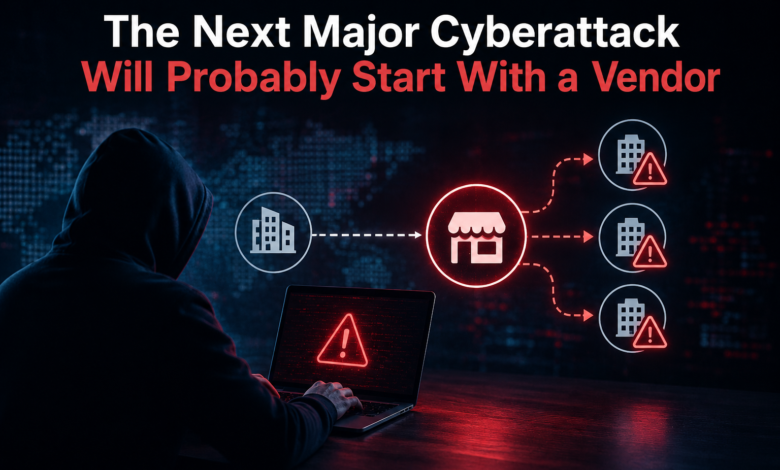
The reality is that a company’s security posture is increasingly influenced by the security practices of the businesses it trusts. As supply chains become more complex and digital integrations become more common, vendor-related cyber risks continue to grow. The next major cyberattack may not begin with a direct breach of its intended target. It may start several steps away, inside a trusted partner that attackers know will provide an easier path.
Why Vendors Have Become Prime Targets
Cybercriminals understand that attacking a well-protected enterprise directly can be difficult. Vendors often provide a more attractive alternative. Many third-party providers have network access, data access, administrative privileges, or software integrations that make them valuable targets.
From an attacker’s perspective, compromising a vendor can create access to hundreds or even thousands of downstream customers. A single successful intrusion can yield far greater rewards than targeting organizations individually.
This strategy has become increasingly effective because businesses rely on specialized software platforms for critical operations. A transportation company, for example, may depend on private fleet compliance software to manage regulatory requirements and streamline operations. That software may be deeply integrated into daily workflows, creating efficiencies but also introducing a potential dependency. If the vendor experiences a security incident, the consequences may extend well beyond a single organization.
Attackers understand these dependencies and increasingly search for weak points throughout the supply chain rather than focusing exclusively on end targets.
Trust Creates Vulnerability
One of the biggest challenges in vendor security is that trust often bypasses traditional security assumptions. When organizations establish relationships with vendors, they frequently grant permissions that would be considered unusual for unknown parties.
Vendors may have access to sensitive databases, employee information, financial records, or operational systems. In some cases, automated integrations allow data to move seamlessly between organizations with minimal human oversight. These connections improve productivity but can also create pathways for attackers.
The problem becomes even more significant when businesses assume that vendor security is someone else’s responsibility. A contract may define services and expectations, but it does not automatically guarantee strong security practices. Organizations that fail to evaluate third-party risks can inadvertently inherit vulnerabilities they never anticipated.
Effective cybersecurity requires understanding not only what systems an organization owns but also which external entities have access to those systems. Many businesses are surprised to discover just how extensive those connections have become over time.
Supply Chain Attacks Are Difficult to Detect
Vendor-related attacks are particularly dangerous because they often appear legitimate. Traditional security measures are designed to identify unusual activity, but interactions originating from trusted vendors may not immediately trigger alerts.
If attackers gain access to a vendor account or compromise a software update mechanism, their activity can blend into normal business operations. Security teams may initially view the traffic, credentials, or system changes as expected behavior.
This challenge has accelerated interest in continuous monitoring and advanced threat detection. Many organizations are investing in tools such as a cybersecurity platform that can help identify unusual patterns across connected systems and third-party access points. By monitoring behavior rather than relying solely on predefined rules, organizations are better positioned to detect supply chain threats before widespread damage occurs.
However, technology alone is not enough. Visibility into vendor relationships, access privileges, and integration points remains a critical requirement for effective defense.
Vendor Management Must Become a Security Function
Many organizations still treat vendor selection primarily as a procurement or operational process. Cost, functionality, and service quality understandably receive significant attention. Security assessments, however, are often less rigorous than they should be.
A more mature approach recognizes vendor management as part of cybersecurity strategy. Security teams should participate in evaluating vendors before contracts are signed and continue assessing risk throughout the relationship.
This includes reviewing security policies, evaluating incident response capabilities, understanding data handling practices, and determining what access vendors require. Periodic reassessments are equally important because risk levels change over time.
Organizations should also follow the principle of least privilege whenever possible. Vendors should receive only the access necessary to perform their responsibilities. Limiting permissions reduces potential damage if an account is compromised.
Strong vendor governance helps reduce exposure while creating clearer expectations for all parties involved.
Preparing for the Inevitable
No organization can eliminate third-party risk entirely. Modern business depends on collaboration, specialization, and interconnected technology. The goal is not to avoid vendors but to manage those relationships intelligently.
Preparation begins with accepting that vendor-related incidents are a realistic possibility. Companies should have response plans that account for third-party breaches, including communication procedures, containment strategies, and recovery workflows.
Regular audits, vendor inventories, access reviews, and tabletop exercises can reveal weaknesses before attackers discover them. Businesses should also prioritize resilience, ensuring that a security incident involving a vendor does not immediately cripple critical operations.
Organizations that prepare in advance are far more likely to respond effectively when problems arise. The difference between a manageable incident and a major crisis often comes down to planning rather than technology alone.
Conclusion
As businesses become increasingly connected, vendor relationships will continue to play a larger role in cybersecurity risk. Attackers recognize that third parties often provide a more efficient pathway into valuable networks, sensitive data, and critical systems. Rather than attacking every target individually, they can exploit trust relationships that already exist.
Organizations that focus exclusively on protecting their own perimeter may overlook one of the most significant threats they face. A comprehensive cybersecurity strategy must include vendor oversight, continuous monitoring, access management, and incident preparedness. The companies that understand this reality today will be better positioned to defend themselves against the cyber threats of tomorrow.