Robotic Case Packer and Robotic Palletizer Solutions are Revolutionizing today’s Industrial Automation

The manufacturing and distribution sectors in America are rapidly changing as they become more automated, more efficient in their use of labor, and demand for faster delivery times increases. There is a growing demand for companies to optimize throughput, to maintain consistency, safety and cost-effectiveness. In today’s era of high volume production lines, especially for food and beverage, consumer goods, e-commerce logistics and other industries, manual packaging and palletizing techniques are no longer adequate.
As a result, many advanced robotics systems have been introduced to manage repetitive tasks that are physically demanding in an accurate and efficient manner. Some of the most significant innovations are automated packaging and palletizing systems that help to reduce end-of-line processes. The systems decrease labor dependency, mistake and boost uptime for production. There is a growing need for automation with the increasing complexity of supply chains as it is now a strategic must for competitive manufacturing performance.
The Role of Robotic Automation in Modern Packaging Lines
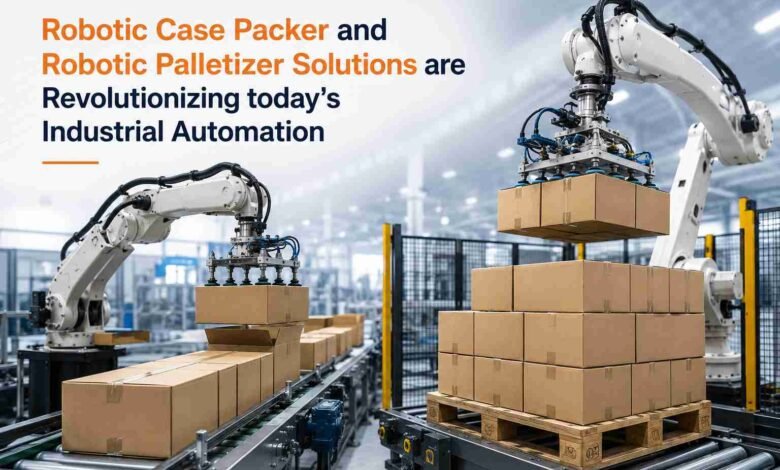
The incorporation of Robotic systems in packaging lines is one of the most important developments in industrial automation. An important example of this is the robotic case packer that is used to organize and pack the product into a case with greater efficiency and speed, while maintaining a high degree of accuracy. That removes the inconsistencies often found in manual packing operations, and provides consistent product handling in large-scale operations.
Automated systems optimize the first part of the production process, by matching the speed of the packaging systems with the rest of the production line. This has a positive impact on overall equipment effectiveness (OEE) and reduces downtime due to human fatigue and error. This uniformity is invaluable to industries where such compliance and hygiene are paramount, like in pharmaceuticals and food processing.
Moreover, more and more robotic systems are built in a flexible manner that enables the manufacturers to produce various sizes and packaging. In today’s rapidly evolving consumer landscape, with the necessity of offering a wide variety of product lines and limited product life cycle, the adaptability is crucial in terms of quick changeovers without losing efficiency.
Optimizing Warehouse Operations with Smart Palletizing Solutions
After packaging, the challenge that remains is to ensure efficient stacking and storage of the products. It’s here that automated palletizing systems come into play. Modern Robotic Palletizer can ensure that the finished products are stacked on the pallets with high accuracy and stability, and can help businesses use less space in warehouses and shipping centers.
In high-volume distribution systems, these systems are especially useful as they directly affect delivery times, and speed and accuracy are paramount. This automates the palletizing process, thereby greatly lowering the number of injuries from repetitive motion and heavy lifting that companies have to deal with in the workplace. Moreover, robotic palletizers can run without a lot of supervision, which will boost through-put and reduce labor costs.
The advanced palletizing systems can also be easy to connect with WMS, giving real-time tracking and optimizing storage patterns. The level of integration enables just in time logistics and enhances the supply chain responsiveness in particular during peak demand.
Key Benefits Driving Adoption of Robotic Systems
There are a number of measurable benefits behind the robotic automation of packaging and palletizing. For one, the efficiency of operation is greatly enhanced because of the speed and uniformity of machine operations as compared to human work. Secondly, there are fewer product damages due to errors and therefore higher customer satisfaction.
One of the other key benefits is that of scalability. Robotic systems can be modified and/or scaled as production demands change without having to make significant changes to the workforce. That’s why they are great options for businesses looking for operational stability over the long-term.
The safety is another main consideration. Companies can save time and reduce workplace injury by replacing tasks that are repetitive and physically straining with automated tasks, and ensure they meet occupational safety standard requirements more effectively. These enhancements, over the years, help increase the ROI and sustainable production systems.
Industry Trends and the Future of Smart Manufacturing
Artificial Intelligence, machine learning and sensor technology are integral to the future of industrial automation. New robot systems are becoming smarter and are able to adjust to the dynamic conditions of production and adapt their performance.
Manufacturers can expect to see fully-integrated smart factories in the coming years that feature robotic case packing and palletizing systems that communicate seamlessly with inventory, logistics and production planning systems. The whole system will enable predictive maintenance, minimize downtime, and optimize resource utilization.
Another trend in the making is sustainability. By optimising packages layouts and minimising operational inefficiencies, automated systems can also help to reduce material waste and energy consumption. In the future, with increasing environmental pressures, they will be increasingly important for international manufacturers.
Conclusion
Speed, accuracy and intelligence are changing the face of manufacturing with robotic automation technology and are changing the way that packaging and palletising are done. These systems are vital in today’s industrial processes, from ensuring uniform packaging to optimizing warehouse operations.
The industries are evolving and companies that invest in advanced automation technology will have the edge in fulfilling the ever-increasing demand and stay competitive. The added value of the long term is not just cost saving, but also for safety, scalability and resilience of operations. Smart robotic systems are the bedrock of an efficient and future-ready manufacturing eco-system in the ever more automated world of today.