AMR Warehouse Automation: Transforming Warehousing in 2026

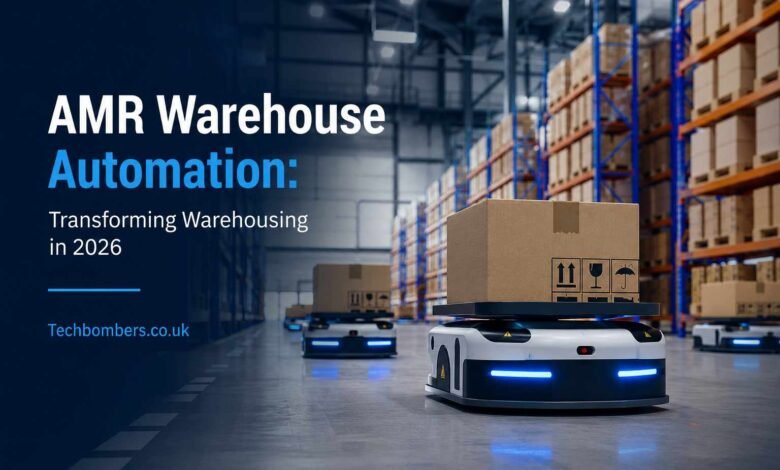
Warehouse operations are evolving rapidly, and Autonomous Mobile Robots (AMRs) are at the center of this change. These intelligent machines can move goods, assist with order fulfillment, and optimize inventory management without requiring constant human supervision.
Businesses that implement AMRs experience faster operations, reduced errors, and significant labor cost savings. AMR warehouse automation is no longer a futuristic concept; in 2026, it is a practical solution for any warehouse aiming to improve efficiency, accuracy, and scalability.
What is AMR Warehouse Automation?
AMR stands for Autonomous Mobile Robot. These robots are designed to operate independently within warehouse environments. Unlike traditional Automated Guided Vehicles (AGVs), AMRs do not rely on tracks, magnetic strips, or fixed paths. Instead, they use AI, sensors, and cameras to navigate dynamically.
AMR vs AGV
- AGV (Automated Guided Vehicle): Follows pre-defined paths; requires physical infrastructure.
- AMR: Flexible, self-navigating, and can reroute in real-time around obstacles.
How AMRs Integrate into Warehouses
AMRs interact with Warehouse Management Systems (WMS) and Enterprise Resource Planning (ERP) tools. This allows them to receive real-time instructions, update inventory automatically, and collaborate with human workers safely.
Key Benefits of AMR Warehouse Automation
Increased Efficiency
AMRs can move goods rapidly across the warehouse, reducing order processing time. Their ability to operate 24/7 without fatigue allows warehouses to maximize throughput and meet higher order volumes.
Sub-benefit: Reduced congestion – AMRs dynamically choose paths to avoid bottlenecks.
Improved Accuracy
Human errors in picking and transporting goods can lead to costly mistakes. AMRs follow precise instructions, reducing inventory discrepancies and shipment errors.
Sub-benefit: Accurate real-time inventory tracking improves reporting and reduces stockouts.
Labor Optimization
AMRs take over repetitive tasks like pallet movement, order picking, and inventory transport. This frees up human workers to handle higher-value tasks, such as quality control, inventory auditing, and exception management.
Sub-benefit: Employee satisfaction – staff focus on meaningful work rather than tedious manual labor.
Scalability
AMRs are highly scalable. Companies can start with a small fleet and expand as warehouse demand grows, without needing extensive modifications to infrastructure.
Case Example:
- Amazon Robotics: Uses fleets of AMRs to pick and transport items efficiently in fulfillment centers, reducing processing time for high-volume orders.
- DHL Supply Chain: Implements AMRs to handle repetitive tasks in e-commerce warehouses, improving both speed and safety.
How AMRs Work in Warehouses
Navigation Systems
AMRs use LiDAR, ultrasonic sensors, and cameras to map their surroundings in real-time. They detect obstacles, identify human workers, and adjust their routes dynamically.
Fleet Management
Warehouse software coordinates multiple robots simultaneously. Tasks are assigned automatically, and robots communicate with each other to avoid congestion.
Sub-benefit: Optimized routing reduces wear and tear, lowers energy consumption, and ensures timely deliveries.
Safety Features
- Collision avoidance with humans and other robots.
- Emergency stop mechanisms in case of unexpected hazards.
- Safe zones for collaborative human-robot interaction.
Integration with Warehouse Management Systems
AMRs sync with WMS and ERP systems to:
- Track inventory in real-time.
- Automate restocking and replenishment.
- Update order status instantly.
AMR vs Traditional Warehouse Automation
Traditional Methods
Manual processes, AGVs, and conveyor systems have long been used in warehouses. While effective, these methods lack flexibility and require significant infrastructure.
Advantages of AMRs
- Adaptability: Re-route in real-time.
- Quick Deployment: No need for tracks or fixed paths.
- Human Collaboration: Work safely alongside staff.
- Lower Maintenance: Self-diagnostics and predictive maintenance reduce downtime.
Comparison Table:
| Feature | AGV | AMR |
| Navigation | Fixed paths | Dynamic, AI-driven |
| Human Collaboration | Limited | Safe & flexible |
| Scalability | Moderate | High |
| Maintenance | High | Predictive, lower |
| Initial Infrastructure Cost | High | Moderate |
Applications of AMRs in Warehousing
Order Fulfillment
AMRs transport products from storage to picking stations, streamlining the entire fulfillment process.
Inventory Management
AMRs conduct stock counts and monitor inventory levels automatically, reducing discrepancies and manual audits.
Material Transport
From raw materials to finished goods, AMRs handle repetitive transport tasks efficiently and safely.
E-commerce Warehouses
Fast-moving e-commerce warehouses benefit the most from AMRs because they can adapt to fluctuating demand and seasonal peaks.
Real Example: Alibaba’s smart warehouses use AMRs to handle thousands of orders per day with minimal human intervention.
Challenges & Considerations
Cost of Implementation
AMRs require a significant upfront investment. However, long-term ROI comes from labor savings, error reduction, and faster processing.
Space and Layout
Warehouse design may need adjustments to allow robots to navigate efficiently. Wide aisles, organized storage zones, and clear pathways are essential.
Maintenance & Expertise
Fleets require technical teams to maintain robots, monitor performance, and troubleshoot issues. Predictive maintenance helps reduce downtime.
Staff Training
Workers must understand how to collaborate safely with AMRs. Proper training ensures smooth integration and prevents accidents.
Technology Dependence
Reliance on AMRs requires robust IT infrastructure, software updates, and cybersecurity measures to prevent system failures.
Future Trends in AMR Warehouse Automation
AI and Machine Learning
Next-generation AMRs will use AI to optimize routes, predict demand, and learn warehouse patterns autonomously.
Fully Autonomous Warehouses
The future may bring warehouses that operate almost entirely without human intervention, where AMRs, drones, and smart shelves work in harmony.
IoT Integration
AMRs will communicate with IoT-enabled devices, smart shelves, and logistics platforms to enable seamless real-time tracking.
Collaborative Robots
AMRs will increasingly collaborate with humans safely in shared workspaces, enhancing productivity without compromising safety.
Expansion Across Industries
From retail and e-commerce to manufacturing and pharmaceuticals, AMR adoption is expected to grow rapidly in 2026 and beyond.
Best Practices for Implementing AMR Automation
Start Small
Deploy a few robots first to test workflows and optimize routes. Gradually expand the fleet as the team gains experience.
Integrate with Existing Systems
Ensure AMRs work seamlessly with WMS, ERP, and other warehouse software to maintain data accuracy.
Train Employees
Educate warehouse staff on robot navigation, safety protocols, and collaboration to prevent disruptions.
Monitor Performance
Use analytics and reporting to track productivity, downtime, and ROI. Continuously improve workflows.
Plan for Maintenance
Schedule predictive maintenance to reduce unexpected breakdowns and maximize uptime.
Conclusion
AMR warehouse automation is transforming warehouse operations in 2026. By combining intelligence, flexibility, and safety, AMRs increase efficiency, reduce errors, and allow businesses to scale rapidly.
Companies adopting AMRs gain a competitive edge, improve employee satisfaction, and future-proof their operations. As technology advances, AMRs will become an essential component of modern warehousing, making warehouses smarter, faster, and more reliable.
FAQs
What is AMR in warehouse automation?
AMRs are autonomous robots that navigate warehouses independently, moving goods and assisting in logistics tasks without fixed paths.
How do AMRs improve warehouse efficiency?
They reduce transit time, minimize human errors, and free up employees for higher-value tasks.
Is AMR warehouse automation expensive?
The initial cost is high, but labor savings, improved accuracy, and faster fulfillment deliver strong ROI.
Can AMRs work safely alongside humans?
Yes. AMRs have sensors, cameras, and safety protocols to avoid collisions and operate in shared spaces.
Which industries benefit most from AMRs?
E-commerce, retail, manufacturing, and pharmaceuticals gain the most from scalable, autonomous robot fleets.