

Modern aircraft are shaped through powerful software, digital simulations, and automated design systems that can test performance before a single part is built. But aviation did not begin with screens, algorithms, or 3D modeling.
Before computers entered engineering, aircraft design depended entirely on human skill, precision, and patience. At the center of this process was a place known as the Boeing drafting room.
Inside this room, engineers and draftsmen translated ideas into detailed technical drawings that eventually became real aircraft. Every line on paper represented a physical component, a structural decision, or a safety calculation. Nothing was automated, and nothing was left to chance.
To understand how Boeing became one of the world’s leading aerospace companies, it helps to step inside this early design environment and see how aircraft were once built on paper before they ever touched the sky.
What Was the Boeing Drafting Room?
The Boeing drafting room was a dedicated engineering workspace used in the early decades of Boeing where aircraft designs were created manually.
It was not a single room in a modern sense, but rather a structured environment inside Boeing’s early engineering facilities where design teams worked on detailed blueprints. These blueprints served as the foundation for aircraft manufacturing.
The drafting room functioned as the core design center of the company. Every aircraft began its life here, first as an idea, then as a mathematical concept, and finally as a precise technical drawing.
Unlike today’s digital environments, everything was done by hand. There were no computers, no simulation tools, and no automated corrections. Every measurement had to be calculated manually and drawn with precision tools.
The Environment Inside the Drafting Room
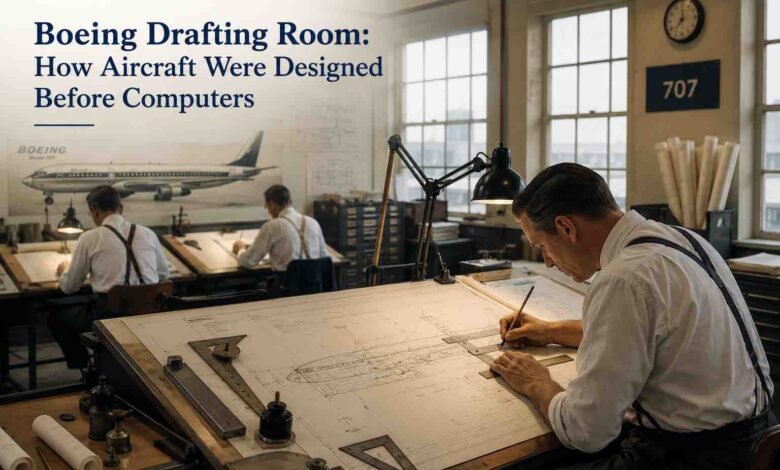
The Boeing drafting room had a very distinct working environment. It was organized, quiet, and highly disciplined.
Large wooden drafting tables filled the room. Each engineer or draftsman had a dedicated workspace with enough room to spread out large sheets of paper. These sheets often represented full aircraft sections drawn at scale.
The lighting had to be consistent because accuracy depended on visibility. Natural light or carefully placed lamps were essential for avoiding errors in line work.
Tools commonly used included:
- T-squares for straight lines
- Compasses for curves and circular geometry
- Mechanical pencils and ink pens
- Slide rules for calculations
- Scale rulers for converting measurements
Every tool had a specific purpose. Even a minor mistake in alignment or scaling could affect the final aircraft structure.
The room itself reflected discipline. Conversations were minimal, and focus was absolute. Engineers were responsible not just for drawing but for ensuring structural integrity through calculations done by hand.
How Aircraft Were Designed Step by Step
Aircraft design in the Boeing drafting room followed a structured process.
First, engineers defined the aircraft concept. This included size, purpose, and performance expectations. Once the concept was approved, calculations began.
Engineers then determined key structural requirements such as wing dimensions, fuselage shape, and load distribution. These calculations were done manually using mathematical methods and engineering principles.
After calculations, draftsmen translated these numbers into detailed technical drawings. These drawings included exact measurements for every component of the aircraft.
Once completed, drawings were reviewed by senior engineers. Any mistake required manual correction and redrawing of sections.
Finally, the approved blueprints were sent to manufacturing teams. These documents became the only reference for building the aircraft.
The entire process required patience, coordination, and extremely high accuracy.
The People Behind the Drafting Room
The drafting room was not just about tools and paper. It was defined by the people who worked inside it.
Three main roles existed in this environment:
Engineers
Engineers were responsible for calculations, structural planning, and design decisions. They ensured that aircraft could physically perform as intended.
Draftsmen
Draftsmen converted engineering data into precise technical drawings. Their work required artistic skill combined with technical understanding.
Supervisors
Senior engineers or supervisors reviewed all drawings for accuracy. They ensured that no structural or measurement errors entered production.
Each role depended on the other. Without coordination, aircraft design could not move forward.
The drafting room also demanded discipline. Mistakes were costly because correcting drawings meant restarting manual work from the beginning.
The Tools That Built Aircraft on Paper
The tools used in the drafting room were simple but powerful in the hands of skilled professionals.
Slide rules were essential for performing multiplication, division, and complex engineering calculations. These tools required practice to use accurately.
T-squares and drafting boards helped maintain perfect straight lines and consistent alignment across large drawings.
Compasses allowed precise circular geometry, essential for aircraft curves, engine components, and aerodynamic shapes.
Ink pens were used for final drawings because they produced clean, permanent lines that could be reproduced for manufacturing.
Scale rulers ensured that small paper drawings accurately represented real-world aircraft dimensions.
Together, these tools formed the backbone of early aerospace engineering.
Why Precision Was Critical
In aircraft design, precision is not optional. Even a small error can affect performance, safety, or structural integrity.
In the drafting room, every measurement was checked multiple times. Engineers understood that once a blueprint left the room, it would be used directly in manufacturing.
There was no software to detect mistakes automatically. Human attention was the only safety system.
Because of this, drafting rooms developed a culture of accuracy. Work was slow but extremely careful. Every line mattered.
The Role of the Drafting Room in Boeing’s Early Growth
The drafting room played a major role in shaping Boeing’s early success.
In the early years, the company developed aircraft for both military and commercial use. Each design started in the drafting room before moving into production.
This environment allowed Boeing to standardize engineering practices. Instead of relying on informal sketches, the company built a structured system for aircraft development.
The drafting room also supported innovation. Engineers could test ideas on paper before committing to physical prototypes, reducing risk and improving efficiency.
Over time, this process helped Boeing establish itself as a serious aerospace manufacturer.
Transition to Digital Design Systems
The introduction of computers transformed aircraft design completely.
Manual drafting rooms gradually evolved into digital engineering departments. Software replaced drawing tables, and CAD systems replaced hand-drawn blueprints.
Modern aerospace companies now use 3D modeling, simulation tools, and automated stress testing. Designs can be analyzed in minutes rather than weeks.
Despite this transformation, the principles remain the same. Engineers still rely on geometry, physics, and structural logic—the same fundamentals used in drafting rooms.
The difference is speed and accuracy, not core engineering thinking.
Why the Boeing Drafting Room Still Matters Today
Although drafting rooms no longer exist in their original form, their importance remains significant.
They represent the foundation of aerospace engineering. Every modern aircraft design system is built on principles developed in those early rooms.
They also reflect human skill in engineering. Before automation, everything depended on discipline, calculation, and manual precision.
For students and engineers, the drafting room is a reminder that tools change, but thinking does not. Good engineering always begins with understanding fundamentals.
Quick Bio Table
| Topic | Details |
| Name | Boeing Drafting Room |
| Company | Boeing |
| Purpose | Manual aircraft design and blueprint creation |
| Era | Early aviation period (pre-digital engineering) |
| Tools Used | Drafting boards, compasses, slide rules, ink pens |
| Output | Technical blueprints for aircraft manufacturing |
| Significance | Foundation of modern aerospace design systems |
Conclusion
The Boeing drafting room represents a time when aircraft design depended entirely on human intelligence and precision. Every airplane began as a hand-drawn idea shaped by engineers working with simple tools but complex knowledge.
While modern aerospace engineering has moved into digital systems, the foundation remains unchanged. The discipline, accuracy, and structured thinking developed in drafting rooms still guide how aircraft are designed today.
The legacy of the drafting room is not in the tools it used, but in the engineering mindset it built.
Stay connected with our educational page for more such tech education information