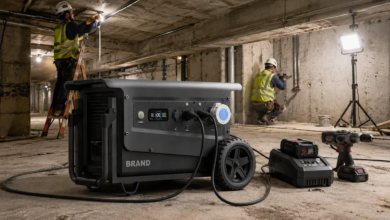


Construction has always been a field defined by hard work, precision, and coordination. Every project involves countless moving parts—from machinery and materials to workers and timelines. Yet, despite decades of technological advances, construction sites have historically faced challenges like delays, safety risks, and inefficiencies. Enter 5G technology, which is not just about faster internet; it’s about fundamentally transforming how construction sites operate. By 2026, 5G is no longer a futuristic concept—it’s becoming a practical tool that enhances safety, efficiency, and decision-making on modern construction sites.
Understanding 5G and Its Relevance to Construction
5G stands for the fifth generation of mobile networks. Unlike its predecessors, it provides ultra-fast speeds, minimal latency, and the ability to connect thousands of devices simultaneously. On a construction site, this means that every machine, sensor, wearable, and camera can be connected in real time.
The real value of 5G lies not just in speed but in the ability to handle massive data flows instantaneously. In construction, projects generate enormous amounts of data: structural monitoring, drone footage, machinery status, and worker safety information. Previously, this data was delayed or fragmented. With 5G, managers can see everything as it happens, enabling faster decisions and more efficient workflows.
Remote Machinery and Robotics
One of the most striking changes 5G brings to construction is remote operation of heavy machinery. Excavators, cranes, and concrete mixers can now be controlled remotely with high precision.
This has several implications:
- Safety: Operators can control machinery from a distance, reducing the risk of accidents in dangerous zones.
- Efficiency: Remote operation allows work to continue even in conditions where on-site presence is difficult, such as extreme weather or high-risk environments.
- Precision: With real-time feedback, robots can perform tasks with millimeter accuracy, reducing errors and material wastage.
Some construction companies have begun testing autonomous bulldozers and robotic bricklaying machines, and the results are promising. Projects that once took weeks can now be completed faster, with fewer human errors.
You Might Also Check: Are AGVs the Future of Construction? Here’s Why
Real-Time Site Monitoring
Monitoring a construction site used to mean walking the site, taking notes, and periodically checking on progress. 5G has changed that.
Drones equipped with high-definition cameras can fly over large sites, streaming live video to project managers. Meanwhile, sensors embedded in materials and structures track stress, vibrations, temperature, and other critical factors.
Managers can now:
- Detect potential structural issues before they become serious problems.
- Track project progress in real time.
- Monitor equipment performance and worker safety simultaneously.
For example, in large-scale infrastructure projects like bridges or skyscrapers, managers can monitor the curing of concrete, stress on support beams, and placement accuracy remotely. This reduces delays and ensures quality control without constant manual inspections.
AR and VR Applications in Construction
Augmented Reality (AR) and Virtual Reality (VR) are no longer just buzzwords—they are practical tools on 5G-enabled construction sites.
- Design visualization: Engineers and workers can see digital models overlaid on real-world sites through AR glasses. This makes it easier to identify clashes, alignments, or design errors before construction begins.
- Training: VR can simulate complex construction scenarios for workers without exposing them to real-world hazards.
- Collaboration: Remote teams can walk through a virtual model of the construction site, discuss changes, and make decisions in real time.
Thanks to 5G’s high speed and low latency, these AR/VR systems work seamlessly without lag, even when multiple users interact with large data models simultaneously.
IoT and Smart Construction Sites
5G is the backbone for smart construction, powered by the Internet of Things (IoT). Connected sensors and devices can monitor almost every aspect of a construction site:
- Equipment tracking: Machinery location, usage, and maintenance needs.
- Material management: Quantity, quality, and storage conditions.
- Energy usage: Monitoring electricity, fuel, and water consumption for efficiency and sustainability.
- Worker monitoring: Health metrics, location tracking, and fatigue monitoring.
By collecting and analyzing this data in real time, construction managers can predict equipment failures, prevent delays, and optimize workflows. For example, predictive maintenance on machinery can prevent unexpected breakdowns, saving both time and money.
You Might Also Check: How IoT Can Be Used in a Warehouse
Enhanced Safety on Construction Sites
Construction is inherently risky, but 5G is helping reduce hazards:
- Wearables: Smart helmets and vests can track worker vitals, detect falls, and send instant alerts.
- Geofencing: Workers can be automatically notified if they enter high-risk areas.
- Emergency response: Automated systems can trigger alarms, stop machinery, and alert onsite personnel during incidents.
The ability to monitor safety conditions in real time means fewer accidents, faster responses, and a culture of proactive safety management.
Benefits of 5G on Construction Sites
Implementing 5G technology provides multiple advantages:
- Increased efficiency: Automation and real-time data help managers make informed decisions quickly.
- Cost reduction: Optimized workflows and predictive maintenance lower operational expenses.
- Improved safety: Wearables, remote machinery, and real-time alerts reduce accidents.
- Better collaboration: Teams across sites can share data and visuals instantly.
- Sustainability: Energy and resource usage can be tracked and optimized.
These benefits combine to produce construction sites that are faster, safer, and smarter.
Challenges of Implementing 5G
While 5G offers enormous advantages, there are practical challenges:
- Infrastructure costs: Setting up 5G towers and networks on large sites is expensive.
- Integration with existing machinery: Older equipment may not support 5G connectivity.
- Data security: Real-time data transmission requires strong cybersecurity measures.
- Workforce adaptation: Training employees to use new technologies can take time.
Despite these challenges, the long-term benefits often outweigh initial costs, especially for large-scale or high-risk projects.
Case Studies and Real-World Applications
Several construction companies and infrastructure projects are already reaping the benefits of 5G:
- Skanska and drones: Used 5G-connected drones to survey sites in real time, reducing inspection time by 40%.
- China’s Smart Cities: Some urban projects integrate 5G, IoT sensors, and digital twins to track construction progress remotely.
- Robotic bricklaying in Europe: Machines controlled over 5G networks are building walls with millimeter precision, reducing material waste.
These examples show that 5G is not just theoretical—it’s being applied in real-world projects to improve outcomes.
The Future of Construction with 5G
By 2026, 5G will continue to reshape construction:
- Fully autonomous sites: Robots performing complex tasks with minimal human oversight.
- Digital twin models: Real-time virtual replicas of construction sites for monitoring, simulation, and decision-making.
- Global standardization: Construction projects worldwide could adopt similar 5G-enabled protocols.
- Sustainable building: Precise energy and material tracking will reduce environmental impact.
The combination of 5G, AI, and robotics promises a construction environment that is safer, faster, and more efficient than ever before.
Conclusion
5G technology is more than just an upgrade to mobile networks; it’s a catalyst transforming construction sites in 2026. From remote machinery and drones to AR, VR, and smart sensors, every aspect of the construction process is becoming connected, data-driven, and more efficient. Companies that adopt 5G early gain a competitive edge, improve safety, and reduce costs.
The construction site of the future is connected, intelligent, and capable of real-time decision-making, and 5G is the backbone enabling this revolution. For engineers, project managers, and workers alike, embracing 5G means building smarter—not just faster.
For more insights, read our article on: What’s New in Construction Telematics Technology in 2026