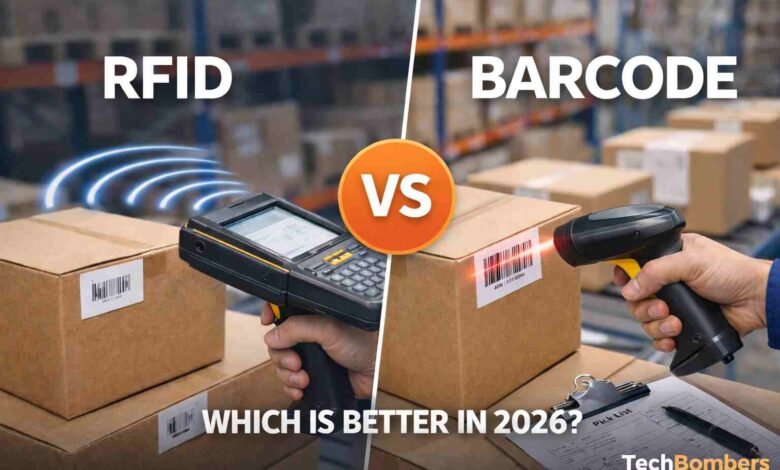
RFID vs Barcode in Warehouse: Which is Better in 2026?

Walk into any modern warehouse and you will see one thing happening constantly: items being tracked. Every product that enters, moves, or leaves must be identified quickly and accurately. If tracking fails, everything else breaks — inventory becomes unreliable, orders get delayed, and costs rise.
For years, barcodes have been the standard solution. They are simple, cheap, and widely used. But now, RFID (Radio Frequency Identification) is gaining attention as a faster and more automated alternative.
So the real question is not just what they are, but which one actually works better in today’s warehouses.
In this guide, we’ll compare RFID and barcode systems in a practical, real-world way — focusing on cost, speed, accuracy, and use cases — so you can decide what fits best in 2026.
What is Barcode Technology in Warehousing?
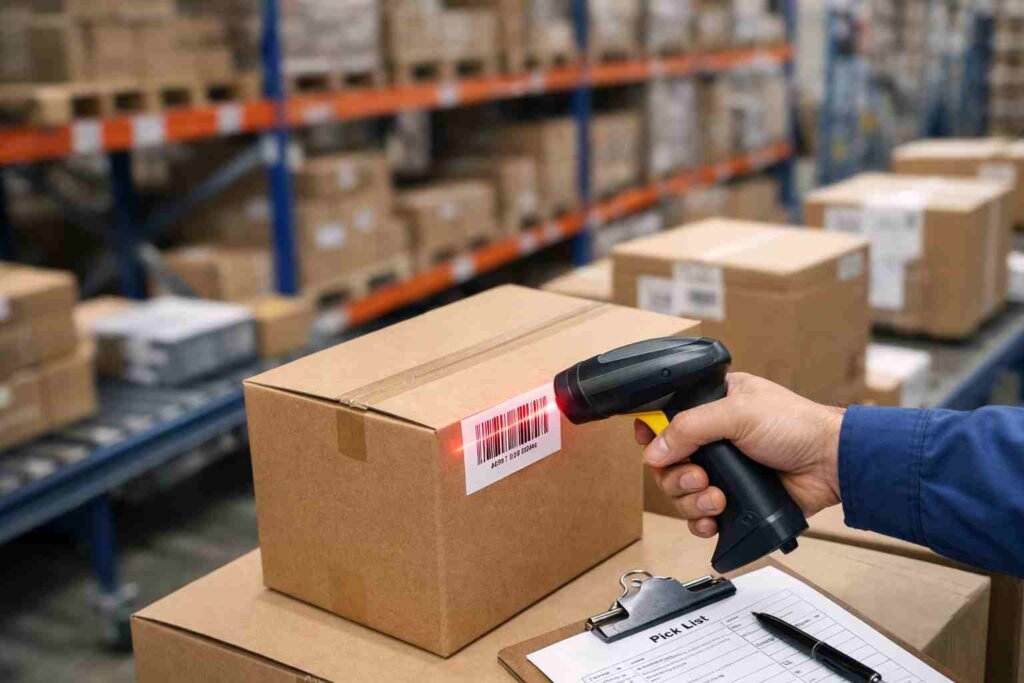
Barcode technology is one of the most common tracking systems used in warehouses today. It relies on printed labels that store information in a visual pattern of lines or squares.
A scanner reads this pattern and converts it into data that the warehouse system understands.
How it works
- A barcode label is attached to a product or package
- A worker scans it using a handheld or fixed scanner
- The system retrieves product details instantly
Types of barcodes
- 1D barcodes: Traditional lines (used for basic identification)
- 2D barcodes (QR codes): Can store more data, including URLs or batch info
Where barcodes are used
- Inventory tracking
- Order picking
- Packing and shipping
- Receiving goods
Strengths of barcode systems
- Very low cost to implement
- Easy to use and train staff
- Works well in small and medium warehouses
Limitations
- Requires line-of-sight (scanner must see the label)
- One item scanned at a time
- Depends heavily on manual work
Barcodes are reliable, but they slow down operations when volume increases.
What is RFID Technology in Warehousing?
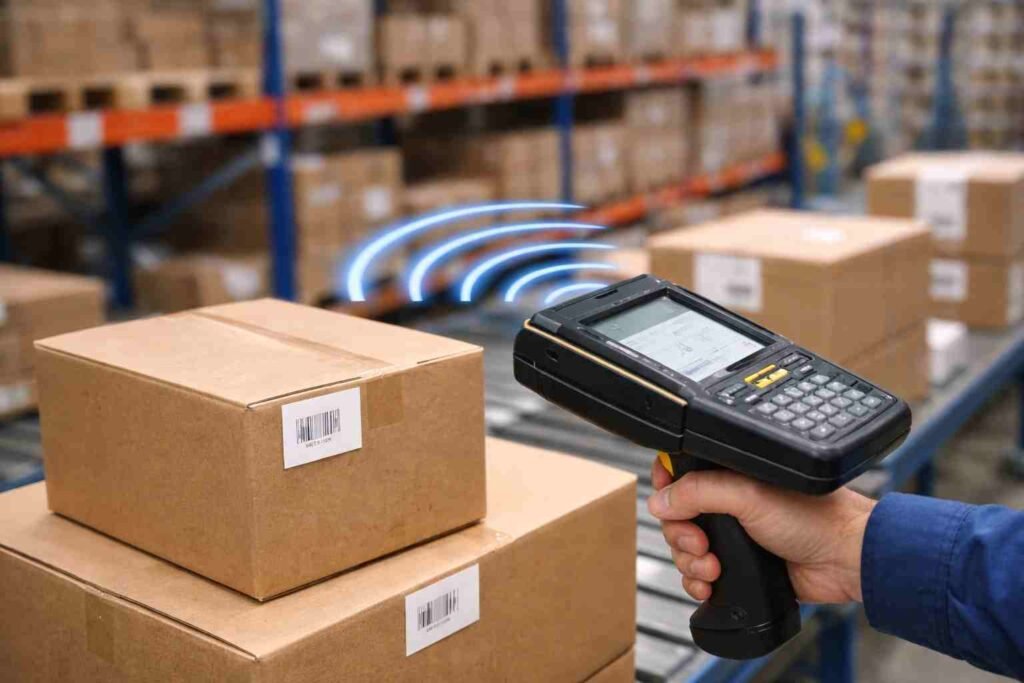
RFID (Radio Frequency Identification) is a wireless tracking technology that uses radio waves instead of visual scanning.
Instead of scanning each item manually, RFID allows systems to detect items automatically, even from a distance.
How it works
- Items are tagged with RFID chips
- RFID readers send out radio signals
- Tags respond with stored data
- The system records multiple items at once
Types of RFID
- Passive RFID: No battery, powered by reader signal (common in warehouses)
- Active RFID: Has a battery, longer range, higher cost
Where RFID is used
- Real-time inventory tracking
- Automated receiving and shipping
- Asset tracking in large facilities
Strengths of RFID
- No need for line-of-sight
- Can scan hundreds of items at once
- Enables automation and real-time updates
Limitations
- Higher setup cost
- Requires infrastructure (readers, antennas, software)
- More complex to deploy
RFID is designed for speed and scale, especially in high-volume environments.
You Might Also Check: How RFID Works in Warehouse Management: The Complete Guide
Key Differences Between RFID and Barcode
Both technologies serve the same purpose — tracking items — but they work very differently.
Cost
Barcodes are significantly cheaper. Labels cost very little, and scanners are affordable. RFID tags and readers are more expensive, especially for large deployments.
Speed
Barcode scanning is slower because it requires manual effort. RFID can scan multiple items instantly without stopping.
Line-of-sight
Barcodes must be visible to the scanner. RFID works without direct visibility, even through packaging.
Accuracy
RFID reduces human error since it automates scanning. Barcodes depend on correct manual handling.
Data capacity
Barcodes store limited data. RFID tags can store more detailed information and can be updated.
Automation level
Barcodes support basic operations. RFID enables advanced automation and real-time tracking.
Performance in Real Warehouse Scenarios
Understanding how each technology performs in daily operations is more important than comparing features.
Inventory management
With barcodes, inventory updates happen when someone scans items. This means data can lag behind real activity.
RFID updates inventory automatically as items move. This provides near real-time visibility.
Receiving and shipping
Barcode systems require scanning each item individually. This can slow down large shipments.
RFID can process entire pallets or shipments at once, saving time and labor.
Picking and packing
Barcodes are reliable for guided picking but require manual scanning at each step.
RFID speeds up picking but may not always be necessary for smaller operations.
Error reduction
Manual scanning increases the chance of mistakes. RFID reduces this risk by automating identification.
Cost Comparison in 2026
Cost is often the deciding factor, especially for small and mid-sized warehouses.
Barcode costs
- Labels: extremely low cost
- Scanners: affordable
- Setup: simple
RFID costs
- Tags: higher per unit
- Readers and antennas: expensive
- Software integration: additional cost
ROI perspective
Barcodes offer low upfront cost but higher labor dependency.
RFID requires a higher initial investment but can reduce long-term labor costs and improve efficiency.
For small warehouses, barcode systems are usually more practical. For large operations with high throughput, RFID can justify its cost.
Advantages and Disadvantages
Barcode advantages
- Low cost
- Easy to implement
- Minimal training required
Barcode disadvantages
- Slower process
- Manual work required
- Limited scalability
RFID advantages
- Fast and automated
- High accuracy
- Real-time tracking
RFID disadvantages
- Higher cost
- Complex setup
- Not always necessary for small operations
You Might Also Check: What is a Consolidation Warehouse?
When Should You Use a Barcode?
Barcode systems are a better choice when:
- You operate a small or medium-sized warehouse
- Your budget is limited
- Your operations are not highly automated
- You handle manageable order volumes
Barcodes provide a simple and reliable solution without heavy investment.
When Should You Use RFID?
RFID makes sense when:
- You run a large warehouse with high throughput
- Speed and efficiency are critical
- You need real-time inventory visibility
- You want to reduce manual labor
RFID is built for scale and automation.
Hybrid Approach: Using Both Together
Many warehouses are not choosing one over the other. Instead, they are combining both technologies.
How hybrid systems work
- Barcode used for low-cost or standard items
- RFID used for high-value or fast-moving goods
Benefits
- Lower overall cost
- Better flexibility
- Gradual transition to automation
This approach allows warehouses to improve efficiency without a full system overhaul.
Future Trends in Warehouse Tracking
Warehouse technology is evolving, and both barcode and RFID are changing with it.
- RFID is becoming more affordable
- Integration with AI is improving tracking accuracy
- IoT systems are connecting warehouse devices in real time
- Hybrid systems are becoming more common
Rather than replacing barcodes completely, RFID is expanding where automation is needed most.
You Might Also Check:
Final Verdict: Which is Better in 2026?
There is no single winner for every warehouse.
Barcode is still the better choice for:
- Small to mid-sized operations
- Budget-focused setups
- Simple workflows
RFID is the better option for:
- Large-scale warehouses
- High-speed logistics
- Automation-driven environments
In 2026, the best solution for many businesses is not choosing one over the other, but using both where they make the most sense.
For more insights, read our article on: How to Choose an Automation System for Warehouse Efficiency
FAQs
Is RFID replacing barcodes?
No. RFID is growing, but barcodes are still widely used because they are cost-effective and reliable.
Why is RFID more expensive?
RFID requires specialized tags, readers, and system integration, which increases initial costs.
Can RFID work without the internet?
Yes. RFID systems can work locally without the internet, though cloud integration adds more functionality.
Which is more accurate?
RFID is generally more accurate because it reduces manual handling.
Do large companies use RFID?
Yes. Many large logistics and retail companies use RFID, especially in high-volume operations.