
In most warehouses, delays are not caused by slow workers or poor systems. They happen because products are stored in the wrong place.
A worker may spend more time walking across the warehouse than actually picking items. Multiply that across hundreds of orders, and the inefficiency becomes expensive.
This is where warehouse slotting optimization comes in.
Slotting is the process of deciding where each product should be stored. When done correctly, it reduces travel time, improves picking speed, and increases overall efficiency.
Traditionally, slotting decisions were based on experience or simple rules. Today, artificial intelligence is changing that approach completely.
AI allows warehouses to analyze real data, adjust layouts dynamically, and continuously improve performance.
In this guide, you will learn what slotting optimization is, why traditional methods fail, and how AI can significantly improve picking efficiency.
What Is Warehouse Slotting Optimization?
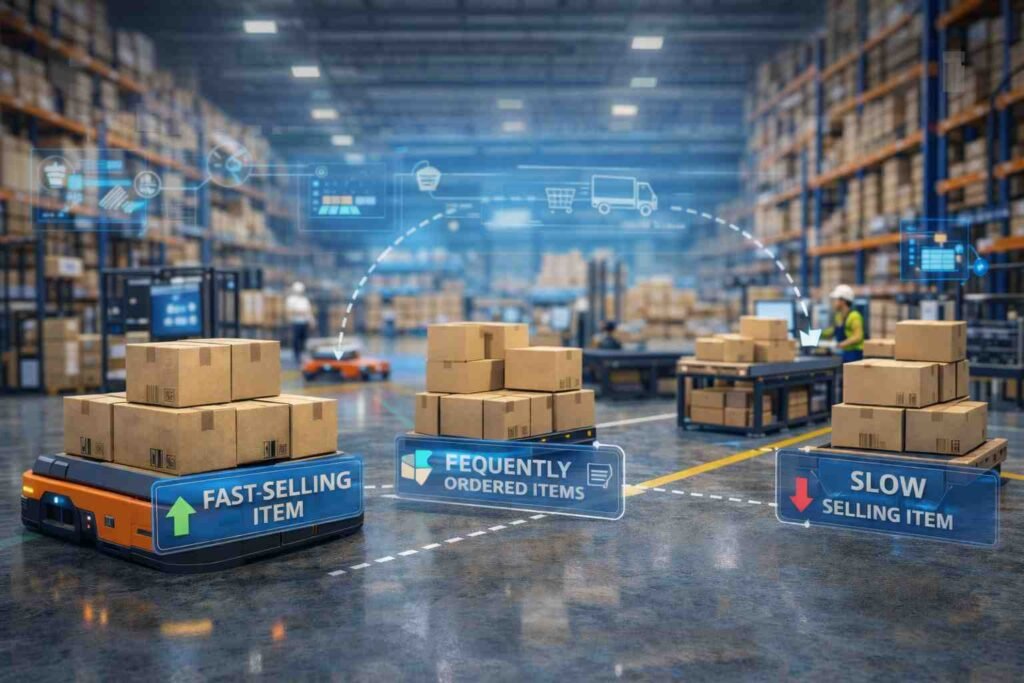
Warehouse slotting optimization is the process of organizing inventory in a way that makes picking faster and more efficient.
Instead of placing products randomly or based on convenience, items are positioned strategically based on demand, size, and order patterns.
For example:
- Fast-moving products are placed closer to packing stations
- Items frequently ordered together are stored nearby
- Heavy or bulky items are placed in accessible locations
The goal is simple: reduce the time and effort required to fulfill orders.
Even small improvements in slotting can lead to noticeable gains in productivity.
Why Traditional Slotting Fails
Many warehouses still rely on basic or outdated slotting methods. These approaches often create hidden inefficiencies.
Static Layouts
Traditional layouts are rarely updated. Once products are placed, they stay there for long periods, even when demand changes.
A product that was popular last month may not be in demand today, but it still occupies prime space.
Human Guesswork
Slotting decisions are often based on experience rather than data. While experience is valuable, it cannot match the accuracy of data-driven insights.
Ignoring Demand Patterns
Seasonal trends, promotions, and changing customer behavior are not always considered. This leads to poor placement of high-demand items.
Inefficient Picking Routes
When products are not positioned correctly, workers have to travel longer distances. This increases picking time and fatigue.
A common scenario:
A frequently ordered item is stored at the far end of the warehouse. Workers repeatedly walk long distances to retrieve it, slowing down the entire operation.
You Might Also Check: Digital vs Traditional Warehouse: What’s the Real Difference?
How AI Changes Slotting Optimization
Artificial intelligence transforms slotting from a static process into a dynamic system.
Instead of relying on fixed rules, AI uses real-time data to make better decisions.
Data-Driven Insights
AI analyzes large volumes of data, including:
- Order history
- Product demand
- Picking frequency
- Inventory movement
This allows it to identify patterns that are not obvious to humans.
Dynamic Slotting
AI systems can recommend changes to product placement as demand shifts.
For example:
If a product suddenly becomes popular, AI can suggest moving it closer to the picking area.
Continuous Improvement
Unlike traditional systems, AI keeps learning. It adapts to new data and improves its recommendations over time.
Smarter Decision Making
AI does not just optimize individual items. It considers the entire warehouse layout, ensuring that all decisions work together.
How AI Slotting Works Step by Step
Understanding the process helps you see where the real value comes from.
Data Collection
The system gathers data from:
- Warehouse Management Systems (WMS)
- Order records
- Inventory databases
- Sensors and scanners
Demand Analysis
AI identifies:
- Fast-moving products
- Slow-moving items
- Seasonal trends
This helps prioritize which items need better placement.
Product Grouping
Items that are frequently ordered together are grouped.
For example:
If customers often buy two products together, storing them nearby reduces picking time.
Layout Optimization
AI calculates the best storage locations based on:
- Demand
- Distance to packing stations
- Available space
Continuous Updates
As new data comes in, the system adjusts recommendations.
This ensures that the warehouse layout always reflects current demand.
Key Factors in Slotting Optimization
Effective slotting is not just about moving products closer to the packing area. Several factors must be considered.
Product Velocity
Fast-moving items should be placed in easily accessible locations.
Slow-moving items can be stored further away without affecting efficiency.
Order Frequency
Products that appear in many orders should be prioritized for better placement.
Product Size and Weight
Heavy or bulky items need special handling.
They should be stored in locations that reduce lifting effort and improve safety.
Picking Paths
The layout should minimize travel distance.
Efficient picking paths reduce time and worker fatigue.
Product Relationships
Items often ordered together should be stored close to each other.
This reduces the number of trips required to complete an order.
You Might Also Check: How to Prevent Picking Errors in Your Warehouse: Small Guide
Benefits of AI-Based Slotting Optimization
When implemented correctly, AI-driven slotting delivers measurable improvements.
Faster Picking Times
Workers spend less time walking and more time picking. This directly increases productivity.
Reduced Travel Distance
Optimized layouts shorten the distance between items and packing stations.
Improved Accuracy
Better organization reduces the chances of picking errors.
Better Use of Space
AI helps utilize available space more effectively, avoiding overcrowding or wasted areas.
Lower Operational Costs
Efficiency improvements lead to cost savings over time.
Real-World Use Cases
AI slotting is already being used across different types of warehouses.
E-commerce Warehouses
High order volumes require fast picking. AI helps position popular items for quick access.
Retail Distribution Centers
Retailers use slotting to manage large product ranges efficiently.
Third-Party Logistics (3PL)
3PL providers handle multiple clients. AI helps optimize layouts for different product types and demand patterns.
Challenges and Considerations
Despite its benefits, AI slotting is not without challenges.
Data Quality
AI depends on accurate data. Poor data can lead to incorrect recommendations.
System Integration
Integrating AI with existing warehouse systems can be complex.
Change Management
Employees may need time to adapt to new processes and technologies.
Initial Setup Effort
Setting up an AI-driven system requires planning and resources.
How to Implement AI Slotting Optimization
A practical approach works best.
Step 1: Analyze Your Current Layout
Identify inefficiencies:
- Long picking times
- Congested areas
- Frequently accessed items stored far away
Step 2: Identify High-Impact Products
Focus on:
- Fast-moving items
- Frequently ordered products
Step 3: Use the Right Tools
Choose a system that fits your operations.
Many modern WMS platforms offer AI-based features.
Step 4: Start with Small Changes
Test improvements in one section of the warehouse before scaling.
Step 5: Monitor Performance
Track key metrics:
- Picking time
- Travel distance
- Order accuracy
Step 6: Adjust Continuously
Use data to refine your layout over time.
AI vs Traditional Slotting
The difference between these approaches is significant.
Traditional slotting:
- Based on fixed rules
- Rarely updated
- Relies on manual decisions
AI-based slotting:
- Data-driven
- Continuously updated
- Adapts to changing demand
This shift allows warehouses to operate more efficiently without constant manual intervention.
Future Trends in Slotting Optimization
Slotting is becoming more advanced as technology evolves.
Real-Time Slotting
AI systems will adjust layouts instantly based on live data.
Integration with Robotics
Robots and AI will work together to improve picking and storage processes.
Predictive Slotting
Systems will predict demand and adjust layouts before changes occur.
Digital Simulations
Warehouses will test layout changes in virtual environments before implementing them.
Conclusion
Warehouse slotting optimization is one of the most effective ways to improve operational efficiency.
While traditional methods rely on static layouts and human judgment, AI introduces a smarter approach. It uses data to make decisions, adapts to changes, and continuously improves performance.
The result is faster picking, lower costs, and better use of resources.
For businesses looking to stay competitive, improving slotting is not just an option. It is a necessary step toward building a more efficient and scalable warehouse operation.
Starting small and focusing on high-impact areas can deliver immediate results. Over time, these improvements can transform the entire warehouse.
FAQs
What is warehouse slotting?
It is the process of organizing inventory to improve picking efficiency and reduce travel time.
How does AI improve slotting?
AI analyzes data, identifies patterns, and recommends better product placement.
Is AI slotting expensive?
It can require initial investment, but it often leads to long-term savings.
Can small warehouses use AI slotting?
Yes. Many solutions are scalable and can be implemented gradually.