

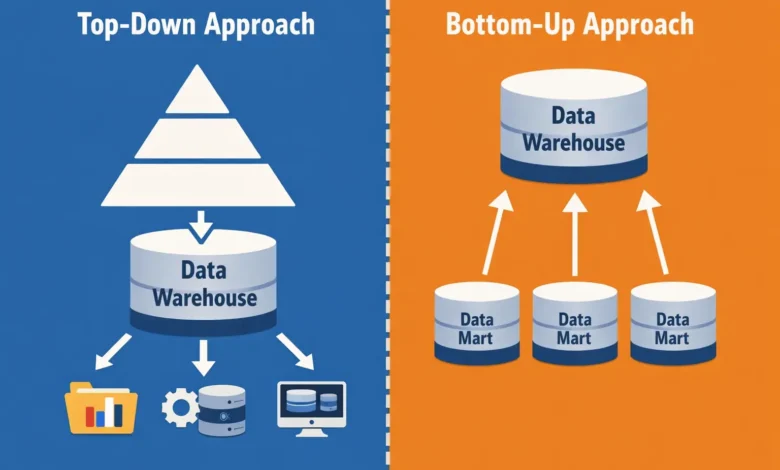
The Top-Down approach focuses on building a centralized “Enterprise Data Warehouse” (EDW) first and then creating smaller data marts from it, whereas the Bottom-Up approach starts by building individual data marts for specific departments and then connecting them to form a larger warehouse.
In the world of data engineering, this is often called the “Inmon vs. Kimball” debate. Bill Inmon, the father of the Top-Down approach, believes in creating a single source of truth before anything else. Ralph Kimball, the proponent of the Bottom-Up approach, believes in delivering business value quickly by building small, manageable components first. Choosing between them is not just a technical decision; it is a strategic one that defines how your company will handle data for the next decade.
What is the Top-Down Approach in Data Warehouse? (Inmon Methodology)
The Top-Down approach is a centralized strategy where the Enterprise Data Warehouse (EDW) serves as the primary data repository. In this model, you do not build anything for a specific department until you have designed the entire warehouse.
The process follows a strict sequence:
- Data Extraction: You pull data from operational systems (ERP, CRM).
- Staging: Data enters a staging area where it is cleaned.
- Normalization (3NF): You store the data in the EDW in a highly structured, normalized format (Third Normal Form) to avoid redundancy.
- Data Mart Creation: Once the EDW is ready, you create small “Data Marts” for specific teams like Sales or Finance.
Why Choose Top-Down?
This method ensures a “Single Version of Truth.” Because every data mart comes from the same central EDW, the Sales team’s report will always match the Finance team’s report. It is the gold standard for data consistency.
The Challenge:
It is slow and expensive. Designing a complete enterprise warehouse can take months or even years before a single report is generated. If your business needs immediate insights, this “waterfall” style can be frustrating.
What is the Bottom-Up Approach in Data Warehouse? (Kimball Methodology)
The Bottom-Up approach is a decentralized strategy that focuses on building individual Data Marts first to solve specific business problems immediately. Ralph Kimball argued that businesses cannot wait years for data.
In this model, the workflow is reversed:
- Identify Business Process: You pick a critical area, say “Sales.”
- Build Data Mart: You build a dimensional data mart (Star Schema) specifically for Sales.
- Repeat: Next, you build one for “Inventory,” then “Marketing.”
- Bus Architecture: You connect these independent marts using “Conformed Dimensions” (shared data elements like ‘Customer’ or ‘Time’) to create a virtual warehouse.
Why Choose Bottom-Up?
Speed is the primary advantage. You can have a working Sales dashboard in a few weeks. It provides a rapid Return on Investment (ROI) and allows the data team to show value quickly.
The Challenge:
The risk here is “Data Silos.” If you don’t manage the connections properly, the Sales mart might define “Revenue” differently than the Finance mart, leading to conflicting reports and a “Data Swamp.”
Comparison Table: Top-Down vs. Bottom-Up
To make the right decision, you must compare these methodologies across key operational metrics.
| Feature | Top-Down (Inmon) | Bottom-Up (Kimball) |
| Primary Focus | Enterprise-wide integration first. | Departmental speed and value first. |
| Data Model | Normalized (3NF) to reduce redundancy. | Dimensional (Star Schema) for fast querying. |
| Complexity | High initial complexity; easier maintenance later. | Low initial complexity; harder maintenance as it grows. |
| Cost | High upfront investment. | Low upfront cost; incremental investment. |
| Time to Value | Slow (Months/Years). | Fast (Weeks). |
| Flexibility | Rigid; changes require EDW updates. | Flexible; easy to add new marts. |
Choosing the Right Approach for Your Business
The decision depends entirely on your company’s budget, timeline, and tolerance for complexity. There is no “wrong” choice, only a choice that fits your specific context.
- Choose Top-Down if: You are a large enterprise (like a bank or insurance firm) where data accuracy and compliance are more important than speed. If you have a large budget and can afford a long development cycle to ensure a perfect “Single Source of Truth,” Inmon is the way to go.
- Choose Bottom-Up if: You are a startup or a mid-sized company that needs to see results now. If your management team is asking for dashboards next month and your budget is limited, Kimball’s approach allows you to start small and grow gradually.
The Hybrid Approach:
In 2026, many modern firms refuse to choose. They use a Hybrid Approach. They use the Bottom-Up method to build quick data marts for urgent needs but simultaneously work on a Top-Down EDW in the background to ensure long-term consistency.
Modern Data Architecture Trends
The strict line between Inmon and Kimball is blurring. With the rise of Cloud Data Warehouses (like Snowflake and BigQuery) and Data Lakehouses, the physical constraints that defined these old methodologies are disappearing. Modern architectures often store raw data in a “Lake” (Bottom-Up flexibility) while applying strict governance layers on top (Top-Down control), giving businesses the best of both worlds.
You can Also Read: Data Mining vs. Data Warehouse: What is the Real Difference?
FAQs
Inmon vs Kimball: Which is better?
Neither is universally “better.” Inmon is better for maintenance and consistency; Kimball is better for speed and business user accessibility.
Is the Bottom-Up approach cheaper?
Initially, yes. It requires less hardware and planning to start. However, if not managed well, the cost of fixing “messy” data connections later can make it expensive in the long run.
Which model is easier to maintain?
The Top-Down (Inmon) model is generally easier to maintain over time because the data is normalized and centralized. Changes in the business rules only need to be updated in one place (the EDW).