What is an RFQ in Construction? The Contractor’s Guide to Smarter Bidding

In construction, an RFQ (Request for Quotation) is a formal document used to invite suppliers and subcontractors to provide a specific price for a clearly defined project scope. Unlike other documents, an RFQ is strictly about the numbers. It’s the tool you use when you know exactly what you need, and you just want to find the best price and terms to get it done.
I’ve seen projects lose thousands of dollars simply because the RFQ was vague. If you don’t define the “Quality” in your request, you’ll get the “Cheapest” price, which often leads to the most expensive mistakes on-site.
RFI vs. RFQ vs. RFP: The Ultimate Comparison
The main difference between an RFI, RFQ, and RFP is the “Intent” of the document: an RFI asks for information, an RFQ asks for a price, and an RFP asks for a solution to a problem. Most Top 100 ranking failures happen because contractors use these terms interchangeably, which confuses vendors and Google alike.
| Document Type | Purpose | When to Use It |
| RFI (Information) | To clarify gaps in plans. | When a drawing is missing a measurement. |
| RFQ (Quotation) | To get a fixed price. | When you need 500 tons of Grade-A steel. |
| RFP (Proposal) | To get a complete solution. | When you need a design-build partner for a bridge. |
What should be included in a Professional RFQ?
A professional construction RFQ must include a detailed Scope of Work (SOW), technical drawings, material specifications, and a clear deadline for submission. If you leave room for interpretation, you leave room for “Change Orders” later. I believe a solid RFQ is your first line of defense against budget overruns.
- Technical Specs: Don’t just say “pipes”; specify the material, diameter, and pressure rating.
- Timeline: When do you need the materials on-site?
- Payment Terms: Are you paying in 30 days or 60 days?
- Submission Format: Do you want a PDF via email or a bid through your dispatch software portal?
How the RFQ Process Works in 2026
The modern RFQ process works through four digital stages: Preparation, Distribution, Evaluation, and Awarding. Gone are the days of faxing papers. Today, smart contractors use digital platforms to ensure transparency and speed.
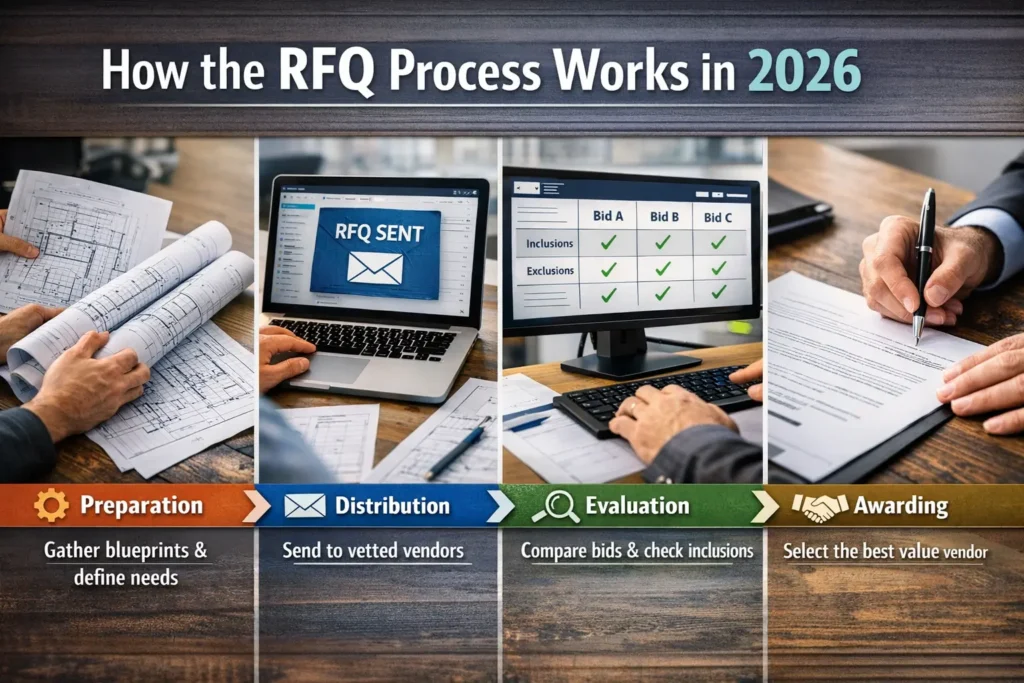
- Preparation: You gather your blueprints and define exactly what needs to be bought.
- Distribution: You send the RFQ to a pre-vetted list of vendors.
- Evaluation: This is where you compare quotes. Pro Tip: Don’t just look at the bottom line; check for “Inclusions” and “Exclusions.”
- Awarding: You sign the contract with the vendor that offers the best “Value,” not necessarily the lowest price.
Digital RFQs: Moving Beyond Spreadsheets
Digital RFQ management allows you to automate the bidding process, reducing human error by up to 40% and ensuring all vendors are bidding on the same data. By integrating your RFQs with your existing project management tools, you create a seamless flow of data from the office to the field.
I’ve found that when an RFQ is digital, it’s much easier to track. If a vendor claims they didn’t see a specific drawing, you have a digital “Read Receipt” to prove otherwise. This level of accountability is what separates the pros from the amateurs in 2026.
Common RFQ Mistakes That Kill Your Profit
The most common RFQ mistakes include giving vendors too little time to respond and being too vague about site conditions. If a subcontractor has to “guess,” they will add a “Risk Premium” to their price, making your bid higher than it needs to be.
- Mistake 1: Comparing “Apples to Oranges” (e.g., one vendor quoted delivery, the other didn’t).
- Mistake 2: Ignoring the vendor’s track record for the sake of a low price.
- Mistake 3: Failing to link the RFQ to the initial RFI that clarified the design.
Expert Verdict: Making RFQs Work for You
Mastering the RFQ process is about more than just saving money—it’s about building a reliable supply chain. In an industry where material costs fluctuate daily, having a clear, professional, and digital RFQ process is the only way to stay profitable. If you are already using tools like GPS in modern construction to track your assets, adding digital RFQs is the next logical step in your tech stack.
FAQs
Is a construction RFQ legally binding?
An RFQ itself is not a contract. However, once you accept a quote and sign a Purchase Order or Contract based on that RFQ, the terms become legally binding.
What is the difference between a Quote and a Bid?
A quote is usually for materials or simple services with a fixed price. A bid is more complex and often includes labor, equipment, and a strategic plan to complete a whole section of a project.
How many vendors should I invite to bid?
I recommend inviting at least 3 to 5 vendors. This gives you enough variety to see the market rate without making the evaluation process overwhelming.