
Warehouse operations today are under constant pressure. Order volumes are unpredictable, delivery timelines are shrinking, and labor shortages continue to impact efficiency. In this environment, automation is no longer optional for many businesses — it is becoming a requirement for staying competitive.
However, traditional automation is not always easy to adopt. It demands large upfront investments, long implementation timelines, and carries operational risk if business needs change. This has led many warehouses to look for alternatives that offer flexibility without long-term commitment.
Robotics-as-a-Service (RaaS) is emerging as one of those alternatives. It allows warehouses to use robotic systems through a service model instead of owning them outright. More importantly, it changes how automation is planned, deployed, and scaled.
What is Robotics-as-a-Service (RaaS)?
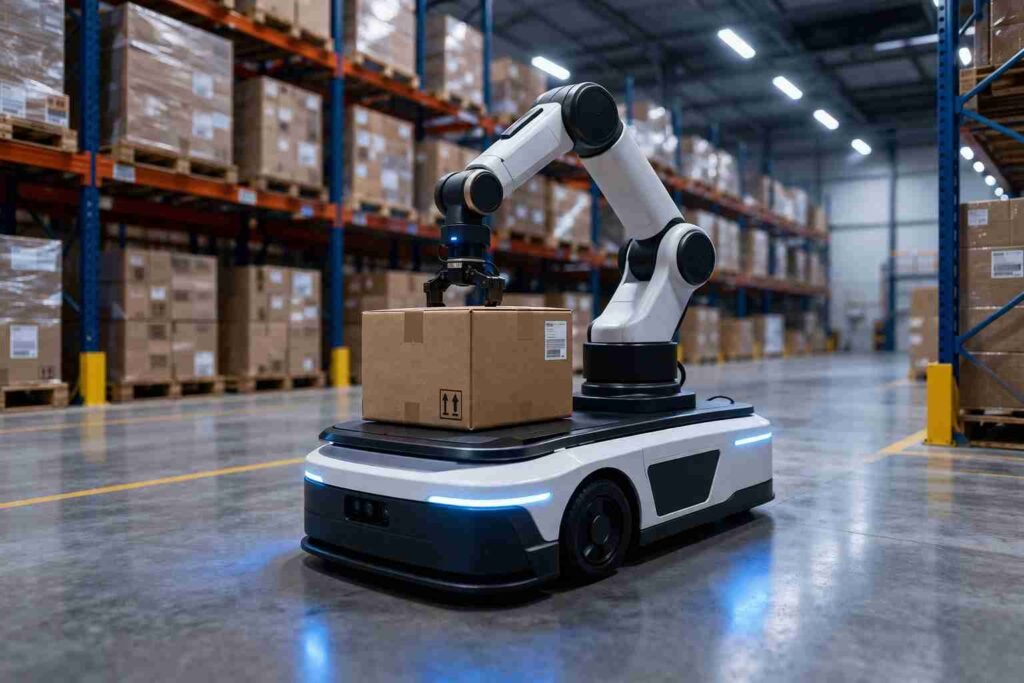
RaaS is a model where robotic systems are delivered as a managed service rather than a purchased asset. Instead of investing in robots, companies pay for their usage through subscriptions or activity-based pricing.
A typical RaaS solution includes:
- Physical robots (for movement, picking, sorting, or handling)
- Software systems for navigation, task management, and coordination
- Ongoing services such as maintenance, monitoring, and updates
From a business perspective, this shifts automation from capital expenditure (CapEx) to operational expenditure (OpEx). That shift alone makes automation more accessible, especially for companies that want to avoid large financial commitments.
Why Traditional Automation Does Not Fit Every Warehouse
Traditional automation has clear advantages, but it is not designed for every operational environment.
First, the financial barrier is significant. Large-scale automation systems often require substantial upfront investment, which can delay adoption or limit it to large enterprises.
Second, implementation takes time. Designing, installing, and optimizing a fixed system can take months or longer. During that time, order profiles and operational needs may change.
There is also a lack of flexibility. Many warehouses experience seasonal demand or sudden spikes in volume. Fixed automation systems are not easy to scale up or down, which can lead to inefficiencies.
These limitations create a gap between the need for automation and the ability to deploy it effectively. RaaS is designed to address that gap by introducing flexibility at both financial and operational levels.
You Might Also Check: What is a Cobot in Warehouse?
How RaaS Works in a Warehouse Environment
RaaS operates as an ongoing service, not a one-time installation. The process begins with understanding the warehouse itself.
The provider typically starts with an assessment of workflows, layout, and demand patterns. Based on this, they identify where robots can improve efficiency without disrupting existing operations.
Deployment follows a modular approach. Instead of building custom infrastructure, many RaaS systems are designed to fit into existing environments with minimal changes. This reduces both cost and implementation time.
Integration with the warehouse management system (WMS) is a critical step. It ensures that robots receive accurate instructions and that inventory data stays synchronized.
Once operational, robots and workers collaborate. Robots handle repetitive and time-consuming tasks, such as transporting goods or supporting picking operations. Workers focus on supervision, exception handling, and quality control.
Over time, performance data is used to refine the system. Providers adjust workflows, improve task allocation, and update software to enhance efficiency. This continuous optimization is one of the defining characteristics of RaaS.
Types of Robots Used in RaaS Warehousing
RaaS does not rely on a single type of robot. Instead, it uses a mix of technologies depending on the operational needs.
Some of the most common include:
- Autonomous Mobile Robots (AMRs)
These robots move freely using sensors and mapping technology. They are widely used for transporting goods across different zones. - Automated Guided Vehicles (AGVs)
These follow predefined paths and are effective in structured, repetitive workflows. - Picking assistance systems
Robots support workers by bringing items or guiding them through picking tasks, reducing travel time. - Sorting robots
Used in high-volume operations to route items quickly and accurately. - Robotic arms
Commonly used for packing and palletizing, especially where consistency is required.
Most modern warehouses combine several of these systems rather than relying on a single solution.
You Might Also Check: What Is a Forklift In Warehouse?
Key Benefits of the RaaS Model
RaaS is not just a financial model. It changes how warehouses approach operations.
One of the main advantages is reduced upfront cost. Businesses can adopt automation without large capital investments, making it easier to start small and expand gradually.
Another important benefit is scalability. Warehouses can increase or decrease the number of robots based on demand. This is especially useful during peak seasons when order volumes surge.
RaaS also improves deployment speed. Since many solutions are modular, they can be implemented faster than traditional systems.
Maintenance and technical support are handled by the provider, which reduces the need for in-house expertise. At the same time, software updates ensure that systems continue to improve over time.
Taken together, these benefits make RaaS particularly attractive in environments where flexibility and speed are critical.
Where RaaS Delivers the Most Value
RaaS is not equally effective in every situation. It delivers the most value in operations that require adaptability.
E-commerce fulfillment centers are a strong example. They deal with fluctuating demand and tight delivery timelines, making flexible automation essential.
Third-party logistics providers (3PLs) also benefit from RaaS. Since they serve multiple clients, their operational needs can change frequently. RaaS allows them to adjust quickly without redesigning infrastructure.
Retail distribution centers use RaaS to manage both store replenishment and online orders, which often require different workflows.
In specialized environments, such as cold storage facilities, robots can improve safety by reducing the need for human exposure to harsh conditions.
RaaS vs Traditional Ownership: Making the Right Choice
Choosing between RaaS and traditional automation depends on long-term goals.
RaaS is often the better choice when flexibility, speed, and lower initial risk are priorities. It allows businesses to experiment with automation and scale gradually.
Traditional ownership may be more suitable for stable operations with consistent, high volumes. In such cases, the long-term cost of ownership may be lower than ongoing subscription fees.
In practice, some companies adopt a hybrid approach. They use RaaS for certain processes while investing in owned systems for others.
Cost and ROI Considerations
While RaaS reduces upfront investment, it is important to look beyond initial costs.
In the short term, RaaS often delivers faster returns because it avoids large capital spending. Productivity improvements, reduced labor dependency, and fewer errors can quickly offset subscription costs.
Over the long term, however, ongoing fees need to be evaluated carefully. Businesses should compare total subscription costs with the potential savings from owning equipment.
Key factors to consider include:
- Labor cost reduction
- Throughput improvement
- Accuracy and error reduction
- Operational flexibility
ROI is not only about direct cost savings. The ability to adapt quickly to changing demand can also create significant value.
Challenges and Limitations
Despite its advantages, RaaS comes with trade-offs that should not be ignored.
Ongoing subscription costs can become significant over time, especially in high-volume operations. Businesses need to ensure that the service continues to deliver value.
There is also a level of dependency on the provider. Since they manage the system, their reliability directly affects operations.
Integration can be complex, particularly in older warehouses with legacy systems. Careful planning is required to avoid disruptions.
Data sharing is another consideration. Operational data is often used by providers to optimize performance, which raises questions about control and security.
Finally, not all processes are suitable for automation. Identifying the right use cases is critical for success.
You Might Also Check: How to Prevent Picking Errors in Your Warehouse
Impact on Workforce and Operations
The introduction of RaaS changes the nature of warehouse work rather than eliminating it.
Robots take over repetitive and physically demanding tasks, allowing workers to focus on supervision, coordination, and problem-solving.
This creates a collaborative environment where humans and robots work together. Employees interact with robotic systems, monitor performance, and handle exceptions.
Training becomes important. Workers need to understand how to operate alongside robots and adapt to new workflows.
At the same time, safety often improves. Reduced physical strain and fewer repetitive movements lower the risk of workplace injuries.
Looking Ahead: The Future of RaaS in Warehousing
RaaS is still evolving, and its role in warehousing is likely to expand.
Advances in artificial intelligence are improving robot capabilities, particularly in navigation and decision-making. Systems are becoming more adaptable to complex environments.
Integration with data analytics and connected systems is also improving visibility. Warehouses are moving toward more data-driven operations.
The concept of managing entire fleets of robots through centralized platforms is becoming more common, enabling better coordination and scalability.
As technology matures, costs are expected to decrease, making RaaS accessible to a wider range of businesses.
Final Thoughts
Robotics-as-a-Service is changing how warehouses approach automation. It removes many of the barriers associated with traditional systems and introduces a more flexible, scalable model.
However, it is not a one-size-fits-all solution. The decision to adopt RaaS should be based on a clear understanding of operational needs, cost structures, and long-term strategy.
For many warehouses, the real value of RaaS lies in its ability to provide flexibility in an uncertain environment. In a sector where speed and adaptability are critical, that flexibility can become a key competitive advantage.
For more insights, read our article on: Warehouse Robotics Trends & Innovations in 2026