From Prototype to Production: How Hardware Companies Plan CNC Machining Volumes

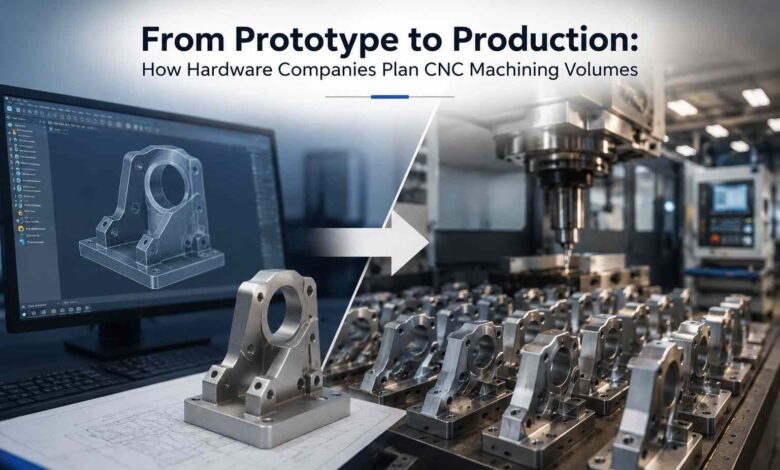
Hardware teams rarely move directly from a single prototype to thousands of finished parts. CNC machining plans typically evolve through several volume stages, each with different priorities for speed, cost, repeatability, and quality control. A machined aluminum enclosure, stainless-steel bracket, or precision shaft may begin as a design-validation part before becoming a recurring production component.
The right approach depends on how stable the design is, how many units are needed, and which features affect performance. Companies that plan these transitions early can avoid expensive redesigns, rushed tooling decisions, and quality problems when demand increases.
Matching Manufacturing Stages to Product Maturity
Prototype CNC machining is used when a design is still being tested. A company might order one to ten parts to check whether a wearable-device housing fits its electronics, whether a drone bracket withstands load, or whether a medical-device handle feels comfortable in use. Fast programming and flexible setups matter more than the lowest possible unit price at this stage.
Because prototypes may change after every test cycle, machinists often use standard vises, clamps, and readily available cutting tools instead of dedicated fixtures. A fixture is a purpose-built holder that positions a part consistently during machining. Avoiding specialized tooling keeps the initial investment lower and allows engineers to revise dimensions without discarding expensive equipment.
Working with custom CNC machining services early can help teams identify features that will be difficult to hold, machine, or inspect at higher quantities. A manufacturing review may reveal that a deep pocket needs a longer cutting tool, a thin wall needs extra support, or a threaded hole should be repositioned for easier access.
Low-volume CNC machining generally follows once the design has been validated, but demand remains uncertain. This stage may involve dozens or hundreds of parts for pilot sales, field testing, or limited product launches. For example, a robotics company could order 200 custom motor mounts while gathering reliability data from early customers.
At low volumes, manufacturers begin improving cycle time, which is the time required to make one part. They may combine multiple operations in a single setup, use soft jaws shaped to hold a particular component, or purchase material in more efficient sizes. These improvements reduce labor without locking the business into heavy production tooling too early.
Controlling Cost, Accuracy, and Scale
Tolerance planning affects every production decision. A tolerance defines how much a finished dimension may vary from its specified size. While a general CNC tolerance may be around ±0.005 inches, critical features such as bearing bores, sealing surfaces, and mating holes may require tighter limits. Tight tolerances take more machining time and more careful measurement, so drawings should reserve them for features that truly affect function.
Inspection also changes with volume. A prototype may receive detailed measurement of every important feature, often through calipers, micrometers, height gauges, or a coordinate measuring machine. Before a larger run, a first article inspection verifies that the first completed part matches the drawing, material requirements, and approved process. During high-volume production, a CNC machining company may use defined sampling plans, in-process checks, and dedicated inspection fixtures to catch variation before it affects an entire batch.
How to Choose the Right CNC Machining Volume and Production Route
| Stage | Typical Volume | Main Priority | Common Manufacturing Approach |
| Design prototype | 1–10 parts | Speed and design validation | Standard tooling and flexible setups |
| Engineering validation | 10–50 parts | Functional and tolerance testing | Revised programs and detailed inspection |
| Pilot production | 50–500 parts | Process repeatability | Soft jaws, optimized setups and first article inspection |
| Recurring production | 500+ parts | Unit cost and consistency | Multi-part fixtures, automation and sampling plans |
Building a Repeatable Route to Market
High-volume CNC machining is appropriate when demand is repeatable, and the part design is unlikely to change. A company producing thousands of camera mounts or industrial sensor housings can justify investments in multi-part fixtures, automated loading, and optimized machining programs. The upfront expense rises, but it is spread across more units, lowering the cost of each finished part. By progressing deliberately from prototype CNC machining to low-volume and high-volume production, hardware companies can protect product quality while making costs more predictable.