
AI Image Generators for Architecture and Interior Design: Tools and Workflows in 2026

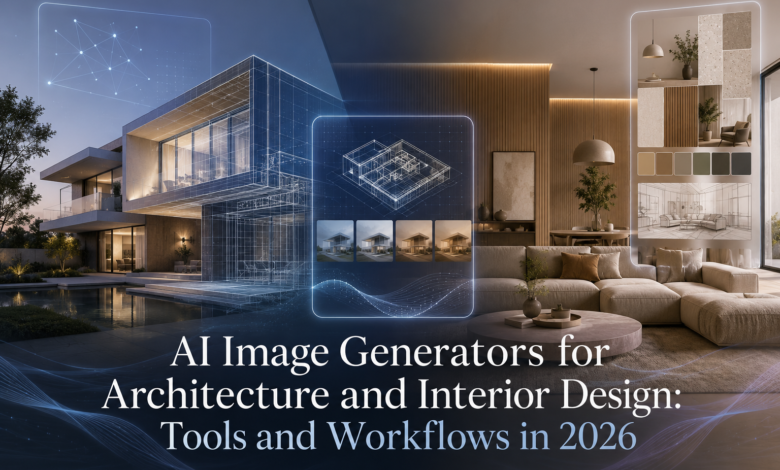
AI image generation has become one of the most practically valuable tools in architecture and interior design — not as a replacement for CAD or BIM software, but as a visualization and ideation accelerator that fits directly into the design process.
How architects and interior designers are using AI image generation
- Early-stage concept visualization: Generating atmosphere images and mood boards that communicate design intent before detailed drawings exist.
- Material and finish exploration: Applying different material combinations, color palettes, and finish treatments to the same space or facade quickly.
- Client presentation images: Photorealistic visualizations from early-stage design data that communicate the final result more effectively than floor plans.
- Exterior context visualization: Placing a proposed building into its actual site context, exploring how it reads against the surrounding streetscape.
For anyone still deciding on tooling, the AI image generator architects are adopting continues to evolve rapidly — it is worth reviewing the current options before committing to a subscription.
Best AI image tools for architecture and interior design
Midjourney v7 — best for atmosphere and concept images
Midjourney produces the most aesthetically compelling architectural visualization images. For early-stage client presentations, Midjourney’s outputs are consistently the strongest. Architectural prompt keywords: ‘architectural visualization’, ‘rendered in V-Ray’, ‘soft diffused light’, ‘wide-angle perspective’.
ControlNet (Stable Diffusion) — best for sketch-to-render workflows
ControlNet allows an existing image to guide the structure of AI generation. A hand sketch, a line drawing, or a basic 3D model can be used as the structural guide for a photorealistic AI rendering — the AI generates realistic materials and lighting while preserving the designer’s spatial intentions.
Magnific AI — best for resolution enhancement of renders
Architectural visualization images need to hold up at large print sizes. Magnific AI’s upscaling handles architectural detail well: sharp edges, material textures, glass reflections, and human figure detail are reconstructed accurately at up to 16x magnification.
Time savings: AI vs. traditional
| Design task | Traditional time | AI-assisted time |
| Concept mood board | 2-4 hours | 20-40 minutes |
| Material combination render | 4-8 hours (3D render) | 30-60 minutes |
| Client presentation images (5 views) | 1-2 weeks | 2-4 hours |
| Exterior context visualization | 1-3 days | 1-3 hours |
FAQs
Can AI architectural images replace traditional 3D rendering?
For concept visualization and early client presentations, yes. For applications requiring precise spatial accuracy or planning submissions, traditional CAD-based rendering remains necessary.
How do I generate an architectural image that accurately reflects my design?
The most accurate results come from ControlNet workflows where your drawing or model guides the AI output. Consumer tools like Midjourney produce beautiful images but do not take spatial input.
Which AI tool is best for quick material explorations?
Adobe Firefly’s Generative Fill is the most practical for applying material variations to an existing render in Photoshop.