
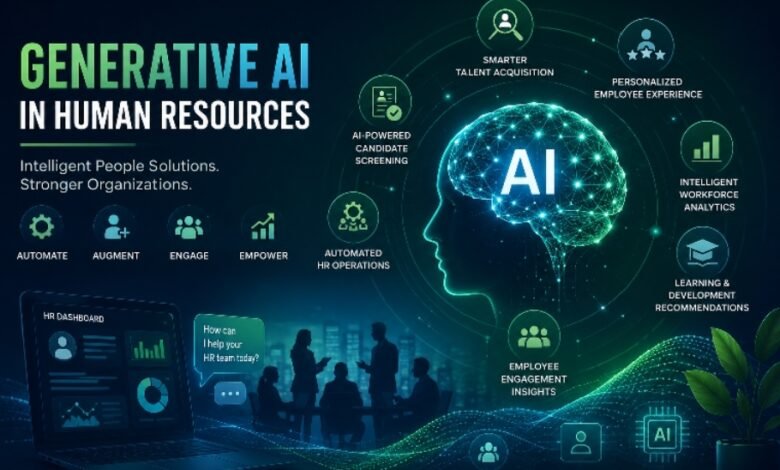
Human resources departments face unprecedented operational pressure. Organizations confront a significant productivity gap driven by rising total workforce workloads, paired with simultaneous reductions in departmental budgets and internal HR headcounts. Traditional strategies for human capital management that rely purely on incremental hiring or legacy automation are no longer sufficient to bridge this divide. To maintain operational efficacy and foster corporate growth, enterprise leaders are pivoting toward advanced technological frameworks. Generative artificial intelligence represents a fundamental paradigm shift in how organizations support, develop, and manage their workforce.
Unlike earlier software iterations that simply moved structured data through rigid, predefined paths, generative technology introduces adaptive intelligence into administrative and strategic workflows. This capability is redrawing the core boundaries of the human resources function, converting it from a cost center focused on transactional compliance into a proactive engine of organizational strategy. By automating repetitive, text-heavy processes and delivering hyper-personalized employee experiences, this technology enables HR leaders to focus on high-value initiatives such as cultural development, executive succession planning, and organizational design. Navigating this transition effectively requires a deep understanding of how these advanced models operate within a corporate framework and where they can deliver the highest measurable return on investment.
Overview of Generative AI in HR
To fully grasp the transformation occurring within human capital management, it is essential to distinguish modern generative systems from traditional rule-based software. Traditional human resources automation operates on explicit logical rules; it excels at executing predictable tasks such as routing a paid time off request to a line manager, sending automated reminders for missing compliance documentation, or pushing an approved job requisition to an applicant tracking system. While these tools remain necessary, they are inherently limited by their inability to interpret context or handle unstructured textual content.
In contrast, generative AI in HR specializes in language-heavy workflows, enabling systems to read, draft, rewrite, summarize, and analyze complex information with nuanced comprehension. Built upon large language models, these solutions process vast repositories of unstructured data, including employee feedback, corporate policy documents, performance evaluations, and regional labor regulations. Instead of delivering static answers from a rigid index, generative tools synthesize context-aware outputs that adapt to an individual employee’s specific role, location, tenure, and historical query background. This transition from rigid automation to contextual intelligence enables modern enterprises to scale their service delivery models without expanding administrative headcount, establishing an adaptable talent ecosystem that aligns individual capabilities with broader corporate goals.
Benefits of Generative AI in HR
Implementing cognitive computing models across corporate talent structures yields substantial, measurable operational improvements. By embedding these tools into daily workflows, enterprises address chronic resource constraints while simultaneously improving service quality.
1. Significant expansion of administrative and recruiter productivity
The primary benefit of deploying generative applications is the immediate reduction in the cognitive load associated with routine, documentation-heavy tasks. HR professionals spend disproportionate time authoring communications, compiling compliance forms, and structuring role profiles. Generative models alleviate this burden by producing high-quality first drafts of complex documents in seconds. This allows human operators to transition from creators to editors, reducing the time required to complete administrative writing tasks by up to eighty percent. Talent acquisition automation allows recruiters to source, screen, and engage candidate pools at unprecedented speeds, significantly shortening the overall time-to-hire cycle.
2. Hyper-personalization of the employee experience
Modern workforces expect immediate, highly accurate interactions tailored to their unique circumstances. Generative systems elevate the internal service experience by delivering real-time support that accounts for individual context. Whether an employee is inquiring about parental leave policies under specific regional jurisdictions or seeking guidance on localized healthcare benefits, intelligent applications provide precise, legally compliant responses. This level of employee experience optimization extends to professional growth, as the technology analyzes individual skill sets and performance histories to generate customized career development pathways and adaptive training recommendations, which ultimately drives higher internal retention and employee satisfaction.
3. Data-driven strategic decision-making for leadership
Enterprise executives often struggle to extract actionable insights from fragmented human capital data. Generative analytics platforms aggregate disparate data streams to provide a cohesive view of organizational health. By evaluating exit interview summaries, performance review trends, and internal skills inventories, these tools identify hidden attrition risks, highlight expanding skills gaps, and offer predictive recommendations for strategic workforce planning. This empowers HR leaders to approach board-level conversations with clear, empirical evidence and predictive modeling rather than relying on retrospective metrics or subjective intuition.
4. Reduction of operational costs and ticket volumes
Large global enterprises manage thousands of repetitive inbound inquiries daily, placing a heavy burden on shared services centers. Cognitive assistants resolve a vast majority of these routine inquiries at the first point of contact without requiring human intervention. This decreases overall support ticket volume, shortens mean resolution times, and lowers operational costs per interaction. The budgetary savings achieved can then be reinvested into strategic talent acquisition campaigns and employee engagement initiatives that directly influence top-line revenue growth.
Use cases of Generative AI in HR
The practical application of generative models spans the entire employee lifecycle, from initial attraction and recruitment to continuous development and offboarding. Organizations achieve optimal results by focusing deployment on clear, language-intensive processes.
1. Job description drafting and standardization
Creating accurate, appealing, and compliant job descriptions is a frequent corporate requirement that is often hindered by inconsistent formatting and varying writing styles. Generative models solve this challenge by converting basic role briefs into comprehensive, structured vacancy announcements. By integrating corporate style guides and defined skills taxonomies, the technology ensures that every job description maintains a unified brand voice and highlights necessary core competencies. Furthermore, the system can actively scan drafts to flag exclusionary wording, supporting workforce transformation initiatives before the vacancy is published.
2. Conversational AI for HR service delivery
Global operations require round-the-clock support across multiple languages and time zones, a requirement that traditional service desks struggle to meet cost-effectively. Next-generation virtual assistants serve as the primary interface for employee inquiries, understanding natural language intent and providing instantaneous feedback. For instance, if an employee asks about maternity benefits, the system checks the individual’s physical work location. It cross-references it with local statutes to deliver a personalized, legally accurate explanation, effectively handling complex nuances that overwhelm standard static FAQ pages.
3. Talent acquisition and context-aware candidate screening
Legacy applicant tracking systems often filter resumes using basic keyword matching, which can inadvertently eliminate highly qualified candidates who use non-standard terminology. Generative screening tools analyze candidate pools holistically, evaluating professional trajectories, adjacent skills, and long-term career growth potential against the full context of a job opening. This advanced evaluation extends to the interview stage, where the technology analyzes a candidate’s background to generate tailored, objective interview questions that help hiring managers assess role fit more accurately.
4. Performance management and continuous feedback consolidation
The traditional annual review cycle is often criticized for its administrative burden and susceptibility to recency bias. Generative solutions streamline this process by continuously consolidating peer feedback, manager check-in notes, and project milestone data into formatted, cohesive performance narratives. This significantly reduces the time managers spend drafting annual evaluations while providing employees with a balanced, objective summary of their contributions throughout the year, making performance discussions more constructive and forward-looking.
5. Personalized learning and adaptive development modules
One-size-fits-all training programs frequently fail to engage employees or address specific organizational capability gaps. Generative platforms revolutionize corporate learning by authoring custom instructional content and real-time development plans. As an employee progresses through a training module, the system evaluates their comprehension and dynamically modifies the complexity, tone, and examples provided. This adaptive learning approach shortens training times, increases knowledge retention, and ensures that professional development aligns directly with corporate operational demands.
Why Choose The Hackett Group® for implementing Generative AI in HR?
Successfully scaling cognitive technology within human resources requires a strategic methodology that extends beyond basic software deployment. Organizations must treat artificial intelligence as a comprehensive change management initiative rather than a standard IT upgrade. To navigate this complex landscape and achieve quantifiable value realization, enterprises partner with specialized AI consultants who possess deep functional expertise.
The Hackett Group® offers an end-to-end, platform-enabled delivery framework that distinguishes its services from those of traditional consulting firms. Their strategic approach is grounded in their world-renowned Digital World Class® performance benchmarks and proprietary best-practice process intelligence. Instead of providing generic advice, they leverage their specialized Solution Language Model to apply deep domain expertise directly to an organization’s unique operating structure, turning theoretical technology concepts into deployable, high-impact enterprise solutions.
To accelerate the path to measurable ROI, the firm utilizes a proprietary suite of advanced intellectual property platforms. Enterprises begin their transformation journey with Hackett AI XPLR™, an innovative readiness and opportunity assessment platform that simulates solutions, models task-level workflows, and defines explicit, value-backed ROI metrics before deployment. Throughout the engagement, advisors use AskHackett™ to gain instantaneous, self-service access to validated, context-specific best practices and applied intelligence repositories, ensuring that all solution designs reflect top-tier industry performance. Clients also gain access to The Hackett Group® Connect®, an exclusive membership community that provides ongoing research, benchmarking data, and peer insights necessary to sustain long-term operational excellence. By anchoring technology design in empirical economics and proven process flows, The Hackett Group® ensures that human resources organizations move seamlessly from initial experimentation to enterprisewide value realization.
Conclusion
The integration of generative artificial intelligence represents a permanent shift in the architecture of human capital management. As macroeconomic pressures continue to strain corporate resources, the capacity to automate text-heavy processes, customize employee experiences, and extract predictive insights becomes a core competitive advantage. Enterprises that successfully adopt these intelligent solutions are well-positioned to eliminate operational productivity gaps and foster highly engaged workforces. However, achieving sustainable success requires moving past generic technological implementation and focusing on structured, value-driven execution. By partnering with experienced advisors and leveraging robust benchmarking frameworks, forward-looking business leaders can confidently navigate this technological evolution, turning human resources into a strategic pillar of long-term enterprise growth.