
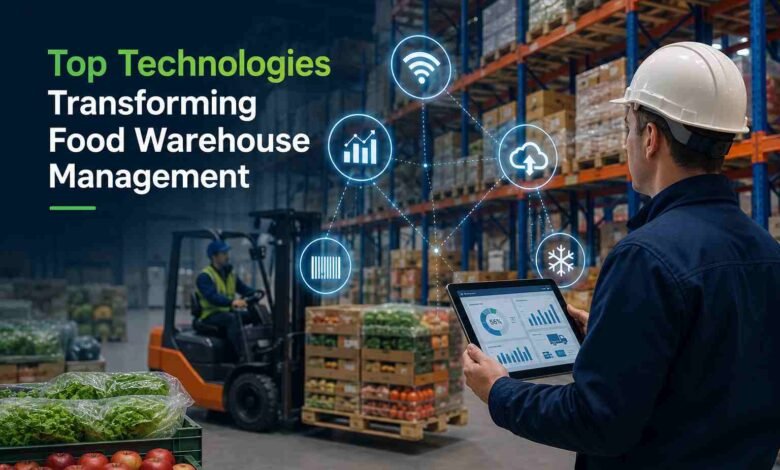
Efficient food warehouse management has become a strategic advantage, not just a back‑office necessity. Behind every grocery shelf, meal kit delivery, and restaurant supply chain are warehouses humming with activity — tracking inventory, managing temperature zones, and moving thousands of products daily. The pressure isn’t just about speed or space anymore; it’s about precision, visibility, safety, and sustainability. Technology is no longer optional — it’s central to how modern food warehouses operate, compete, and grow.
In this article, we’re going to explore the technologies that are reshaping food warehouse management. These aren’t buzzwords. They are proven systems and tools that real warehouses are deploying right now to reduce waste, increase accuracy, cut costs, and deliver better results.
Warehouse Management Systems (WMS): The Digital Backbone
A Warehouse Management System (WMS) acts like the command center of a food warehouse. It tracks where every product is stored, records movements, manages orders, and integrates with suppliers and logistics partners. Think of it as the brain that orchestrates dozens of moving parts.
In the past, warehouse teams relied on paper lists, basic spreadsheets, or legacy systems that lacked real‑time visibility. A modern WMS replaces all of that. It gives warehouse managers a live dashboard showing inventory levels, turnover rates, expiry status, and inbound/outbound shipments.
Key advantages:
- Real‑time inventory visibility: You always know what stock is on hand, where it is stored, and how long it’s been there.
- Better accuracy: Barcode scanning and system checks reduce human error.
- Integration: A WMS can connect with transportation systems, accounting platforms, and suppliers to create a seamless flow of information.
For food products — where expiry dates and freshness matter — this visibility isn’t just operational, it’s financial. A WMS helps reduce spoilage by ensuring that stock is rotated correctly and alerts are set for approaching expiry dates.
Internet of Things (IoT) and Smart Sensors: Monitoring in Real Time
Temperature and environmental control are critical in food warehouses, especially for perishable items like dairy, produce, and frozen goods. The Internet of Things (IoT) enables warehouses to collect live data from sensors placed throughout coolers, freezers, and ambient zones.
These sensors continuously measure:
- Temperature
- Humidity
- Door openings
- Power outages
Why is this useful? Because when a freezer goes above a safe threshold or humidity rises unexpectedly, the system can send alerts to managers instantly. This early warning can prevent thousands of dollars of loss before human staff even notice.
Smart sensors also collect historical data. Warehouse teams can analyze this to identify recurring issues, optimize energy use, and maintain consistent product quality.
In warehouses that manage mixed storage conditions (frozen, chilled, dry), these IoT devices bring precision control that human checks simply cannot match.
RFID and Barcode Technology: Fast, Accurate Tracking
Radio Frequency Identification (RFID) and barcode systems may seem basic compared to AI or robotics, but they are among the most impactful technologies in warehouse management.
Barcodes and RFID tags allow every item to be scanned quickly:
- When it arrives
- When it moves
- When it is shipped
This creates a complete digital record of every product in the warehouse. The difference between RFID and traditional barcodes is speed and automation. RFID doesn’t require line‑of‑sight scanning; multiple tags can be read simultaneously from a distance. This capability dramatically accelerates inventory counts, inbound receiving checks, and outbound packing.
For food warehouses, this increases accuracy in picking orders and reduces misplaced or lost stock. It also supports traceability — a critical factor during recalls or quality audits.
Robotics and Automation: Speed Meets Precision
Robotics is one of the most visible changes in modern warehouses. Automated guided vehicles (AGVs), robotic picking arms, and conveyor systems are streamlining tasks that were once labor‑intensive.
Here’s how automation is helping food warehouses:
- Automated picking and packing: Robots can sort and prepare orders faster than human staff in high‑volume zones.
- Transport automation: AGVs move pallets and crates across the warehouse without manual driving.
- Sorting systems: Conveyors and robotic sorters can organize products by order, destination, or temperature requirement.
Warehouse automation doesn’t eliminate human work — it reallocates it. Staff shift from repetitive tasks to oversight, quality control, and exception handling — where human judgment really matters.
Automation systems are particularly effective in warehouses with large SKUs and high turnover, such as e‑commerce fulfillment centers or regional distribution hubs.
Artificial Intelligence and Machine Learning: Predictive Power
Seeing what’s happening today is helpful. Predicting what will happen tomorrow transforms strategy.
This is where Artificial Intelligence (AI) and Machine Learning (ML) come into play. These technologies analyze patterns in data — from sales trends and seasonality to shipping delays — and turn them into actionable insights.
Examples:
- Demand forecasting: Instead of ordering the same amount of products each week, AI predicts demand based on seasonality, promotions, and external events.
- Dynamic slotting: AI suggests how to organize products in the warehouse so that high‑velocity items are closer to packing stations.
- Anomaly detection: If a temperature spike is unusual, machine learning models can flag it differently than a normal fluctuation, reducing false alarms.
AI doesn’t replace human decision‑making — it supplements it with data that would be impossible to analyze manually at scale.
Blockchain for Food Traceability
Blockchain gets mentioned mostly in finance, but it has powerful use cases in food supply chains. A blockchain is a secure, unchangeable digital ledger. When applied to food warehousing, it can record every movement or transaction of a product — from the farm to the fork.
The value of blockchain in food warehousing includes:
- Complete traceability: Every batch can be traced back to its source.
- Verified authenticity: Counterfeit or mislabeled products are easier to identify and remove.
- Faster recalls: If a contaminated product needs to be pulled from shelves, blockchain helps pinpoint exactly which batches are affected.
This transparency builds trust with customers, partners, and regulators. In industries like seafood, dairy, and produce where origin matters, blockchain is becoming a standard expectation.
Augmented Reality (AR) in Warehouse Operations
Augmented Reality (AR) isn’t just for gaming. In warehouse settings, AR tools — like smart glasses or tablet overlays — guide workers through tasks with visual instructions.
Imagine a picker wearing lightweight glasses:
- Arrows guide them to the exact shelf location.
- Product details appear as overlays.
- Scan confirmations show without pausing work.
This reduces errors and accelerates training for new staff. With AR, warehouses can improve picking accuracy while reducing the cognitive load on workers.
AR also supports real‑time collaboration. Supervisors can see what a picker sees, offer guidance instantly, and resolve issues without walking across the floor.
Data Analytics and Business Intelligence Tools
Technology in a warehouse generates vast amounts of data. From inventory movement to environmental readings to order cycle times, every activity becomes a data point. But data is only useful if it can be interpreted.
Data analytics and business intelligence (BI) tools help teams:
- Visualize performance trends
- Identify bottlenecks
- Track key performance indicators (KPIs)
- Forecast future needs
A warehouse manager might use BI dashboards to answer questions like:
- Which products are aging on the shelf?
- When is peak inbound activity?
- What zones have the highest picking errors?
This information supports smarter decisions and keeps performance visible to everyone, from supervisors to executives.
Cloud Computing: Flexibility and Scalability
Cloud technology isn’t specific to warehouses, but its role in enabling scalable systems is undeniable. Cloud‑based WMS platforms allow teams to access information from anywhere, update systems instantly, and expand capabilities without heavy hardware investment.
Cloud benefits include:
- Lower upfront costs
- Automatic software updates
- Remote access for teams
- Better collaboration across locations
For growing businesses or networks of warehouses, cloud systems ensure that operations stay aligned and flexible.
Technology in Food Warehouses: Real-World Impact
Technology in food warehouses is already making a tangible difference. Studies show that implementing IoT-enabled warehouse management systems (WMS) significantly improves inventory accuracy. For instance, a research study reported that inventory accuracy in warehouses using IoT-driven WMS increased from roughly 84.5% to over 99%, demonstrating a substantial reduction in inventory errors.
Similarly, adopting automation and robotics in picking and packing operations has shown measurable efficiency gains. According to a case study in logistics management, warehouses integrating automated guided vehicles (AGVs) and robotic sorting systems reduced labor-intensive manual tasks, improving order fulfillment speed and accuracy without compromising product safety.
The most effective warehouses do not implement technology randomly. They first identify their specific operational challenges, such as:
- High spoilage rates in perishable inventory
- Delays in order fulfillment
- Errors due to staff turnover or manual processes
By addressing these real pain points with the right technological solutions — like IoT sensors for monitoring storage conditions, WMS for inventory tracking, and robotics for repetitive tasks — warehouses improve reliability, reduce waste, and enhance overall customer satisfaction.
Conclusion: How to Approach Technology Adoption
Food warehouse management technology isn’t one size fits all. Smaller operations might find value first in barcode systems and a cloud‑based WMS. Mid‑sized warehouses may focus on IoT sensors and BI dashboards. Large, high‑volume centers often justify automation and AI forecasting.
Here’s a simple approach to technology adoption:
- Assess your biggest operational challenges.
- Define clear goals — less waste, faster fulfillment, better visibility.
- Start with solutions that deliver measurable impact.
- Built from a solid WMS foundation.
- Monitor results and scale gradually.
Successful implementation doesn’t happen overnight, but with thoughtful planning, the technologies we’ve covered here can transform a food warehouse from reactive to proactive — efficient, transparent, and prepared for growth.