

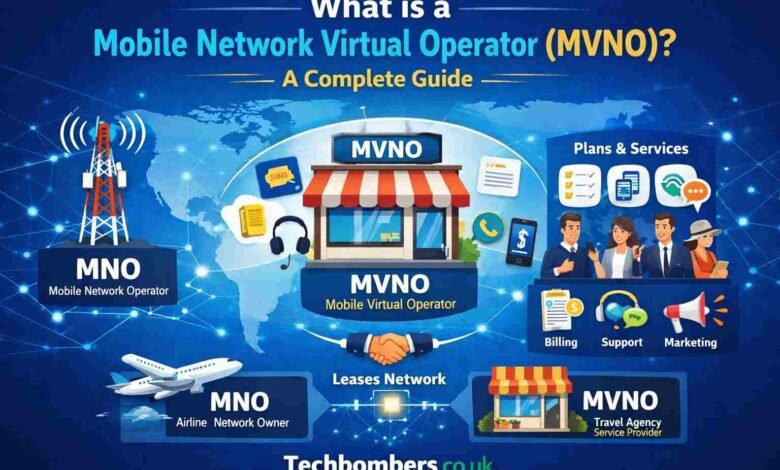
The telecom industry has changed rapidly over the last decade. Building and maintaining a mobile network requires billions in infrastructure, spectrum licenses, and ongoing maintenance. This high barrier has traditionally limited the number of operators in any country. However, a different model has emerged that allows new players to enter the market without building towers or owning spectrum. This model is known as the Mobile Network Virtual Operator, or MVNO.
An MVNO offers mobile services such as voice calls, SMS, and data without owning the underlying network infrastructure. Instead, it leases access from existing Mobile Network Operators (MNOs). This approach has reshaped competition in many markets and created new opportunities for both businesses and consumers.
What is a Mobile Network Virtual Operator (MVNO)?
A Mobile Network Virtual Operator is a telecom service provider that does not own its own radio network. Instead, it purchases network capacity from a traditional operator and resells it under its own brand.
In simple terms, an MVNO focuses on customer experience, pricing, and service innovation, while the host network handles the physical infrastructure. The term “virtual” refers to the absence of owned network assets like cell towers and spectrum.
This separation allows MVNOs to enter the market faster and operate with lower costs compared to traditional telecom companies.
How MVNOs Work
The MVNO model is built on a partnership between two key entities: the MVNO and the Mobile Network Operator (MNO).
First, the MVNO signs a wholesale agreement with an MNO. This agreement defines pricing, network access, and service conditions. The MVNO then purchases bulk network capacity at a negotiated rate.
Next, the MVNO creates its own mobile plans. These may include prepaid bundles, data-focused packages, or niche offerings tailored to specific customer groups.
Customers interact directly with the MVNO. The MVNO manages billing, customer support, marketing, and branding. However, when a user makes a call or uses mobile data, the service is delivered through the host network.
This model allows the MVNO to focus on differentiation while relying on established infrastructure for service delivery.
Types of MVNOs
Not all MVNOs operate in the same way. They differ based on how much control they have over network elements and operations.
Full MVNO
A Full MVNO has significant control over its services. It typically owns core network components such as billing systems, customer databases, and SIM card management platforms. The only part it does not own is the radio access network.
This model offers greater flexibility but requires higher investment and technical expertise.
Light MVNO
A Light MVNO depends more heavily on the host operator. It may outsource many backend functions while focusing on branding and customer acquisition.
This approach reduces complexity and cost, making it suitable for companies entering the telecom space for the first time.
Branded Reseller
A branded reseller has minimal control over operations. It essentially markets and sells services provided almost entirely by the host network.
This model is the simplest but offers the least differentiation.
MVNO Business Model
The MVNO business model is based on buying network services at wholesale prices and selling them at retail prices.
Revenue comes mainly from customer subscriptions, prepaid plans, and data usage. Some MVNOs also generate income through value-added services such as international calling, roaming packages, or bundled digital services.
On the cost side, the largest expense is the wholesale fee paid to the host network. Other costs include marketing, customer support, billing systems, and regulatory compliance.
Profitability depends on the ability to manage costs while attracting and retaining customers. Since MVNOs do not invest in infrastructure, they can operate with lower capital expenditure compared to traditional operators.
MVNO vs MNO: Key Differences
The main difference between an MVNO and an MNO lies in infrastructure ownership.
An MNO owns and operates network infrastructure, including towers, spectrum, and core systems. This requires heavy investment but provides full control over service quality and coverage.
An MVNO, on the other hand, does not own network infrastructure. It relies on agreements with MNOs to provide services. This reduces costs but also limits control over network performance.
MVNOs are typically more flexible and can launch new plans quickly. MNOs, however, have greater control over technical capabilities and long-term strategy.
Advantages of MVNOs
MVNOs offer several benefits that have contributed to their growth.
For consumers, the biggest advantage is affordability. MVNOs often provide lower-cost plans because they avoid infrastructure expenses. They also tend to offer flexible options, including prepaid and no-contract plans.
MVNOs are also known for targeting specific customer segments. Some focus on international calling, while others cater to students, travelers, or data-heavy users.
For businesses, the MVNO model provides a way to enter the telecom market without large upfront investment. Companies can leverage existing networks while focusing on branding and customer relationships.
Challenges and Limitations
Despite their advantages, MVNOs face several challenges.
One major limitation is dependence on the host network. Service quality, coverage, and network speed are largely controlled by the MNO. If the host network experiences issues, the MVNO cannot fully resolve them.
Another challenge is lower profit margins. Since MVNOs pay wholesale fees, their margins are often tighter compared to traditional operators.
Regulatory requirements can also create barriers. In some countries, policies may limit MVNO operations or make entry more complex.
Building brand trust is another challenge, especially in markets where consumers prefer established network providers.
Real-World Examples of MVNOs
MVNOs operate in many countries and serve millions of users.
Some well-known examples include Google Fi in the United States, which uses multiple networks to provide coverage. Lycamobile operates in several countries and focuses on international communication services. Tesco Mobile in the UK leverages a retail brand to offer mobile services.
These examples show how MVNOs can succeed by targeting specific needs and leveraging strong brand identities.
You Might Also Check: Best MVNO UK (2026) – Cheap Mobile Networks Compared
MVNO Market Trends
The MVNO market continues to evolve alongside broader telecom trends.
One major trend is the adoption of eSIM technology. eSIM allows users to switch operators without changing physical SIM cards, making it easier for MVNOs to attract customers.
The rollout of 5G networks is also creating new opportunities. MVNOs can offer high-speed data services without investing in new infrastructure.
Another emerging trend is digital-only operators. These MVNOs operate entirely through mobile apps, reducing operational costs and improving user experience.
There is also growing interest in IoT-focused MVNOs. These operators provide connectivity for devices such as smart meters, vehicles, and industrial equipment.
MVNO Opportunities in Emerging Markets
In emerging markets, the MVNO model has significant potential but also faces unique challenges.
In countries like Pakistan, the telecom market is dominated by a few major operators. While this creates strong infrastructure coverage, it also limits competition.
MVNOs could introduce more pricing flexibility and specialized services. For example, digital-first plans or niche offerings for specific user groups could fill gaps in the market.
However, regulatory frameworks and market dynamics play a key role in determining whether MVNOs can succeed.
How to Start an MVNO
Starting an MVNO requires careful planning and strategic partnerships.
The first step is identifying a target market. Successful MVNOs often focus on a specific audience rather than competing broadly.
Next, the company must secure a wholesale agreement with a network operator. This partnership is critical, as it defines service quality and cost structure.
The MVNO must also set up operational systems, including billing, customer support, and distribution channels.
Compliance with local telecom regulations is essential. Licensing requirements vary by country and must be addressed before launching services.
Finally, building a strong brand and marketing strategy is key to attracting customers.
The Future of MVNOs
The future of MVNOs is closely tied to digital transformation in telecom.
As networks become more advanced, the barrier between infrastructure and service providers continues to blur. MVNOs are well positioned to take advantage of this shift.
Personalized plans, data-driven services, and integration with digital platforms are likely to shape the next phase of growth.
Partnerships with fintech, streaming services, and other digital ecosystems may also become more common.
Conclusion
Mobile Network Virtual Operators have introduced a flexible and cost-effective model to the telecom industry. By separating service delivery from infrastructure ownership, they have opened the market to new players and increased competition.
While challenges remain, especially in terms of network dependency and regulation, MVNOs continue to grow in relevance. Their ability to adapt quickly and focus on customer needs gives them a strong position in the evolving telecom landscape.
As technology advances and markets mature, MVNOs are likely to play an even greater role in shaping the future of mobile connectivity.
Stay tuned to our Networks section for more updates and insights on similar topics