
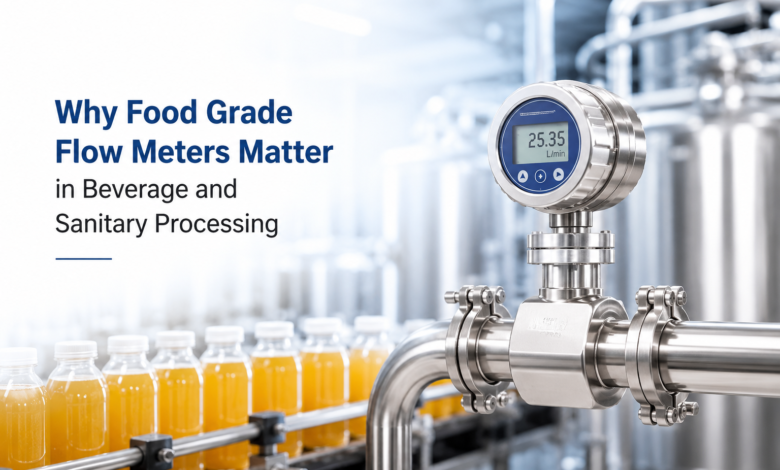
In food and beverage production, accurate flow measurement is about more than process efficiency. It also affects product consistency, sanitation, traceability, and overall system reliability. When a process involves ingredients, flavorings, syrups, water, or finished beverage products, the equipment used in the line must be suitable for hygienic service. That is why flow meter selection matters so much in sanitary applications.
Unlike general industrial flow measurement, sanitary processing places extra demands on instrumentation. Materials must be compatible with food and beverage products, surfaces must be suitable for clean operation, and the meter must perform reliably without introducing contamination concerns. In many facilities, the wrong meter can create challenges not only for measurement accuracy, but also for cleaning, inspection, and regulatory confidence.
One of the most important uses of hygienic flow measurement is batch consistency. In beverage systems, the amount of liquid moving through the line has a direct effect on product formulation, filling accuracy, and repeatability. If the measured flow is too high or too low, operators may see inconsistent product ratios, wasted ingredients, or quality deviations. In operations where precision matters, dependable flow measurement is a critical part of process control.
Another reason these meters are important is system cleanliness. Food and beverage facilities often need instrumentation that can support sanitary design expectations while operating dependably in real production environments. Flow meters used in these systems need to perform without becoming a weak point in the process. This is particularly important in beverage manufacturing, where liquids may vary in viscosity, sugar content, or cleaning requirements depending on the product being processed.
Flow measurement also supports production efficiency. In many beverage and food processes, operators rely on accurate flow data to confirm transfer rates, manage batching, track usage, and verify filling performance. Better measurement can help reduce product waste, improve repeatability, and support tighter control over production targets. In facilities where ingredient cost and product consistency are both important, that value becomes even more significant.
Another key factor is compliance and confidence. When instrumentation is intended for sanitary or beverage service, buyers often look for solutions that align with hygienic expectations and recognized approvals. That helps ensure the equipment is better suited to the application and gives operators more confidence in both performance and product compatibility. For this reason, many engineers and buyers specifically search for Food grade flow meters when reviewing options for beverage processing and sanitary liquid applications.
The right meter still depends on the details of the process. Flow range, fluid characteristics, viscosity, pressure, temperature, connection style, and cleaning requirements all influence the best choice. But in sanitary systems, it is not enough for a meter to simply measure flow. It also has to support the hygienic and operational needs of the application.
For beverage producers and other sanitary-process users, food-grade flow measurement is an important part of maintaining control, consistency, and product quality. When the process requires reliable measurement in a hygienic environment, selecting a meter designed for beverage and sanitary service is one of the smartest steps in building a dependable system.