What is a Consolidation Warehouse? Definition, Benefits, and Strategic Importance


In the complex world of modern logistics, efficiency is driven by the ability to maximize transport capacity while minimizing costs. A consolidation warehouse is a specialized storage facility where multiple small shipments from different suppliers are combined into a single, larger load before being dispatched to a common destination. This facility acts as a central hub that transforms fragmented supply chains into streamlined operations by converting Less-Than-Truckload (LTL) shipments into more economical Full-Truckload (FTL) units.
Unlike a traditional distribution center where goods may sit for long periods, a consolidation warehouse is designed for high-velocity movement. The goal is to gather various small batches, organize them by destination, and ship them out as a single consolidated unit, thereby significantly reducing the number of individual trips and handling points in the journey.
Understanding the Consolidation Process: From Receiving to Dispatch
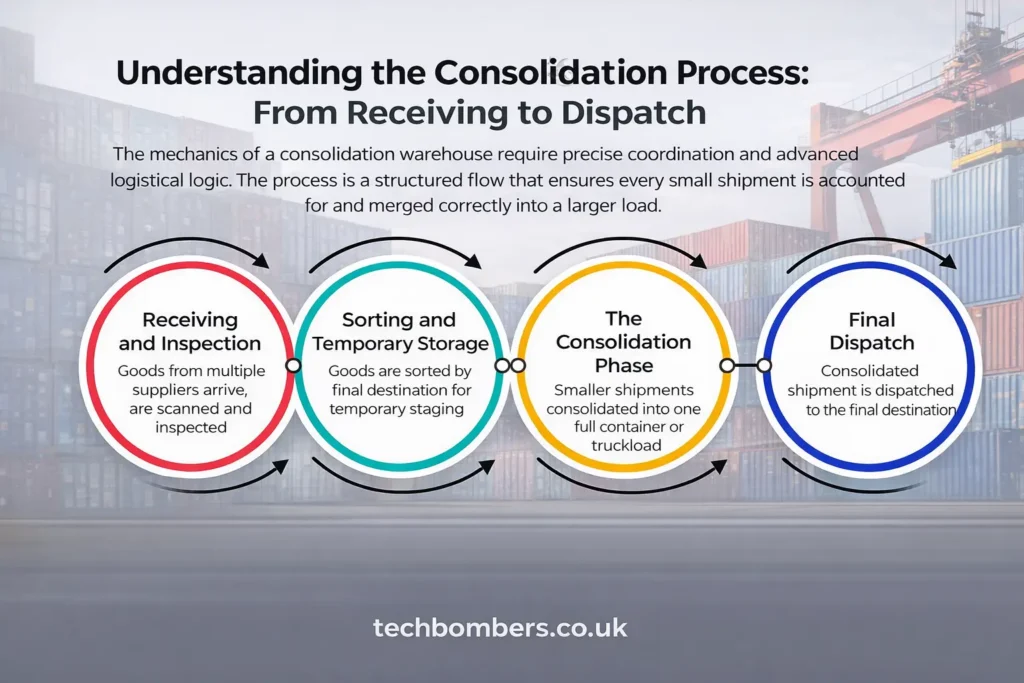
The mechanics of a consolidation warehouse require precise coordination and advanced logistical logic. The process is a structured flow that ensures every small shipment is accounted for and merged correctly into a larger load.
1. Receiving and Inspection: The cycle begins when various small shipments arrive from multiple suppliers. Upon arrival, each shipment is scanned and inspected to ensure the physical quantity matches the digital record in the Warehouse Management System (WMS).
2. Sorting and Temporary Storage: Once verified, the goods are sorted based on their final destination. Unlike standard warehouses, the storage here is often short-term. Items are moved to a specific “staging area” where they wait for the other components of the consolidated load to arrive.
3. The Consolidation Phase: This is the core operation. Logistical staff or automated systems combine multiple smaller orders—often on pallets—into a single container or truckload. This stage requires a deep understanding of weight distribution and volume optimization to ensure the final load is both safe and cost-effective.
4. Final Dispatch: Once the full load is ready, the system generates a single set of shipping documents for the entire unit. The consolidated shipment is then loaded onto a single vehicle and dispatched to its destination, such as a retail hub or a larger regional distribution center.
You Can Also Read: How to Select Best Dispatch Software For Construction Management?
Key Strategic Advantages of Consolidation Warehousing
For modern businesses, switching to a consolidation model provides several measurable benefits that directly impact the bottom line.
Drastic Shipping Cost Reduction
The primary driver for using a consolidation warehouse is the massive saving on transportation costs. Shipping several small LTL loads is significantly more expensive than shipping one FTL load. By consolidating freight, companies share the cost of the truck and the fuel, paying only for the space they use while benefiting from the lower rates associated with high-volume transport.
Improved Logistics Speed and Efficiency
While it may seem that adding a “stop” at a warehouse would slow down delivery, the opposite is often true. Consolidated loads follow more direct routes with fewer intermediate stops at various carrier terminals. This streamlined path reduces the risk of transit delays and ensures that goods reach the final destination faster than they would through fragmented shipping methods.
Reduced Carbon Footprint in 2026
In today’s environmentally conscious market, “Green Logistics” is no longer optional. Consolidation warehouses play a vital role in sustainability by reducing the total number of trucks on the road. Fewer vehicles mean lower carbon emissions and less traffic congestion, allowing firms to meet their corporate social responsibility (CSR) goals while optimizing their supply chain.
Lower Inventory Handling and Damage Risks
Every time a package is handled, the risk of damage increases. In a consolidation setup, goods are handled at the source and then again at the consolidation hub. Because the shipment travels as a single unit thereafter, there is far less manual handling at carrier terminals along the way. This leads to higher product integrity and a significant reduction in insurance claims and returns.
Critical Drawbacks: The Challenges of Consolidation
Despite the benefits, consolidation is not without its risks. It requires a high level of coordination and technical precision.
- Complexity in Planning: You must synchronize multiple suppliers to ensure all parts of the load arrive at the warehouse at the same time.
- Potential for Delays: If one supplier is late with a small shipment, it can delay the entire consolidated truckload, potentially affecting dozens of other orders.
- Need for Advanced Technology: Successful consolidation is almost impossible without a modern WMS. Manual tracking of fragmented shipments often leads to errors in sorting and shipping.
Essential Technology for Consolidation Warehouses
A consolidation warehouse is a tech-heavy environment. In 2026, firms are utilizing specific storage and software systems to manage high-velocity goods.
WMS and Cloud Integration
A robust Warehouse Management System (WMS) is the brain of the consolidation hub. It tracks every incoming LTL shipment and automatically calculates when a consolidated load is ready for dispatch. It also provides real-time visibility, allowing suppliers and customers to see where their portion of the load is at any given second.
High-Density Storage and Cross-Docking Systems
Because speed is critical, these warehouses often use Cross-Docking systems. This allows goods to move directly from the receiving dock to the outbound staging area with minimal or no long-term storage. Furthermore, high-density racking systems, such as Pallet Flow or Drive-In Racks, are used to maximize space for items that must wait for a few days before the full batch is ready.
Consolidation vs. Deconsolidation: Knowing the Difference
While consolidation is the process of combining small loads into one, deconsolidation is the exact inverse. Deconsolidation occurs when a large bulk shipment arrives at a facility and is broken down into smaller individual orders for “Last Mile” delivery to various customers. Most modern logistical hubs perform both functions, acting as a “Consolidation Center” for inbound supply and a “Deconsolidation Center” for outbound retail fulfillment.
Final Words
A consolidation warehouse is more than just a storage space; it is a strategic tool for cost control and logistical agility. By merging shipments, companies can navigate the rising costs of fuel and labor while providing faster, safer delivery to their customers. For any business looking to optimize its supply chain in 2026, mastering the art of consolidation is the key to sustainable growth.
You can Also Read: What is a 3PL Warehouse Management System?
FAQs
What is the main purpose of a consolidation warehouse?
The main purpose is to lower shipping costs by combining several small (LTL) shipments into one large (FTL) load, reducing the total number of trips required.
How is a consolidation warehouse different from a distribution center?
A distribution center usually stores goods for longer periods and serves as a stock hub. A consolidation warehouse is focused on the fast movement of goods, specifically for the purpose of merging freight for transport.
Which industries benefit most from consolidation?
Industries with high-volume, small-item shipments—such as e-commerce, retail, and pharmaceutical supplies—benefit the most because they often have multiple suppliers shipping to the same regional hubs.