
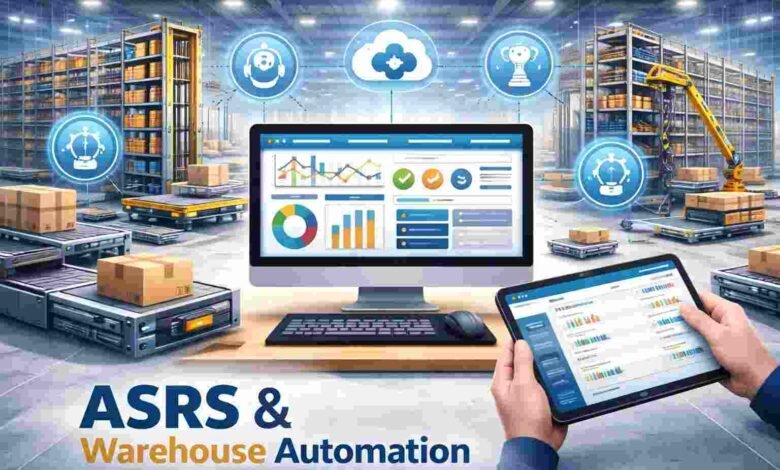
If you are running a warehouse in 2026, you are likely facing two massive headaches: the skyrocketing cost of industrial real estate and a labor market that is increasingly difficult to manage. You cannot simply “hire more people” to fix a slow fulfillment cycle anymore. This is why Automated Storage and Retrieval Systems (ASRS) have moved from being a luxury for giants like Amazon to a survival necessity for mid-sized firms.
An ASRS is not just a fancy robot that moves boxes. It is a complete re-imagining of how a warehouse functions. It is a computer-controlled system that replaces traditional wide-aisle racking with high-density, vertical storage modules that use robotic cranes or shuttles to handle inventory.
In this guide, we will break down the mechanics, the strategic pitfalls, and the real-world math of why ASRS is the single most important investment you can make for your facility.
The Myth of the “One-Size-Fits-All” Automation
One of the biggest mistakes business owners make is thinking they can just “buy an ASRS” and their problems will vanish.
In reality, ASRS is an umbrella term for several different technologies. If you choose the wrong one, you end up with a very expensive paperweight.
To understand what you need, you first have to look at your “Unit of Handling.” Are you moving full 1,000kg pallets of raw materials, or are you picking individual bottles of perfume for e-commerce?
Unit-Load ASRS: The Heavy Lifters
Unit-Load systems are designed for warehouses that deal with massive bulk. These systems use enormous Stacker Cranes that can reach heights of over 100 feet.
- How it works: These cranes run on a fixed rail system. They don’t just move forward and backward; they move vertically at the same time.
- The Human Perspective: Imagine a crane that can carry a pallet the size of a small car and place it at the height of a 10-story building with millimeter precision. This is the ultimate solution for “Buffer Storage”—where you need to store a lot of heavy stuff for a long time without wasting floor space on wide forklift aisles.
Mini-Load and Shuttle Systems: The Speed Demons
If your warehouse is a high-velocity environment—meaning items come in and go out every few hours—then cranes are too slow for you. You need Shuttles.
- The Mechanism: Instead of one big crane for an entire aisle, you have small, agile robots (shuttles) on every single level of the rack.
- The Speed Advantage: While a crane is busy on the 5th floor, a shuttle on the 2nd floor is already grabbing the next order. This “parallel processing” is what allows modern e-commerce hubs to ship orders within 30 minutes of a customer clicking “buy.”
The Death of Walking: Understanding “Goods-to-Person”
According to research by the Material Handling Institute(MHI), workers in traditional manual warehouses spend nearly 60% to 70% of their shift just walking. You are essentially paying for their legs, not their brain.
ASRS flips this completely through the Goods-to-Person (GTP) model. In a GTP setup:
- The worker stays in a high-tech, ergonomic “Port” or workstation.
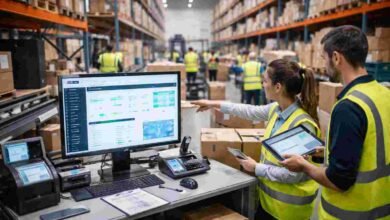
- The ASRS robot digs through the racks, finds the correct bin, and brings it directly to the worker’s waist level.
- The worker picks the item, hits a button, and the robot takes the bin back.
This doesn’t just make the process faster; it makes it sustainable. You no longer have workers getting “fatigue errors” at 4:00 PM because they’ve walked 12 miles. Their only job is to pick and verify, which keeps your accuracy levels at a near-perfect 99.99%.
Why Verticality is Your New Best Friend
Let’s talk about the math that Google and business consultants love. Most warehouses are “air-wasters.” If your warehouse has a 40-foot ceiling but your forklifts can only reach 20 feet, you are essentially paying rent on 50% of a space you aren’t using.
ASRS allows you to build Vertical High-Bay Racking. Since a robotic crane doesn’t need to worry about human balance or visibility, it can safely operate at heights that would be terrifying for a forklift driver.
- Density Comparison: A traditional warehouse might store 2,000 pallets in a specific area. An ASRS Unit-Load system can often fit 5,000 to 6,000 pallets in that exact same square footage.
- The Rent Factor: If you are in the UK or a high-rent district, doubling your storage capacity without moving to a new building is the difference between a profitable year and a loss.
The Hardware-Software “Handshake”: The Role of WMS and WCS
Bhai, ye wo hissa hai jahan bohot se log mar kha jate hain. Aap robots to le aate hain, lekin wo “bolte” kaise hain?
An ASRS is useless without a Warehouse Control System (WCS). Think of the WMS as the “Boss” who says, “We need to ship 50 units of Product X.” The WCS is the “Supervisor” who tells the specific robot, “Go to Aisle 4, Level 12, Bin 98, and bring it to Station 2.”
If your software is slow, your robots will “stutter.” They will stop and wait for data. In a 2026 setup, you need Sub-Second Latency. The communication between the sensor on the robot and the server must be instantaneous. This is why we emphasize high-speed IoT connectivity. Without a solid software handshake, your million-dollar robots are just expensive statues.
Strategic Implementation: How to Avoid an Automation Disaster
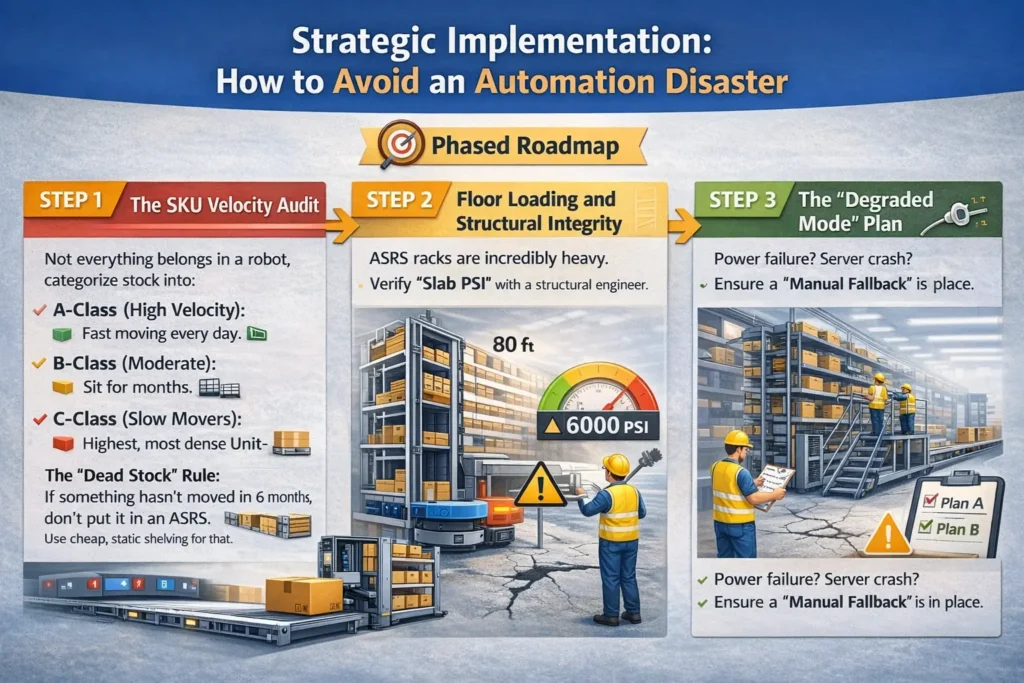
If you are convinced that ASRS is the way forward, do not jump into the deep end immediately. As a firm, we recommend a Phased Roadmap:
Step 1: The SKU Velocity Audit
Not everything belongs in a robot. You need to categorize your stock into A, B, and C classes.
- A-Class (High Velocity): These move every day. Put them in your fastest Shuttles.
- C-Class (Slow Movers): These sit for months. Put them in your highest, most dense Unit-Load racks.
- The “Dead Stock” Rule: If something hasn’t moved in 6 months, don’t put it in an ASRS. Use cheap, static shelving for that.
Step 2: Floor Loading and Structural Integrity
People forget that ASRS racks are incredibly heavy. When you stack pallets 80 feet high, the pressure on your concrete floor is immense. Before buying a system, you must have a structural engineer verify your “Slab PSI.” If your floor cracks, the entire robotic system will go out of alignment, leading to a catastrophic system failure.
Step 3: The “Degraded Mode” Plan
What happens if the power goes out? Or the main server crashes? A professional warehouse manager always has a “Manual Fallback.” You need to ensure your ASRS layout allows for manual access in emergencies. This “Plan B” is what separates a high-quality firm from an amateur operation.
The 2026 ROI Calculation: Is it Worth the Millions?
Let’s be honest: ASRS is expensive. The upfront CapEx (Capital Expenditure) can be daunting. But you have to look at the Total Cost of Ownership (TCO) over 5 to 10 years.
- Labor Savings: In a manual warehouse, you might need 40 pickers. With ASRS, you might only need 8. Calculate the salary, insurance, and taxes of those 32 people over 5 years. That alone usually pays for the system.
- Energy Efficiency: Robots don’t need the lights on. They don’t need the warehouse to be heated to “comfortable human levels.” “Dark Warehousing” can reduce your utility bills by 30%.
- Inventory Insurance: Because ASRS reduces damage and theft, your insurance premiums often drop.
Final Verdict: The Future is Automated
The days of the “Low-Tech” warehouse are numbered. As customer expectations move toward “Same-Day Delivery,” the human body simply cannot keep up with the data and the speed required. ASRS is the solution that allows your business to scale without being limited by the number of people you can hire or the amount of floor space you can rent.
It is a journey from being a “Storage Room” to becoming a “Precision Fulfillment Engine.”
You can Also Read: 8 Ways to Choose a Warehouse Management System
FAQs
Can I install ASRS in my old warehouse?
Yes, but it’s called a “Retrofit.” It’s harder because you have to work around existing pillars and low ceilings. Modular shuttle systems are usually the best bet for older buildings.
How long does the installation take?
From the first blueprint to the first “Live Pick,” expect 12 to 18 months. This is a marathon, not a sprint. You need time for testing and software integration.
Will robots replace all my workers?
No. They replace the “boring” parts of the job. You will still need people for quality control, maintenance, and handling “non-conveyable” items (things that are too big or weirdly shaped for a robot).