
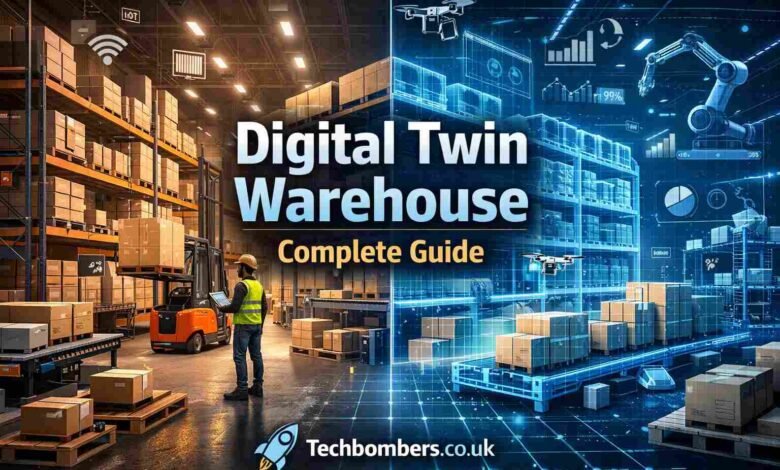
Warehousing is no longer just about storing goods.
It has become a complex system where speed, accuracy, and efficiency directly impact business success. Customers expect faster deliveries, supply chains are becoming unpredictable, and competition is tighter than ever.
Yet many warehouses still operate with limited visibility. Managers often don’t know what’s happening on the floor until it’s too late. Inventory mismatches, delays in picking, and inefficient layouts quietly eat into profits.
This is exactly where the concept of a digital twin warehouse becomes important.
Instead of relying on reports and assumptions, businesses can now create a live digital version of their warehouse that reflects every movement, every process, and every inefficiency in real time.
This is not just another tech trend. It’s a shift in how warehouses are managed, optimized, and scaled.
What Is a Digital Twin Warehouse? (In Practical Terms)
A digital twin warehouse is not just a 3D model or a fancy dashboard.
It is a live, continuously updated digital replica of your physical warehouse, powered by real-time data.
Imagine being able to open a system and instantly see:
- Where every product is located
- Which areas are congested
- How workers are moving through tasks
- Which machines are slowing down
This is what a digital twin does.
But the real value is not just visibility.
It allows you to analyze, predict, and improve operations before problems occur.
For example, instead of discovering that an order is delayed after it happens, a digital twin can show early signs of delay and allow you to act immediately.
That shift—from reacting to predicting—is what makes this technology powerful.
You Might Also Check: What Are Self-Healing Warehouses? The Next Big Thing in Logistics
Why Warehouses Need Digital Twins Today
Most warehouses already use systems like WMS (Warehouse Management Systems). But these systems often provide static or delayed information.
The real issue is not lack of data.
It lacks usable, real-time insight.
Here’s what typically happens in a traditional warehouse:
- Inventory data updates after processes are completed
- Bottlenecks are identified only after delays
- Space utilization is guessed rather than measured
- Decisions are based on past reports instead of current reality
This creates a gap between what is happening and what decision-makers see.
A digital twin closes that gap.
It connects physical operations directly with digital intelligence, so decisions are based on what is happening right now—not yesterday.
How a Digital Twin Warehouse Actually Works (Step-by-Step)
To understand this properly, let’s break it down in a practical way.
Capturing Data from the Physical World
Everything starts with data collection.
A warehouse is equipped with technologies such as:
- IoT sensors to track movement and environmental conditions
- RFID and barcode systems to monitor inventory
- Cameras and computer vision systems to analyze activity
- Existing systems like WMS and ERP
These tools continuously collect data about location, movement, and status.
This is not occasional tracking—it’s continuous and automated.
Processing and Structuring the Data
Raw data on its own is not useful.
It needs to be processed and organized.
This is where analytics and AI come in.
The system converts raw inputs into structured insights, such as:
- Real-time inventory levels
- Movement patterns inside the warehouse
- Performance metrics for operations
- Equipment efficiency data
Instead of looking at scattered numbers, you get meaningful insights.
Creating the Digital Environment
Once processed, the data is visualized in a digital environment.
This can take different forms:
- A dashboard showing key metrics
- A visual map of the warehouse
- A 3D simulation of operations
The goal is simple: make complex operations easy to understand.
Managers should be able to look at the system and immediately know what’s working and what’s not.
Real-Time Synchronization
The most critical part is synchronization.
The digital twin is constantly updated with live data.
If inventory moves, the system reflects it instantly. If a delay occurs, it becomes visible immediately.
This real-time connection ensures that the digital model is always aligned with reality.
Key Capabilities That Make Digital Twins Powerful
A digital twin warehouse is not just about monitoring. It actively improves operations.
Real-Time Operational Visibility
You no longer need to wait for reports.
Everything—from inventory to workflow—is visible as it happens.
This reduces uncertainty and allows faster responses.
Bottleneck Identification
Instead of guessing where delays occur, you can see exactly where processes slow down.
For example, you might discover that:
- Picking routes are inefficient
- Packing stations are overloaded
- Certain zones create congestion
This level of clarity is difficult to achieve with traditional systems.
Predictive Insights
One of the most valuable capabilities is prediction.
The system analyzes patterns and identifies risks before they turn into problems.
This could include:
- Predicting stock shortages
- Identifying upcoming delays
- Detecting early signs of equipment failure
This allows businesses to act early rather than react later.
Simulation and Scenario Testing
A digital twin allows you to test decisions before implementing them.
For example:
- What happens if you change warehouse layout?
- How will adding more workers affect efficiency?
- Will automation improve throughput or create new bottlenecks?
Instead of taking risks, you can simulate outcomes first.
Detailed Use Cases (Where Real Value Comes From)
Inventory Accuracy and Control
Inventory errors are one of the most expensive problems in warehousing.
A digital twin eliminates guesswork.
You always know:
- Exact stock levels
- Precise product locations
- Movement history of items
This reduces lost items, incorrect shipments, and stock discrepancies.
Warehouse Layout Optimization
Many warehouses waste space without realizing it.
A digital twin reveals:
- Underutilized areas
- Overcrowded zones
- Inefficient storage patterns
With this insight, layouts can be redesigned based on actual usage data—not assumptions.
Workforce Optimization
Labor is a major cost in warehousing.
Digital twins help analyze:
- Worker movement paths
- Task completion times
- Idle time vs productive time
This helps improve workforce allocation and productivity without overworking staff.
Equipment Monitoring and Maintenance
Machines don’t fail instantly—they show warning signs.
A digital twin tracks performance data and detects anomalies early.
This allows:
- Scheduled maintenance instead of emergency repairs
- Reduced downtime
- Longer equipment lifespan
Order Fulfillment Efficiency
Faster order processing is critical.
A digital twin helps optimize:
- Picking routes
- Packing workflows
- Dispatch timing
This leads to faster delivery and fewer errors.
You Might Also Check: How Can Modern Technology Enhance Inventory Accuracy?
Business Benefits (Beyond Operations)
Better Decision-Making
Decisions are based on real-time data, not assumptions.
This improves accuracy and reduces risk.
Lower Operational Costs
By reducing errors, improving efficiency, and preventing downtime, overall costs decrease.
Improved Customer Experience
Faster and more accurate deliveries lead to better customer satisfaction.
Scalability
As operations grow, the system scales with them.
You don’t lose control as complexity increases.
Challenges You Should Be Aware Of
No technology is perfect.
Initial Investment
Setting up infrastructure requires capital.
However, this should be seen as a long-term investment.
System Integration
Connecting existing systems can be complex.
Older systems may need upgrades.
Data Handling
Large amounts of data require proper management and security.
Skill Gap
Teams need training to fully use the system.
Without proper understanding, the value is limited.
What the Future Looks Like
Digital twin warehouses are just the beginning.
In the future, we can expect:
- Fully autonomous warehouses with minimal human intervention
- AI systems that make decisions without manual input
- Integration across the entire supply chain
- Real-time collaboration between suppliers, warehouses, and logistics
Warehousing will shift from manual control to intelligent systems.
Final Thoughts
A digital twin warehouse is not just about technology.
It’s about visibility, control, and smarter decision-making.
Businesses that adopt this approach move from reacting to problems to preventing them.
They gain clarity over operations that were once difficult to manage.
And most importantly, they build systems that can adapt to future demands.
In a world where speed and accuracy define success, that advantage matters.
For more insights, read our article on: RaaS in Warehousing: Benefits, Use Cases & Trends