
Smart Sensors in Warehouse: Types, Use Cases & Benefits (2026 Guide)

Warehouses are no longer just storage spaces. They are becoming data-driven environments where every movement, condition, and process can be tracked in real time.
The shift is happening because of one key technology: smart sensors.
Instead of relying only on manual checks or periodic scans, warehouses can now monitor temperature, movement, weight, and location continuously. This improves accuracy, reduces delays, and helps prevent costly mistakes.
In this guide, we will break down what smart sensors are, how they work in warehouses, the different types you should know, and where they actually make a difference.
What Are Smart Sensors?
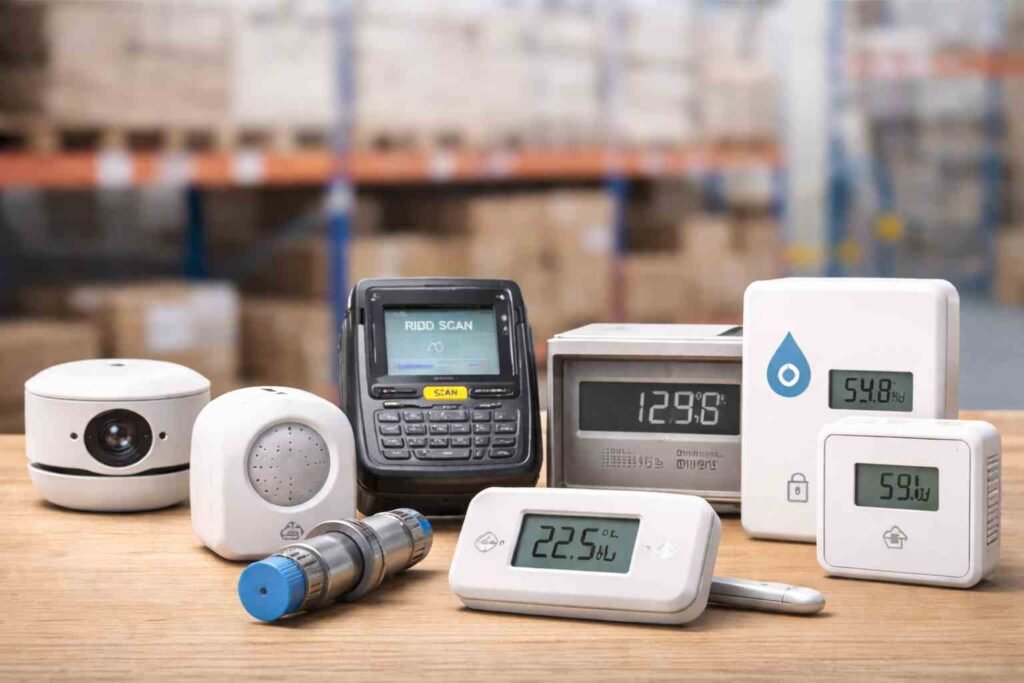
Smart sensors are devices that collect physical data from the environment and send it to a system for processing. Unlike basic sensors, they can process data, communicate with other devices, and trigger actions automatically.
In a warehouse, these sensors act as the eyes and ears of the system.
They can detect:
- Movement of goods
- Temperature changes
- Equipment activity
- Storage conditions
Most smart sensors are connected through IoT (Internet of Things), which allows them to send data to warehouse management systems in real time.
How Smart Sensors Work in a Warehouse
Smart sensors follow a simple but powerful process:
Data collection
The sensor detects a physical condition such as motion, weight, or temperature.
Data transmission
The data is sent to a central system using wireless technologies like Wi-Fi, Bluetooth, or industrial networks.
Data processing
The warehouse system analyzes the data and identifies patterns or issues.
Action or alert
The system can trigger alerts, update inventory, or automate decisions.
For example, if a temperature sensor detects a rise in a cold storage area, the system can immediately alert staff or adjust cooling systems.
This real-time response is what makes smart sensors valuable.
You Might Also Check: Warehouse Slotting Optimization with AI (2026)
Types of Smart Sensors Used in Warehouses
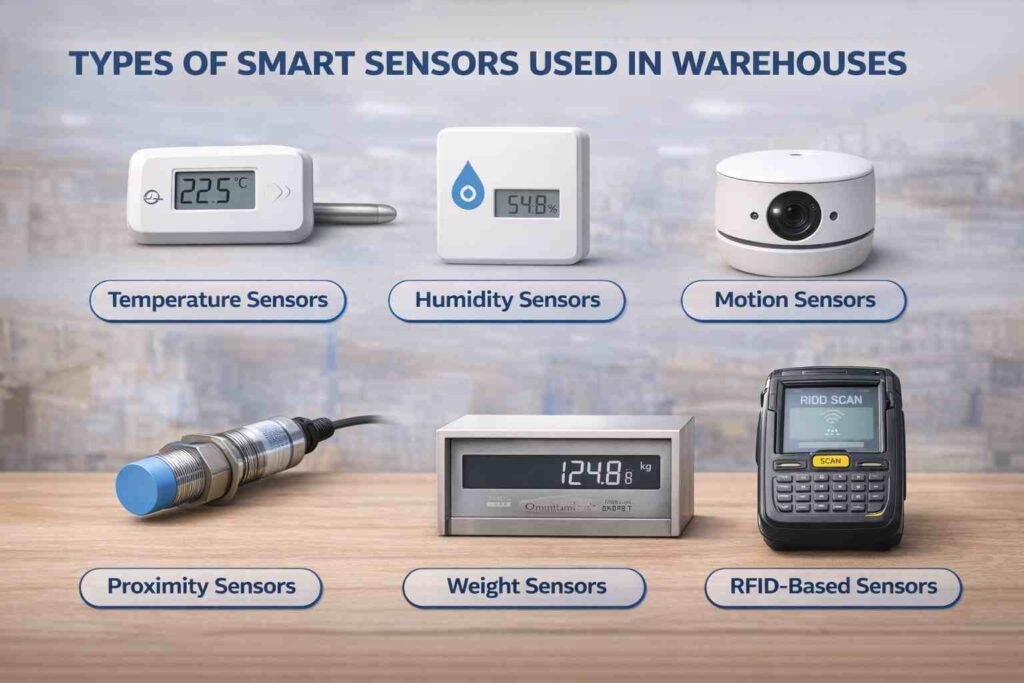
Different sensors are used for different purposes. Understanding these types helps in choosing the right setup.
Temperature Sensors
Temperature sensors monitor environmental conditions, especially in warehouses storing food, pharmaceuticals, or sensitive goods.
They ensure that products remain within safe limits. If temperatures go beyond a set range, alerts are triggered.
Humidity Sensors
Humidity sensors track moisture levels in the air. This is important for products like electronics, paper goods, and chemicals.
Too much moisture can damage inventory, while too little can affect certain materials.
Motion Sensors
Motion sensors detect movement within a specific area. They are often used for:
- Security monitoring
- Tracking worker movement
- Detecting activity in restricted zones
They help improve safety and reduce unauthorized access.
Proximity Sensors
Proximity sensors detect when objects are near without physical contact.
In warehouses, they are used in:
- Conveyor systems
- Automated picking systems
- Robotics navigation
They help machines operate safely and efficiently.
Weight Sensors
Weight sensors measure the load on shelves, pallets, or conveyor belts.
They are useful for:
- Inventory estimation
- Detecting overloading
- Monitoring stock levels automatically
Instead of counting items manually, weight sensors can provide quick estimates.
RFID-Based Sensors
RFID tags can also act as sensors when combined with smart systems. They help identify and track items automatically.
When integrated with sensor networks, they provide both identification and location data.
Real-World Use Cases of Smart Sensors
Smart sensors are not just theoretical. They are already being used in practical ways across modern warehouses.
Inventory Tracking
Sensors help track where items are stored and how they move. Combined with RFID or other systems, they provide real-time inventory visibility.
This reduces the need for manual stock checks.
Cold Storage Monitoring
In temperature-sensitive environments, sensors continuously monitor conditions.
If something goes wrong, alerts are sent immediately. This helps prevent product loss and ensures compliance with storage standards.
Equipment Monitoring
Sensors can be attached to machines to track usage and performance.
They can detect:
- Overheating
- Unusual vibrations
- Equipment failure risks
This supports predictive maintenance and reduces downtime.
Worker Safety
Motion and proximity sensors improve safety by detecting risky situations.
For example:
- Warning when workers are too close to moving equipment
- Monitoring restricted areas
- Identifying unsafe movement patterns
Automated Systems
Smart sensors are a key part of automation.
They guide:
- Robots
- Conveyor systems
- Sorting machines
Without sensors, automation would not function properly.
Benefits of Smart Sensors in Warehousing
Improved Accuracy
Manual processes often lead to errors. Sensors reduce human involvement in data collection, which improves accuracy.
Real-Time Visibility
Instead of waiting for updates, warehouse managers can see what is happening instantly.
This helps in faster decision-making.
Increased Efficiency
Automation powered by sensors speeds up operations.
Tasks like monitoring, tracking, and checking conditions happen automatically.
Cost Savings Over Time
Although sensors require investment, they reduce:
- Labor costs
- Product losses
- Equipment downtime
Over time, this leads to cost savings.
Better Compliance
For industries like food and pharmaceuticals, maintaining proper conditions is critical.
Sensors help ensure compliance with storage standards and regulations.
You Might Also Check: What Are Self-Healing Warehouses? The Next Big Thing in Logistics
Challenges of Using Smart Sensors
Initial Cost
Setting up a sensor network requires investment in hardware, software, and integration.
Integration Complexity
Sensors must work with existing systems like WMS or ERP.
This can require technical expertise and planning.
Maintenance
Sensors need regular checks to ensure accuracy and proper functioning.
Battery-powered sensors may need replacements.
Data Management
Large numbers of sensors generate a lot of data.
Warehouses need systems to manage, analyze, and use this data effectively.
Future of Smart Sensors in Warehouses
The role of smart sensors will continue to grow.
Some key developments include:
AI Integration
Sensors combined with AI can predict issues before they happen.
For example, detecting patterns that indicate equipment failure.
More Affordable Hardware
Sensor technology is becoming more accessible, making it easier for smaller warehouses to adopt it.
Better Connectivity
With technologies like 5G, sensors can communicate faster and more reliably.
Fully Connected Warehouses
In the future, warehouses will rely on a network of connected devices working together.
Sensors will play a central role in this ecosystem.
Final Thoughts
Smart sensors are changing how warehouses operate. They provide real-time data, improve accuracy, and support automation.
However, they are not a one-size-fits-all solution.
For smaller warehouses, a full sensor-based system may not be necessary. But for larger operations or businesses dealing with sensitive goods, smart sensors offer clear advantages.
The key is to use them where they add real value.
As warehouse technology continues to evolve, sensors will become a standard part of modern operations, not just an optional upgrade.
For more insights, read our article on: How IoT Can Be Used in a Warehouse: A Complete Implementation Guide
FAQs
What are smart sensors used for in warehouses?
They are used to monitor conditions, track movement, improve safety, and support automation.
Are smart sensors expensive?
They can be costly initially, but they often reduce long-term operational costs.
Do smart sensors replace barcode systems?
No. They often work alongside barcode or RFID systems to improve tracking.
Can small warehouses use smart sensors?
Yes, but usually in a limited way, focusing on specific needs like temperature monitoring.
Are smart sensors reliable?
Yes, when properly installed and maintained, they provide accurate and consistent data.