
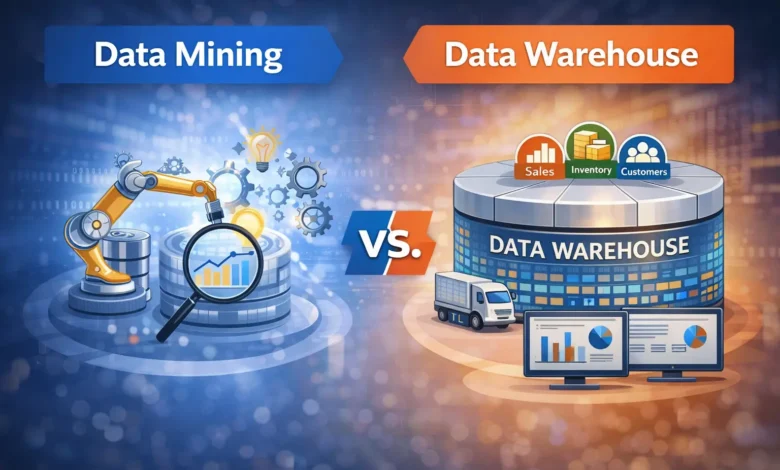
A data warehouse is a centralized storage system that aggregates data from multiple sources for reporting, while data mining is a technical process used to extract hidden patterns and insights from that stored data. Think of a data warehouse as a massive digital library where information is organized and stored, and data mining as the researcher who studies the books to find new theories or trends.
In a professional business environment, these two concepts work together to drive decision-making. You cannot effectively mine data if it is scattered across different departments; therefore, the warehouse provides the necessary foundation. Conversely, a data warehouse alone is just a static repository; without data mining, you cannot turn that historical information into predictive intelligence for the future.
Understanding the Data Warehouse (The Foundation)
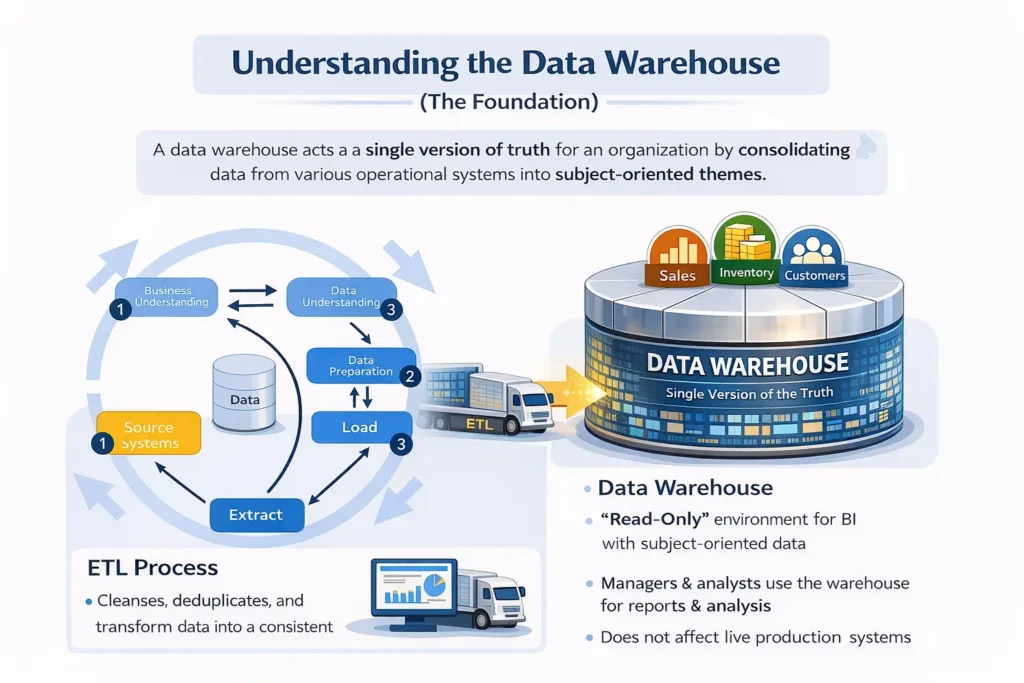
A data warehouse acts as a single version of truth for an entire organization by consolidating data from various operational systems. It is a “subject-oriented” repository, meaning it organizes data around specific business themes like Sales, Inventory, or Customers, rather than focusing on daily transactions.
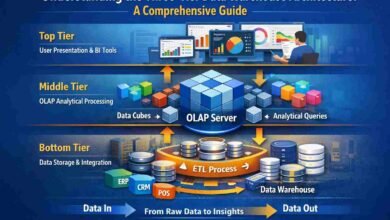
The primary goal of a data warehouse is to provide a clean, structured environment for Business Intelligence (BI). Before data enters the warehouse, it undergoes a process called ETL (Extract, Transform, Load). This process cleanses the data, removes duplicates, and ensures that the information is consistent. Once the data is loaded, it becomes a “Read-Only” environment, allowing managers and analysts to run complex reports without slowing down the company’s live production systems.
Understanding Data Mining (The Intelligence)
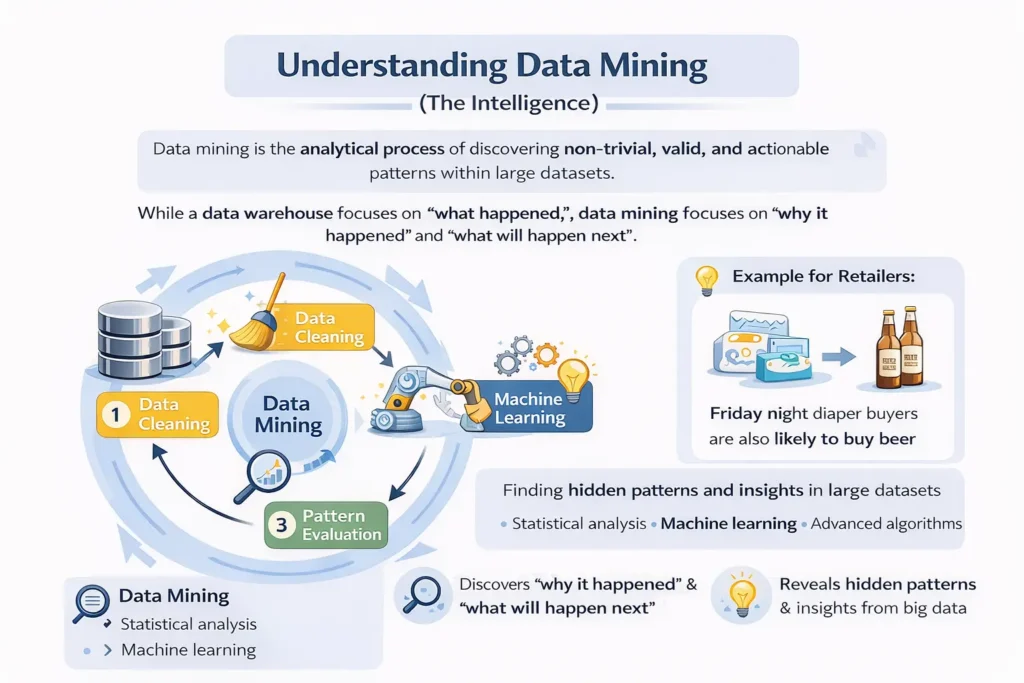
Data mining is the analytical process of discovering non-trivial, valid, and actionable patterns within large datasets. While a data warehouse focuses on “what happened,” data mining focuses on “why it happened” and “what will happen next”.
To perform data mining, experts use sophisticated statistical algorithms and machine learning techniques. The process involves several stages, including data cleaning, pattern evaluation, and knowledge representation. For example, a retail company might use data mining to find that customers who buy diapers on Friday nights are also likely to buy beer. This kind of “hidden” insight is impossible to find through standard reporting but becomes obvious through the deep-dive analysis that mining provides.
Data Mining vs. Data Warehouse: Head-to-Head Comparison
To choose the right strategy for your business, you must understand how these two functions differ across several technical and operational categories.
| Feature | Data Warehouse | Data Mining |
| Primary Goal | Consolidates and stores historical data for reporting. | Discovers hidden patterns and predictive insights. |
| Data Nature | Subject-oriented, integrated, and non-volatile. | Exploratory, statistical, and algorithm-driven. |
| Time Focus | Focuses on historical and current data. | Focuses on future trends and predictions. |
| User Base | Business analysts, managers, and executives. | Data scientists and specialized data analysts. |
| Process | Uses ETL to assemble data. | Uses mathematical algorithms to analyze data. |
How They Work Together (The Synergy)
You achieve the best results when you treat the data warehouse as the primary source for your data mining activities. Relying on raw, uncleaned data from different department spreadsheets for mining often leads to inaccurate conclusions.
The professional workflow follows a specific sequence:
- Data Ingestion: Raw data from CRM, ERP, and POS systems is extracted.
- Warehousing: The data is transformed and stored in a structured data warehouse.
- Mining Preparation: Data scientists pull a specific subset of data (often called a Data Mart) from the warehouse.
- Pattern Discovery: Mining algorithms analyze this clean data to identify trends.
- Decision Making: Executives use the discovered knowledge to change business strategies.
Without a warehouse, data mining is a slow and error-prone process. Without mining, a data warehouse is an expensive storage room with no active output.
Real-World Use Cases in 2026
Modern industries rely on the combination of warehousing and mining to maintain a competitive edge in a fast-paced market.
- E-commerce and Retail: Companies use a data warehouse to store years of purchase history. Data mining algorithms then analyze this history to create “Recommendation Engines” (like Amazon’s “People also bought” section), which significantly increases cross-selling revenue.
- Banking and Finance: Banks store millions of daily transactions in a secure data warehouse. Data mining tools monitor this data in real-time to detect “Anomalies”—patterns that deviate from a customer’s normal behavior—allowing the bank to block fraudulent transactions instantly.
- Healthcare Systems: Hospitals maintain patient records and treatment outcomes in a data warehouse. Mining these records allows researchers to identify which treatments are most effective for specific demographics, leading to “Personalized Medicine” that improves survival rates.
Final Words: Choosing the Right Strategy
Building a data warehouse should always be your first step toward becoming a data-driven organization. You cannot build high-level intelligence on a weak foundation. Once your data is centralized and clean, you can then invest in data mining to uncover the “Gold” hidden within your information.
In 2026, the businesses that succeed are those that do not just “keep” data, but those that “understand” it. By integrating a robust data warehouse with sophisticated mining techniques, you ensure that your company is always looking forward, not just looking back.
You can Also Read: What is a Digital Warehouse?
FAQs
Can you perform data mining without a data warehouse?
Yes, it is possible to mine data directly from raw sources, but it is highly inefficient. You will spend 80% of your time cleaning the data rather than analyzing it, and the results are often inconsistent due to poor data quality.
Which one is harder to implement?
A data warehouse is generally more difficult and expensive to set up initially because it requires complex ETL pipelines and massive infrastructure. Data mining requires specialized talent (Data Scientists), but it can be scaled more easily once the data foundation is ready.
Are data mining and machine learning the same thing?
Data mining is the broader field of finding patterns in data, while machine learning is one of the primary tools or “methods” used to perform that mining. Machine learning allows the mining process to become “automated” and improve over time without manual intervention.