

How do we truly measure academic success? Is it just about grades, or is there more to it?
For years, marks and GPA have been the primary way to judge performance in education. But these numbers often fail to capture the full picture. A student may score well but lack critical thinking skills. A teacher may deliver lectures but contribute little to research or innovation.
This is where the concept of Academic Performance Indicator (API) becomes important.
API is designed to offer a more complete and structured way to evaluate academic performance. It goes beyond marks and looks at multiple dimensions of learning, teaching, and contribution.
In this article, we will explore what API is, how it works, why it matters, and where it falls short.
What is Academic Performance Indicator (API)?
An Academic Performance Indicator (API) is a system used to measure academic performance through a set of defined criteria.
Instead of relying on a single number like a grade, API evaluates performance using different indicators. These indicators may include teaching quality, research output, student engagement, and more.
In simple terms, API answers a broader question:
How well is a person or institution performing in all aspects of education?
It is commonly used for:
- Evaluating teachers for promotions
- Measuring student performance beyond exams
- Assessing institutional quality
API is not just a score. It is a structured framework that turns academic activities into measurable outcomes.
Why Traditional Evaluation Methods Are Not Enough
Traditional academic evaluation focuses heavily on exams. While exams test knowledge, they do not measure everything.
Here are some common gaps:
- Exams often reward memorization rather than understanding
- Creativity and critical thinking are rarely measured
- Participation and engagement are ignored
- Teaching effectiveness is difficult to evaluate through student results alone
Because of these limitations, education systems began moving toward more comprehensive evaluation methods. API is one of those approaches.
You Might Also Check: Standardized Testing in 2026: What’s New and What’s Next
The Concept Behind API
The idea of API comes from performance measurement systems used in business and management, often known as Key Performance Indicators (KPIs).
In education, the same logic applies. If you want to improve performance, you need clear and measurable indicators.
API works on three basic principles:
- Measurement – Define what counts as performance
- Standardization – Use the same criteria for everyone
- Evaluation – Compare results and make decisions
This approach helps institutions move from subjective judgment to data-based evaluation.
Core Components of Academic Performance Indicator
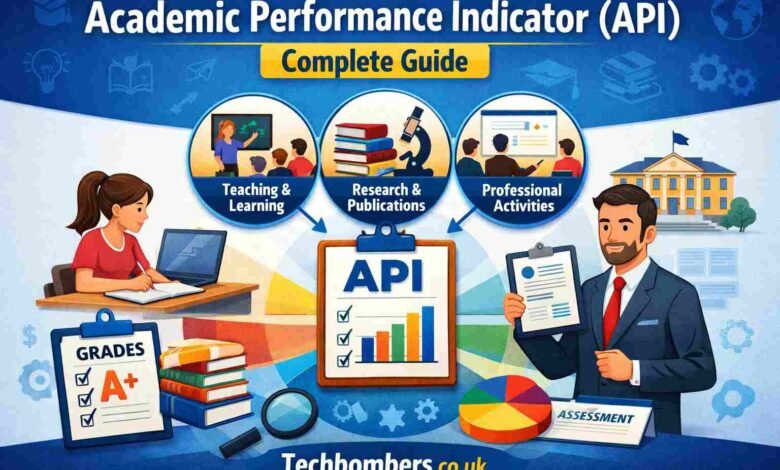
API usually includes multiple components to capture different aspects of academic work. While the exact structure may vary, most systems include the following three areas.
Teaching and Learning
This is the foundation of any academic system.
Indicators in this category may include:
- Classroom teaching quality
- Student performance and outcomes
- Course planning and delivery
- Mentoring and supervision
The goal is to measure how effectively knowledge is delivered and understood.
Research and Academic Output
Education is not only about teaching. It also involves creating new knowledge.
This component evaluates:
- Research publications
- Academic papers and articles
- Books or contributions to academic literature
- Research projects
Strong research output reflects intellectual contribution and academic growth.
Professional and Institutional Contribution
Academic work goes beyond classrooms and research papers.
This area includes:
- Participation in seminars and workshops
- Academic leadership roles
- Contribution to institutional development
- Community engagement
These activities show involvement in the broader academic environment.
Types of Academic Performance Indicators
API uses both quantitative and qualitative indicators to provide a balanced evaluation.
Quantitative Indicators
These are measurable and easy to track.
Examples include:
- Grades and GPA
- Attendance percentage
- Number of publications
- Completion rates
Quantitative data provides clear and objective information. However, it does not always reflect quality.
Qualitative Indicators
These focus on aspects that are harder to measure but equally important.
Examples include:
- Critical thinking ability
- Creativity
- Communication skills
- Classroom engagement
Qualitative indicators require observation and judgment. They add depth to the evaluation process.
How API is Calculated
API systems often use a points-based structure.
Each activity is assigned a certain number of points. These points are then added to calculate a total score.
For example:
- Teaching activities may carry a fixed number of points
- Research publications may earn points based on quality and impact
- Participation in academic events may also contribute
The final API score represents overall performance.
The exact formula may vary between institutions, but the idea remains the same: convert academic work into measurable units.
Real-World Applications of API
API is widely used in different parts of the education system.
Teacher Evaluation
Many institutions use API scores to:
- Assess teaching performance
- Decide promotions and career progression
- Identify areas for improvement
This ensures that evaluation is based on clear criteria rather than personal opinion.
Student Assessment
API can also be used to evaluate students more holistically.
Instead of focusing only on exams, it considers:
- Participation
- Projects and assignments
- Overall engagement
This approach encourages balanced learning.
Institutional Assessment
Educational institutions use API-like systems to:
- Measure academic quality
- Improve standards
- Maintain accountability
It helps in ranking and benchmarking institutions.
You Might Also Check: Centro Politecnico Superior: Top Technical Education for Career Success
Benefits of Academic Performance Indicator
API offers several advantages over traditional evaluation methods.
Comprehensive Evaluation
It covers multiple aspects of academic work, not just exam results.
Transparency
Clear criteria reduce bias and make evaluation more objective.
Encourages Improvement
When performance is measured, it becomes easier to identify weaknesses and improve.
Standardization
API creates a uniform system that can be applied across departments or institutions.
Better Decision Making
Administrators can use API data for:
- Promotions
- Policy decisions
- Resource allocation
Limitations and Criticism of API
Despite its benefits, API is not without problems.
Overemphasis on Numbers
When performance is reduced to scores, quality may be ignored. People may focus on earning points rather than meaningful work.
Pressure on Teachers and Students
A points-based system can create stress. Individuals may feel forced to meet targets instead of focusing on learning.
Quantity Over Quality
In research, this is a major issue. Some may produce more publications just to increase their score, even if the quality is low.
Limited Measurement of Soft Skills
Not all skills can be measured easily. Creativity, ethics, and deep understanding may not be fully captured.
Risk of Standardization
While standardization is useful, it may ignore individual differences and unique strengths.
The Future of Academic Performance Measurement
Education is evolving, and so are evaluation systems.
API is likely to change in the following ways:
Use of Technology
Digital tools and learning platforms can track performance in real time.
Personalized Evaluation
Future systems may focus more on individual learning paths rather than fixed criteria.
Data-Driven Insights
Advanced analytics can provide deeper insights into performance trends.
Balanced Approach
There is growing awareness that both quantitative and qualitative factors must be considered equally.
How to Improve Academic Performance Within an API System
Understanding API can help individuals improve their performance.
For Students
- Focus on understanding, not just memorization
- Participate actively in class
- Complete assignments with quality
- Develop communication and analytical skills
For Teachers
- Improve teaching methods regularly
- Engage students in meaningful discussions
- Focus on quality research
- Participate in academic development activities
Conclusion
Academic Performance Indicator is more than just a scoring system. It represents a shift toward a more structured and comprehensive way of evaluating education.
By combining teaching, research, and overall contribution, API provides a broader view of academic performance. It helps institutions maintain standards and supports better decision-making.
However, it is important to use API wisely. Numbers should guide improvement, not replace meaningful learning.
In the end, true academic success cannot be captured by scores alone. It lies in understanding, growth, and the ability to apply knowledge in real life.
Stay connected with our educational page for more such tech education information