

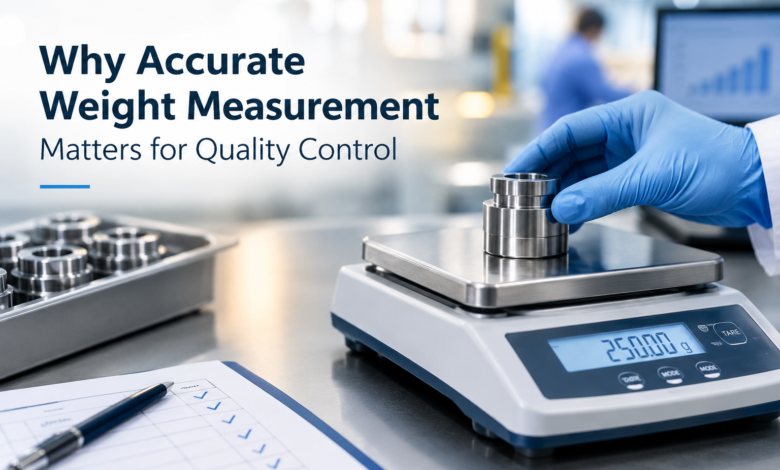
Achieving high quality on a consistent basis is one of the most imperative objectives that almost any business has. This applies across the likes of manufacturing premises, laboratories, food production sites, and other industrial settings.
Accurate weight measurement may be far from the only factor dictating whether such organisations realise sustained quality control, but it can certainly be a major one.
Businesses that invest in quality weighing scales available from RS can be better placed to measure materials reliably, keep a close eye on production processes, and ensure finished products adhere to the required specifications.
Here are a few of the reasons for the accurate measurement of weight being so important from a quality-control perspective.
- It Can Help Maintain Product Consistency
Accurate weighing can be a vital step on the road to ensuring products are manufactured to consistent standards. This can be especially the case when the measurement of ingredients, raw materials, or individual components is needed.
The repeatability of formulations needs to be ensured when it comes to such operations as food production and chemical processing.
Sure enough, the consistently precise weighing of ingredients can support this goal. For example, when manufacturers are able to reliably check the exact weight of components, they can be in a strong position to notice variations potentially indicating material inconsistencies or production issues.
In the absence of reliable weight measurements, even merely “small” discrepancies that creep in can have an accumulative effect across production runs. This could have a detrimental impact on the performance, appearance, or all-round quality of a final product.
- It Can Be Key to Lowering Waste and Controlling Costs
Businesses in a variety of sectors are also understandably mindful of the importance of managing their material usage responsibly. If packages are constantly overfilled, excessive quantities of ingredients added, or more raw material used than strictly necessary, this can push up operating costs over time.
However, such organisations should be equally vigilant to avoid the underfilling of products. After all, this may leave customers dissatisfied, lead to batches having to be rejected, or bring about regulatory issues, depending on the application.
When a business with these concerns has reliable weighing equipment to hand, it can be in a better position to establish appropriate target weights and monitor any deviations over the course of production.
The organisation’s integration of accurate weight measurement into its broader quality-control efforts can help it use materials more efficiently, drive down avoidable waste, and refine its cost-management practices.
- It Can Support Compliance and Quality Standards
Reliable measurement processes are not just a “nice to have”. They are, instead, essential for organisations that need to satisfy exacting customer specifications, comply with formal quality-management systems, and adhere to regulatory obligations.
If, for example, a given UK-based business sells prepackaged goods by weight, it can’t afford to ignore or overlook applicable UK weights and measures legislation. These include requirements relating to the quantity stated on product packaging.
Businesses can better demonstrate that their processes are adequately controlled when they have suitable weight measurement equipment in place, together with appropriate checking procedures.
Of course, it is important to emphasise at this point that simply investing in and using the right weighing instrument won’t suffice on its own to ensure compliance. That’s why organisations must also pay close attention to factors like calibration, the training of their personnel, and documented procedures.
Conclusion: The Accurate Measurement of Weight Is a Must-Not-Ignore Priority
Far from the peripheral laboratory task that some observers might imagine it to be, accurate weight measurement is a core control point that plays a fundamental role in protecting product quality, regulatory compliance, and commercial performance.
When a given organisation takes the time and care to invest in dependable weighing technology and well-honed procedures, it can be putting itself in an advantageous position to drive measurable returns. This is achievable through a combination of fewer deviations, tighter adherence to the law, and more consistent output.
Such efforts, in turn, can help deliver products that satisfy even the most demanding customer expectations, thereby supporting the organisation’s growth.